Ccreating effective Facebook advertising campaigns is the decisive factor for the success of many businesses. However, to optimize budget and reach the right audience, you need a detailed and clear plan. Let's explore with Hidemyacc the 7 important steps that help you build a successful Facebook advertising strategy in 2025!
Step 1: Define the goal of the Facebook Advertising Campaign
To build an effective Facebook advertising campaign, the first and most important step is to define a specific, clear, and suitable goal for the business's target market. A correct goal not only helps you evaluate the campaign's effectiveness but also ensures advertising efforts are oriented correctly.
Setting goals for running an effective Facebook campaign is the same as other business goals: it needs to be realistic and measurable. Metrics like likes or number of followers are no longer very meaningful; instead, you should focus on important metrics such as the number of people who interact with the ad, the number of inboxes, or the conversion rate from ad viewers to real customers.
To determine the goal of running an effective Facebook campaign, you need to review previous results. This will help you build a suitable strategy and achieve clearer progress in the future.
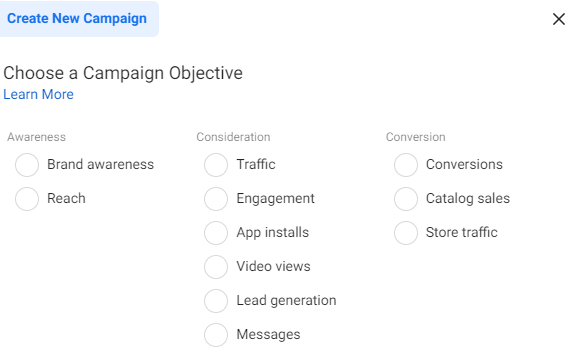
Based on the orientation of each business, the goals for creating a Facebook advertising campaign are usually divided into three main groups:
- Increase brand awareness: The goal of this campaign is to introduce and build the brand, helping businesses reach more people and create a long-lasting impression on customers.
- Find potential customers: This goal aims to attract customer interest in your product or service. Campaigns may include creating events, promotions, or contests to encourage users to visit the website or sign up to participate.
- Increase sales: This goal focuses on promoting direct purchases from ads, possibly through offers, discount codes, or special promotions.
In short, defining clear goals is the important factor deciding whether a Facebook advertising campaign is effective or not? Each campaign can have different goals, from increasing awareness, finding potential customers to revenue growth, and you can completely adjust the campaign according to specific needs and goals.
>>>> SEE NOW:
- 17+ super effective and fast ways to increase Facebook views
- What is the Facebook algorithm? Update the latest changes
Step 2: Choose the budget for the campaign
Choosing the budget for an effective Facebook advertising campaign is a decisive factor in the success or failure of the campaign. Too low a budget will limit the ability to reach the target audience, while too high a budget can leave you lacking resources for subsequent campaigns. Therefore, choosing a reasonable bidding strategy is very important.

Facebook offers two main budget options for ad campaigns: daily budget and lifetime budget:
- Daily budget: Allows you to set a fixed budget for each day. When this budget is spent, the ad will pause and will resume the next day. This option is suitable if you are running a campaign for a short period or have a limited budget.
- Lifetime budget: Is the total budget for the entire campaign. Facebook will allocate this budget to ads based on performance and when the budget is used up, the campaign will automatically stop. This option is suitable for long-term campaigns or when you want to control the total spending for the entire campaign.
When choosing a budget, you need to consider the campaign duration and advertising goals. If you want to run a campaign for a short time and need quick adjustments, the daily budget will be a reasonable choice. Conversely, if the goal is to optimize spending for a long-term campaign, the lifetime budget will provide more proactive resource allocation.
>>>> FIND OUT NOW: Answer: How long is a Facebook account temporarily locked ?
Step 3: Choose the target audience
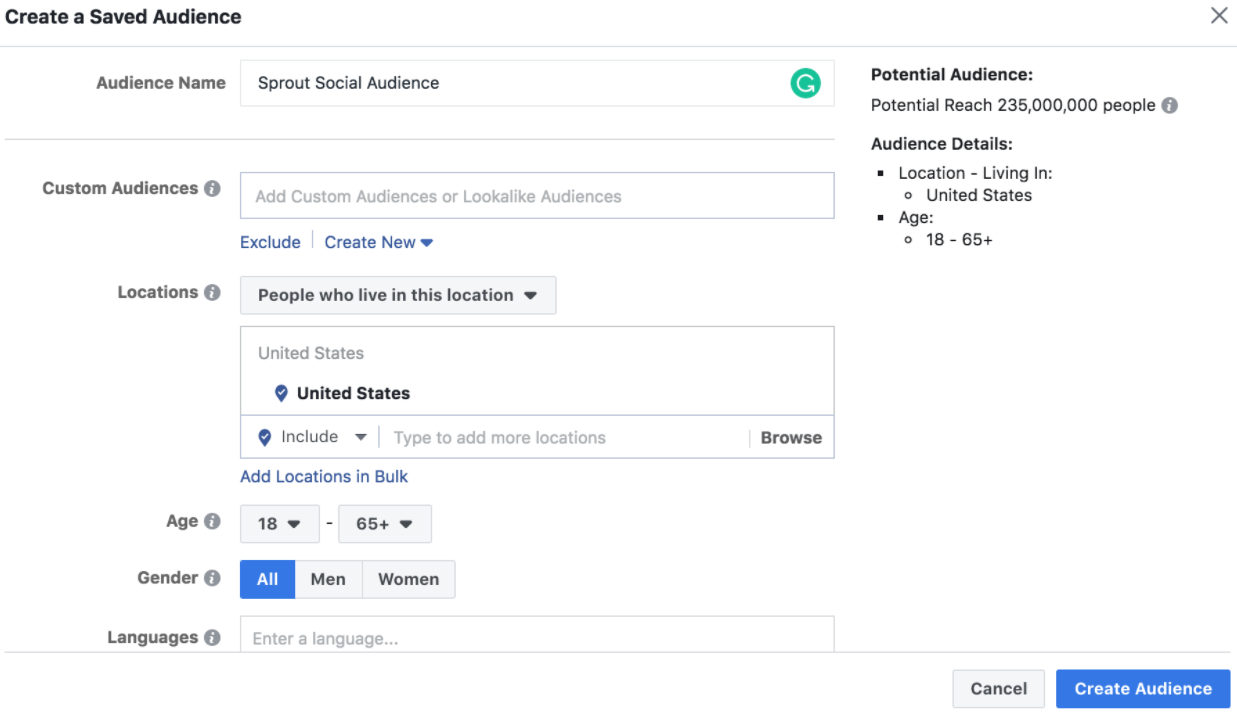
Defining the target audience is a crucial step to optimize an effective Facebook advertising campaign. With a massive number of users, you need to categorize and study the behavior of each audience group to target accurately. Below are 3 common audience types:
- Core Audience targets based on demographics, interests, and behaviors. The age group 18-29, especially women, use Facebook the most. For local products or services, location and income factors are very important. You should regularly update demographic information because customer behavior changes constantly.
- Custom Audience targets people who already know the brand through the website, customer list, or previous interactions on Facebook. This audience is very suitable for remarketing or implementing exclusive promotional campaigns, optimizing efficiency from the familiar customer group.
- Lookalike Audience is created from a custom audience group, targeting people who have similar characteristics to current customers. This is an effective way to expand reach, especially with similarity ratios of 1%, 2%, or 5%, helping to find new potential customers more accurately.
The right way to create a Facebook ad campaign is to create a detailed customer persona based on location, age, gender, language, interests, and behavior. Use advanced targeting features to exclude people who have already interacted, helping to attract new customers. At the same time, apply dynamic product ads (video, short, animation) to automatically display a large product catalog, especially when there are more than 20 items.
>>>> SEE NOW: How to recover a Facebook account disabled for 30 days
Step 4: Determine ad placement location
Ad placement determines where your ad will appear to the target customer. Based on your Marketing goals and the audience you want to target, ads can appear on various platforms of Facebook, Instagram, Messenger, and Audience Network.
Initially, you should choose automatic placement. This is the suitable way to create an ad campaign on Facebook for beginners, as Facebook will automatically select the optimal ad placement based on the set goals and audience.
However, if you have experience or work with an advertising expert, you can choose manual placement to optimize the campaign your own way.
Common ad placements on Facebook and linked platforms include:
- Reach Campaign: Ads appear to optimize reach.
- Stories and Reels: Ads appear in the form of short videos on Facebook/Instagram Stories and Reels.
- In-article Ads: Article-format ads appear in the user's feed.
- In-stream: Video ads appear before, during, or after videos on Facebook.
- Reels overlay: Image or video ads overlaying Reels videos.
- Apps and websites: Ads on mobile apps or partner websites.
- Messages: Ads sent directly via Messenger.
- Search: Ads appear in Facebook search results.
Choosing the right placement for the campaign goal will help the ad reach the right customer and optimize costs more effectively.
>>>> DON'T MISS: The most effective time frame to post on Facebook in 2025
Step 5: Create Ad content
Visual and lively ad content will attract viewers and increase interaction. You can create ads from unpaid posts or upload original ads; however, this will consume more time and resources.
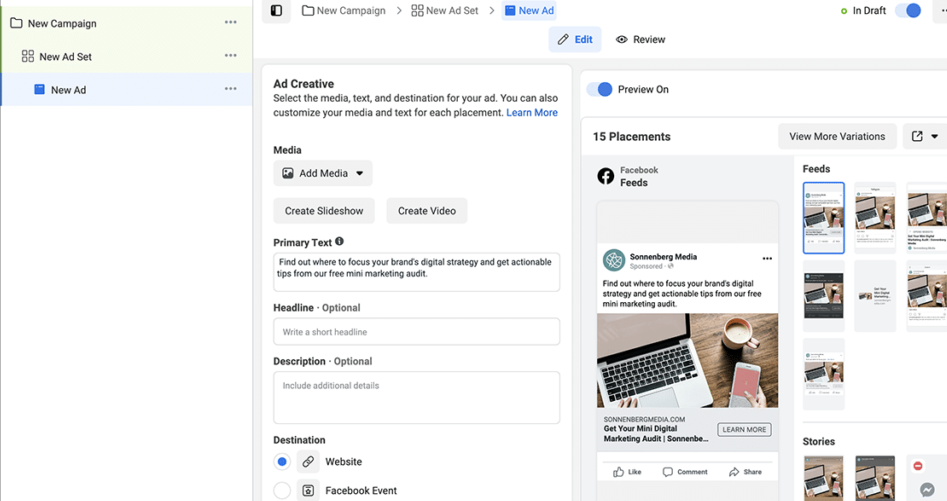
Before starting an effective Facebook advertising campaign, determine the appropriate ad format, depending on your business goals, products, and creative ability. Below are some common ad formats when creating a Facebook ad campaign:
- App Ads
- Story Ads
- Single Image
- Collection Ads
- Video Ads
- Carousel Ads
- Slideshow Ads
- Messenger Ads
After selecting the format, you can upload images and copy. Note that space for ad copy is limited, so the message needs to be concise and prominent.
An important factor when creating content is to avoid annoying customers with too many ads. Create useful content that helps customers solve problems, brings joy, and real value. According to a study from Sprout Social (Q3 2016), 57.5% of social media users complain about being annoyed by too many ads.
>>>> RELATED ARTICLE: The most accurate Facebook ad size in 2025
Step 6: Launch the Ad
Before publishing the ad, you need to carefully check the image size and copy length to ensure they are suitable. After pressing the "Publish" button, your ad will go through Facebook's review process for about 24 hours. Facebook will check whether the ad complies with community guidelines and technical standards.
Although the way to create a Facebook ad campaign seems simple, building an effective advertising strategy is a great challenge. Facebook currently has over 4 million advertisers, with an average CTR of only about 10%. Therefore, to create an effective Facebook advertising campaign, you need to invest time and effort to develop a separate strategy.
Each Facebook advertising strategy needs to focus on two main factors:
- Cost-effectiveness: This ensures you don't exceed the budget while still achieving the goal.
- Content relevance: The ad content must be suitable for the target audience and the business's marketing goals.
For beginners, you should allocate the budget daily, weekly, or monthly to avoid waste. Additionally, create small ad sets with a small budget to measure effectiveness before deciding to inject a larger budget.
>>>> DISCOVER NOW: 9+ latest updated standard Facebook video sizes
Step 7: Monitor Ad performance
To ensure the way to create a Facebook ad campaign is effective and converts well, continuous monitoring and optimization are very important. Don't expect to create a perfect ad on the first try; instead, you need to test different versions and adjust frequently.
For example: You can create and publish multiple ad versions, then monitor performance and choose the version that receives the most interaction.
Additionally, integrate the Facebook campaign with the email list to implement a multi-channel strategy, helping to attract attention and convert users into paying customers.
Finally, to evaluate whether the Facebook advertising campaign is effective, you need to define the appropriate metrics for the initial goal. If the goal is to increase orders, metrics like impressions or likes will not be as important as the number of orders or the conversion rate.
Experience for funning effective Facebook ads
To have highly effective Facebook advertising campaigns, you need to grasp important factors and suitable strategies. Below are experiences to help optimize your advertising campaign and achieve desired results:
- Define clear goals: Knowing the advertising goal (increase interaction, attract website visits, or promote a product) helps you set up a strategy and allocate the budget effectively.
- Choose the right customer audience: Define the segment of potential customers to save advertising costs and increase revenue effectiveness.
- Create engaging content: Creative content, linked to customer needs, and updated with new trends will attract attention and create interaction.
- Use eye-catching images: Clear, eye-catching images highlight the product and attract attention; you can combine short videos to highlight the product.
- Invest a reasonable budget: Allocate the budget for suitable ad campaigns, optimize keywords and product features to save costs.
- Natural advertising: Avoid overly inviting ads; instead, help customers see the product's value to drive purchase demand.
- Continuous performance monitoring: Use reporting tools to track ad effectiveness and adjust promptly if necessary.
- Test many ad creatives: Try dividing the budget for many different ad formats to find the way to optimize marketing effectiveness and save costs.
Conclusion: Above are the 7 basic steps to create an effective Facebook advertising campaign. Hopefully, these sharings from Hidemyacc will help you optimize your campaign and achieve your advertising goals more easily. If you still have questions or need further support, don't hesitate to contact Hidemyacc for detailed consultation.
>>> Read more:
- How to manage multiple social media accounts without getting banned
- How to create multiple Facebook accounts: A practical guide
- Disabled Facebook ads account and how to fix it
- How to rent Facebook advertising accounts safely (Step-by-Step)
- 7 Steps to How to create a Facebook ad campaign effectively