Have you ever faced the sudden shutdown of your multiple Facebook ad accounts? With over 2.7 billion active users, Facebook is a powerhouse for advertising, but its strict policies and ad account limits can quickly lead to bans. Whether you’re an individual or business advertiser, understanding how to navigate these rules is crucial to protect your accounts and keep your campaigns running smoothly. In this article, we’ll reveal why bans happen and how to prevent your multiple Facebook ad accounts from being restricted.
1. Why run multiple Facebook ad accounts?
Running multiple Facebook ad accounts is a common strategy among advertisers, agencies, and businesses that want to scale campaigns while reducing operational risks. Instead of putting all campaigns into a single ad account, separating them allows for better control, safer scaling, and more efficient campaign management.
Below are the main reasons why many advertisers choose to run multiple Facebook ad accounts.
1.1. Reduce the risk of mass account suspensions
Facebook enforces strict advertising policies, and even a single policy violation can trigger ad disapprovals or account suspensions.
- When all campaigns are run under one ad account, a suspension can immediately stop all advertising activities.
- If multiple ad sets target different products or audiences, one flagged campaign may affect the entire account.
- Using separate ad accounts helps isolate risks, ensuring that issues in one account do not impact others.
This approach protects your overall advertising operation and prevents a single mistake from causing major revenue loss.
1.2. Overcome Facebook ad account limits
Facebook imposes various limits on ad accounts, especially for new or low-trust accounts.
- Daily and lifetime spending caps can restrict scaling.
- Limits on the number of active ads or ad sets may slow down testing.
- New accounts often require time to build trust before higher budgets are allowed.
By running multiple Facebook ad accounts, advertisers can distribute campaigns across accounts and scale more efficiently without being bottlenecked by a single account’s restrictions.
1.3. Scale campaigns and test strategies more effectively
As advertising budgets grow, managing everything in one ad account becomes inefficient.
- Multiple ad accounts allow you to test different creatives, offers, or funnels simultaneously.
- Budgets can be scaled in parallel instead of being constrained by one account’s learning phase.
- Performance data becomes cleaner and easier to analyze when campaigns are grouped by objective or strategy.
This setup is especially useful for performance marketers and media buyers focused on rapid testing and optimization.
1.4. Separate brands, products, or markets
Many businesses operate multiple brands or target different regions, each with its own advertising goals.
- Each brand or product line can have its own dedicated ad account.
- Campaigns targeting different countries or languages remain fully isolated.
- Policy issues affecting one niche or market will not spill over to others.
This separation improves organization, compliance, and long-term scalability.
1.5. Simplify team, agency, and client management
For agencies and large teams, managing multiple Facebook ad accounts is often unavoidable.
- Each client can have a separate ad account with clear ownership and permissions.
- Billing, pixels, and reporting stay independent, reducing operational errors.
- Teams can assign specific roles without exposing all advertising assets.
This structure helps maintain transparency and professionalism when working with multiple stakeholders.
1.6. Prepare for Facebook’s advanced detection systems
While running multiple Facebook ad accounts offers many advantages, it also introduces technical risks.
- Facebook actively monitors IP addresses, browser fingerprints, and login behavior to detect linked accounts.
- Logging into multiple ad accounts from the same environment can trigger account reviews or suspensions.
- Proper technical separation is essential to avoid account linking and mass bans.
Understanding these risks is the first step toward running multiple Facebook ad accounts safely and sustainably.
2. Why Facebook bans Ad Accounts
Facebook uses automated systems and manual reviews to protect users and maintain advertising quality. Ad account bans can happen suddenly, sometimes without a clear warning, and may affect not only individual ad accounts but also related Business Managers, Pages, and payment methods.
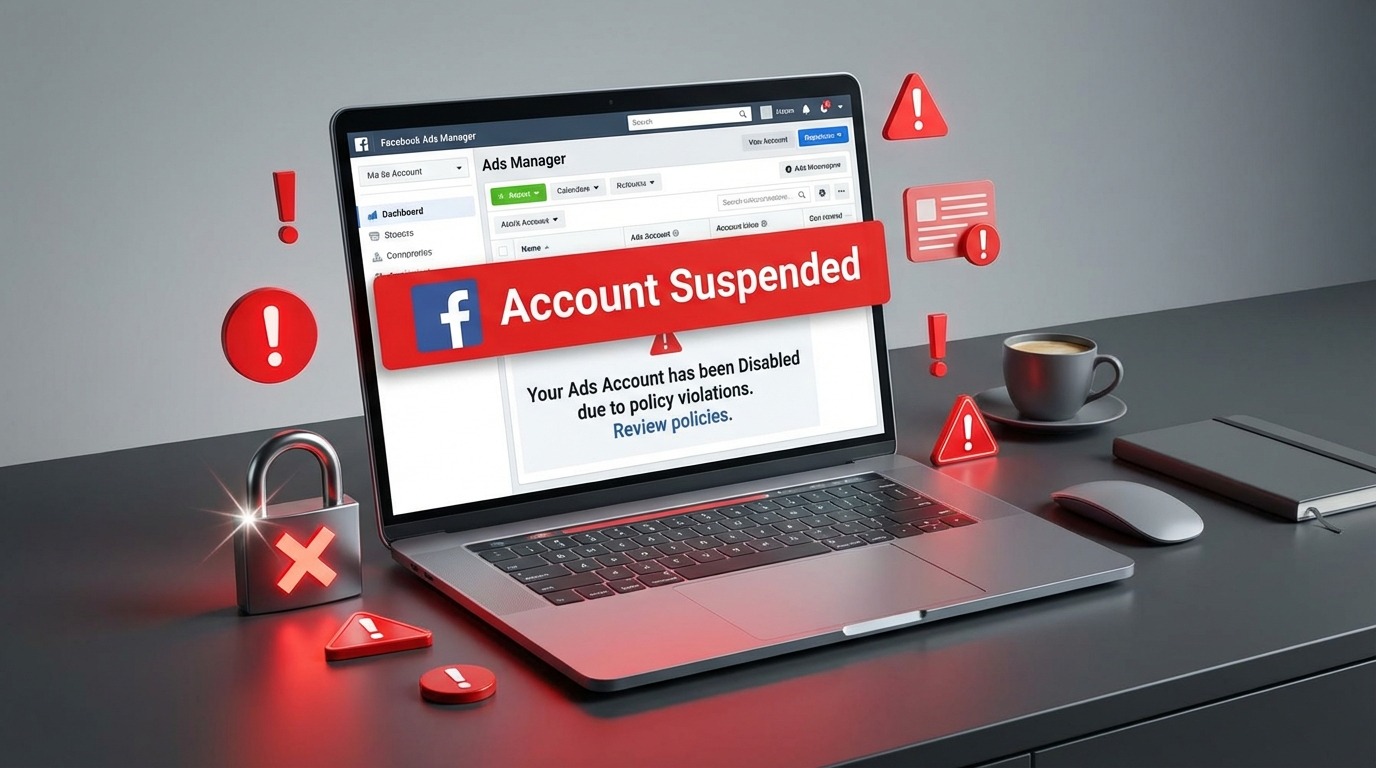
Understanding why Facebook bans ad accounts is essential, especially for advertisers managing multiple Facebook ad accounts.
2.1. Violations of Facebook advertising policies
One of the most common reasons for ad account bans is policy non-compliance.
- Misleading or exaggerated claims in ad copy
- “Before and after” images or unrealistic promises
- Restricted or prohibited content categories
- Mismatch between ad content and landing page experience
Even repeated minor violations can reduce account trust and eventually lead to suspension.
2.2. Suspicious account behavior and unusual activity
Beyond ad content, Facebook closely monitors advertiser behavior.
- Sudden spikes in ad spend on new or low-trust accounts
- Rapid creation or deletion of ads and ad sets
- Frequent ad rejections within a short time period
These patterns often trigger automated reviews that may result in temporary or permanent bans.
2.3. Running too many ad accounts without proper structure
Facebook allows advertisers to manage multiple ad accounts, but excessive or poorly organized account creation can raise red flags.
- Creating multiple ad accounts in a short timeframe
- Managing many ad accounts under the same Business Manager without clear purpose
- Repeatedly replacing banned ad accounts with new ones
Such behavior may be interpreted as attempts to bypass Facebook’s enforcement systems.
2.4. Account linking through technical signals
This is one of the most overlooked but critical reasons Facebook bans ad accounts.
- Logging into multiple ad accounts from the same IP address
- Using the same browser profile or device for different ad accounts
- Shared fingerprints across accounts, such as cookies or system configurations
When Facebook detects strong links between accounts, a ban on one ad account can quickly spread to others.
2.5. Compromised accounts and security issues
Facebook may also ban ad accounts to protect advertisers from fraud.
- Unauthorized access by third parties
- Suspicious payment activity or billing changes
- Signs that an account has been hijacked or abused
In these cases, bans are often precautionary but can still disrupt active campaigns.
2.6. Why appeals do not always work
Although Facebook provides an appeal process, success is not guaranteed.
- Reviews can take days or weeks
- Automated decisions are often upheld
- Linked accounts may remain restricted even after appeals
Relying solely on appeals is risky, especially for businesses that depend on continuous ad delivery.
2.7. Prevention is more effective than recovery
For advertisers, particularly those running multiple Facebook ad accounts, avoiding bans is far more effective than trying to recover from them.
- Policy compliance alone is not enough
- Technical setup and behavioral consistency play a major role
- Proper account isolation reduces the risk of mass suspensions
Understanding these factors is the foundation for building a safe and scalable Facebook advertising system.
3. How Facebook detects multiple Ad accounts
Facebook allows advertisers to manage multiple ad accounts, but it closely monitors how those accounts are created, accessed, and operated. To prevent abuse, policy circumvention, and system manipulation, Facebook uses advanced detection systems to identify accounts that appear to be controlled by the same entity.
Rather than relying on a single signal, Facebook combines multiple technical and behavioral factors to detect linked ad accounts.
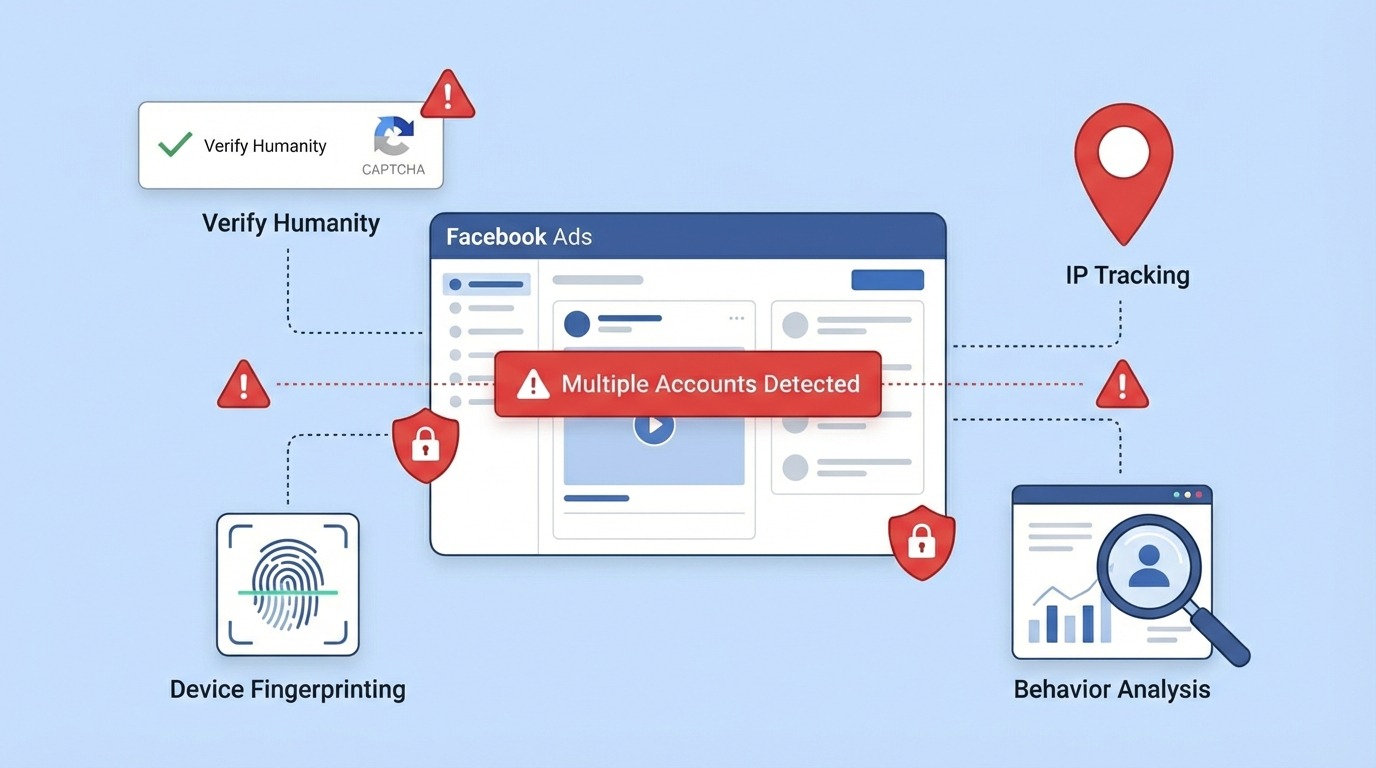
3.1. IP Address and Network Signals
IP address remains one of the most basic but still important signals.
- Multiple ad accounts accessed from the same IP address
- Repeated logins from shared or unstable IP ranges
- Mismatch between IP location and account or billing country
While changing IPs can help, IP isolation alone is not sufficient to avoid detection.
3.2. Browser Fingerprints and Device Identification
Facebook collects detailed browser and device-level information to uniquely identify users.
- Browser type, version, and operating system
- Screen resolution, timezone, and system language
- WebGL, Canvas, AudioContext, and other fingerprinting signals
If multiple ad accounts share the same browser fingerprint, Facebook may link them—even when IPs are different.
3.3. Cookies, Sessions, and Stored Data
Cookies and session data help Facebook track user activity across logins.
- Shared cookies between accounts
- Residual data from previous logins
- Reused browser profiles without proper isolation
Without clean browser environments, accounts can easily become connected over time.
3.4. Behavioral Patterns and Usage Signals
Facebook analyzes how ad accounts behave, not just where they log in from.
- Similar login times and activity schedules
- Identical campaign structures or scaling patterns
- Repeated actions performed in the same sequence
Consistent behavioral similarities can signal centralized control of multiple ad accounts.
3.5. Advertising Content and Targeting Similarities
Content-level analysis also plays a role in account detection.
- Promoting similar products or offers across accounts
- Using near-identical creatives, copy, or landing pages
- Targeting overlapping audiences at the same time
When combined with other signals, these similarities can strengthen account-linking decisions.
3.6. Payment Methods and Billing Information
Billing data is a strong indicator of account ownership.
- Shared credit cards or payment methods
- Reused billing profiles across multiple ad accounts
- Frequent billing changes linked to the same financial source
Payment connections can quickly link otherwise separated ad accounts.
3.7. Business Assets and Administrative Connections
Facebook evaluates the entire advertising ecosystem—not just individual ad accounts.
- Shared Business Managers or admin profiles
- Common Pages, pixels, domains, or catalogs
- Overlapping roles or permissions across assets
A single shared asset can connect multiple ad accounts and increase suspension risk.
3.8. Why Facebook Uses Combined Signals
Facebook does not ban ad accounts based on one factor alone.
- Detection systems evaluate multiple signals simultaneously
- Clean IPs cannot compensate for identical fingerprints
- Policy-compliant ads do not override risky technical setups
This multi-layered approach allows Facebook to detect account networks rather than isolated violations.
3.9. What This Means for Advertisers
For advertisers running multiple Facebook ad accounts, compliance goes beyond ad content.
- Policy compliance is necessary but not enough
- Technical isolation is critical to prevent account linking
- Proper environment separation reduces the risk of mass bans
Understanding how Facebook detects multiple ad accounts is the foundation for building a safe, scalable advertising system.
4. How to avoid Facebook Ad account bans
Facebook ad account bans can severely disrupt your marketing operations. They may lead to lost revenue, halted campaigns, damaged brand credibility, and long-term restrictions on advertising activities. While bans are sometimes unavoidable, most can be prevented by combining policy compliance with proper technical and operational practices.
Below are the most effective ways to reduce the risk of Facebook ad account bans, especially when managing multiple ad accounts.
4.1. Follow Facebook advertising policies consistently
Policy compliance is the foundation of account safety.
- Avoid misleading claims, exaggerated results, or restricted content
- Ensure landing pages match ad messaging and user expectations
- Monitor ad rejections and fix patterns early before trust scores drop
Even small, repeated violations can gradually weaken account trust.
4.2. Use separate payment methods for each ad account
Billing information is a strong ownership signal for Facebook.
- Assign a unique payment method to each ad account
- Avoid reusing cards across multiple ad accounts
- Monitor billing activity for unusual or failed transactions
This reduces the risk of Facebook linking accounts through financial data.
4.3. Isolate IP addresses and network environments
Accessing multiple ad accounts from the same network can quickly trigger account linking.
- Use a dedicated IP address for each ad account
- Avoid unstable or flagged IP ranges
- Ensure IP location aligns with account and billing regions
Network isolation is critical, but it must be combined with other safeguards.
4.4. Maintain unique browser and device fingerprints
Facebook relies heavily on browser fingerprinting to detect linked accounts.
- Do not log into multiple ad accounts using the same browser profile
- Avoid shared cookies, cache, and local storage
- Keep device attributes consistent for each account over time
Using clean, isolated browser environments significantly lowers detection risks.
4.5. Avoid using physical devices for each account
While using a separate physical device for every ad account can reduce risk, it is not scalable.
- Managing many devices is expensive and inefficient
- Device switching increases human error
- Hardware limitations make long-term scaling difficult
A virtualized approach is more practical for managing multiple accounts safely.
4.6. Warm up new ad accounts gradually
New or low-trust ad accounts are more sensitive to abnormal behavior.
- Start with small budgets and simple campaigns
- Avoid sudden spend increases or aggressive scaling
- Allow time for accounts to build trust naturally
Gradual warm-up reduces automated reviews and early suspensions.
4.7. Separate business assets and administrative access
Facebook evaluates entire asset networks, not just ad accounts.
- Avoid sharing Business Managers across unrelated ad accounts
- Do not reuse Pages, pixels, or domains unnecessarily
- Assign clear roles and limit admin overlap
Clean asset separation minimizes the impact of potential enforcement actions.
4.8. Monitor account health and behavioral patterns
Ongoing monitoring helps detect risks early.
- Track ad rejections and feedback signals
- Watch for sudden performance or delivery changes
- Avoid repetitive, synchronized actions across multiple accounts
Consistent but natural behavior reduces suspicion.
4.9. Use an antidetect browser for complete account isolation
To manage all these factors efficiently, many advertisers rely on antidetect browsers.
- Each ad account operates in a fully isolated browser profile
- Browser fingerprints, cookies, and sessions remain separate
- Combined with high-quality proxies, this setup simulates unique devices per account
An antidetect browser provides a scalable and reliable solution for managing multiple Facebook ad accounts without triggering bans.
5. Manage your Facebook Ad accounts with Hidemyacc
Managing multiple Facebook ad accounts safely requires more than just following ad policies. Facebook uses advanced systems to detect account connections through IP addresses, browser fingerprints, device signals, and behavioral patterns. Without proper technical isolation, advertisers risk account linking, mass suspensions, and long-term advertising disruptions.
This is where Hidemyacc Antidetect Browser becomes a practical solution for Facebook advertisers.
5.1. What is Hidemyacc antidetect browser?
Hidemyacc is a professional antidetect browser designed to help advertisers manage multiple online accounts, especially Facebook ad accounts without triggering detection systems.
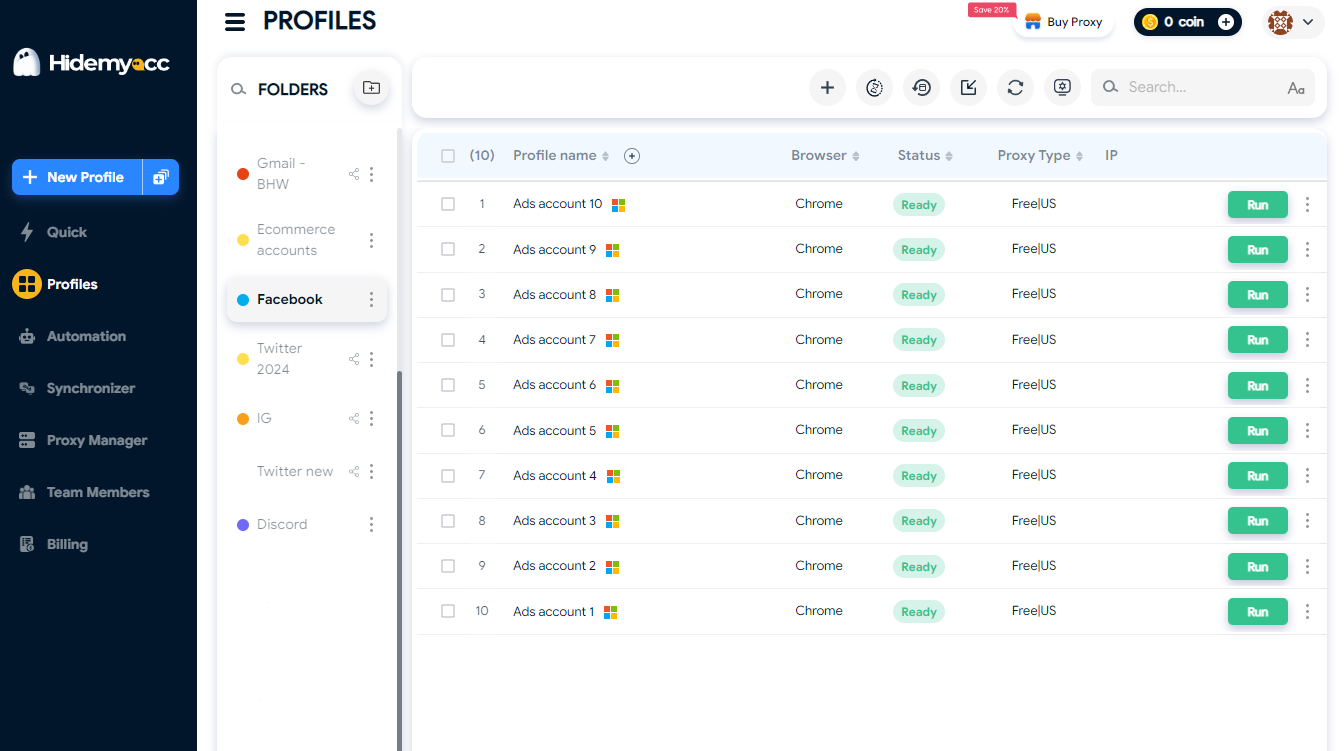
Instead of using one browser or device for all accounts, Hidemyacc allows you to create multiple isolated browser profiles. Each profile functions as a completely separate environment, with its own browser fingerprint, cookies, local storage, cache, and device configuration.
For Facebook advertisers, this means each ad account can appear as if it is operated by a unique user on a unique device in a unique location.
5.2. Why Facebook advertisers use Hidemyacc
Hidemyacc directly addresses the main reasons Facebook bans or links ad accounts:
- Browser fingerprint duplication
- Shared IP addresses
- Overlapping cookies and sessions
- Centralized account behavior
By isolating these signals, Hidemyacc significantly reduces the risk of account linking and mass bans.
5.3. Key benefits of using Hidemyacc for Facebook ad accounts
Create fully Isolated browser profiles
- Each Facebook ad account runs in a separate browser profile
- Cookies, cache, and local data are never shared
- Customizable fingerprints simulate different devices and systems
This setup replicates the effect of managing accounts on multiple physical computers—without the cost or complexity.
Assign a dedicated proxy to each profile
- Attach a unique proxy to every browser profile
- Ensure each ad account has its own IP address
- Reduce network-based account linking risks
When combined with fingerprint isolation, proxies help Facebook see each account as independently operated.
Import cookies for safer account access
- Log in using existing cookies instead of fresh credentials
- Reduce suspicion when accessing aged or purchased accounts
- Maintain account trust signals across sessions
This feature is especially useful when migrating accounts to a new environment or managing accounts with prior history.
Collaborate securely with team members
- Share browser profiles without revealing passwords
- Organize accounts into folders by brand, client, or region
- Enable remote team access in fully isolated environments
Hidemyacc is ideal for agencies or teams managing multiple Facebook ad accounts at scale.
Automate repetitive tasks more efficiently
- Automate routine actions across multiple accounts
- Reduce manual workload and human error
- Maintain consistent but natural activity patterns
When used responsibly, automation improves efficiency without compromising account safety.
5.4. A scalable alternative to using multiple physical devices
While using a separate device for each Facebook ad account can reduce risk, it is expensive and difficult to scale. Hidemyacc provides a virtualized alternative that delivers the same isolation benefits, without hardware limitations.
This makes it a cost-effective and scalable solution for advertisers, media buyers, and agencies.
A Smarter Way to Manage Facebook Ad Accounts
Avoid Facebook ad account bans with proper technical isolation. Hidemyacc keeps your accounts separated and secure.
Get Started with HidemyaccIf you manage multiple Facebook ad accounts and want to scale safely, Hidemyacc offers a practical foundation for long-term advertising stability.
6. Conclusion
Managing multiple Facebook ad accounts is no longer just about creating good ads. Facebook’s detection systems analyze technical signals such as IP addresses, browser fingerprints, device environments, and behavioral patterns to identify linked accounts and enforce bans.
To run Facebook ads safely and at scale, advertisers need both policy compliance and proper technical isolation. With the right setup, you can reduce account-linking risks, protect your advertising assets, and focus on growing performance instead of constantly dealing with suspensions.
>>> Read more:
- How to manage multiple social media accounts without getting banned
- How to create multiple Facebook accounts: A practical guide
- Disabled Facebook ads account and how to fix it
- How to rent Facebook advertising accounts safely (Step-by-Step)
- 7 Steps to How to create a Facebook ad campaign effectively
7. FAQ
Is it allowed to have multiple Facebook ad accounts?
Yes. Facebook allows multiple ad accounts, but closely monitors how they are created and operated to prevent abuse or account linking.
Why do Facebook ad accounts get banned even when ads follow policies?
Because Facebook also evaluates technical signals such as IP addresses, browser fingerprints, devices, and asset connections, not just ad content.
Does using different IP addresses fully prevent account bans?
No. IP changes alone are not enough, as Facebook combines IP data with fingerprints, cookies, and behavior patterns.
Can Facebook detect multiple ad accounts on the same device?
Yes. Facebook uses advanced browser fingerprinting to identify devices, even when different accounts are used.
Is using an antidetect browser safe for Facebook ads?
When used correctly, an antidetect browser helps isolate environments, but advertisers must still follow Facebook ad policies.
Do I need a separate payment method for each Facebook ad account?
Yes. Shared payment methods are a strong signal for account linking and increase ban risk.
Can Hidemyacc replace using multiple physical devices?
Yes. Hidemyacc creates isolated browser profiles that function like separate devices without hardware costs.
Will Hidemyacc guarantee that my Facebook ad accounts never get banned?
No. Hidemyacc reduces technical risks, but policy compliance and responsible behavior are still required.