


Manage multiple Ecommerce stores from one device


Running several online stores on the same computer makes it easy to log in to the wrong account, mix up browser data between stores, or lose track of who on your team can access what. Hidemyacc lets you create a separate profile for each store, give it the right environment and proxy, and share only that profile with the person in charge. Every store gets its own clean workspace that is easy to manage and easy to hand over as your team grows.
See how to set up a profile for each store
1. Why running multiple stores on one device is risky
Every major marketplace has cases where sellers are allowed to run more than one account, as long as they follow the platform's policies. But when those accounts are accessed from the same device or browser, they can leave behind shared data such as IP address, cookies, browser fingerprint and login activity. Platforms can use these signals to tell that several accounts run in the same environment and are related to each other.
That matters when one account in the group breaks a policy. Depending on the marketplace's rules, related accounts may also be reviewed or affected, even if they were registered correctly and never violated anything.
So the question is not only whether a marketplace allows multiple accounts. Sellers also need to control how each account is accessed and operated, and avoid sharing data and environments unnecessarily, so that one account's problem is less likely to spill over to the others.
- Amazon: Amazon allows sellers to keep more than one Seller Central account when there is a legitimate business need and every account is in good standing. However, Amazon can identify related accounts based on how they are operated. According to Amazon's guidance, a seller or employee accessing another account can be one of the factors that links accounts together. If one account violates a policy, its related accounts may be affected too.
- TikTok Shop: In many markets, individual sellers can register only one account per government ID, and the name on the linked bank account must match the ID. Verified businesses may be allowed more accounts depending on the legal entity and the market. Beyond documents, the platform may also take into account several accounts being operated from one device. Sellers with multiple shops need accurate registration details and a clean login environment for each account.
- Shopee: Shopee detects unusual login activity. Its Terms of Service state that it may take action on accounts when it detects multiple user accounts, abnormal activity such as logins from many devices or IP addresses, or other signs of fraud. In other words, device and connection data can become part of how Shopee evaluates an account, alongside registration and identity verification.
- eBay: eBay allows one person to own multiple accounts and even mentions businesses separating accounts by product line. All accounts still fall under the same policies, and if one account is restricted, its linked accounts may be affected as well. Under eBay's privacy notice, the platform collects device data such as device type, operating system, browser, device fingerprint, cookies and IP address when you use its services.
- Etsy: Etsy lets sellers run multiple shops, but each shop needs its own account and email address and must follow the Seller Policy. The shops can belong to the same seller and share the same policies, so when one shop violates them, related shops may also be affected. Keeping the environment, cookies and session separate for each shop makes every account easier to manage and reduces mistakes in daily operations.
Being linked is not the same as breaking the rules. When a platform sees that accounts have things in common, it only shows they may share an owner or an operating environment. The risk appears when one account violates a policy and the platform then reviews the related accounts under its own rules. That is why sellers with multiple stores need to follow each marketplace's policies and keep a clear, separate workspace for every account.
For teams with several employees or virtual assistants, having everyone log in from one environment adds another problem: permissions and access control. Managers need to keep each store's environment separate and make sure every team member can access only the stores assigned to them.
A separate environment for every store, even on the same marketplace
Keep cookies, fingerprint and proxy separate for each store so they never share browser traces, and give each store to the right team member.
2. How Hidemyacc helps you manage multiple ecommerce stores
Hidemyacc is an antidetect browser that lets you create and manage many independent browser profiles on one computer. Each profile can have its own fingerprint, cookies, login session and proxy, so every store gets its own workspace instead of sharing one browser.
This setup suits sellers running multiple stores on Amazon Seller Central, Shopee, TikTok Shop, Etsy or eBay. Organize profiles by store, region or marketplace, then use Hidemyacc to set up and manage each environment to match what every marketplace expects.
2.1. Manage proxies by sales region
An online store is usually tied to a specific country through its registration details, business address, payment method and related data. When a store keeps logging in from an environment or IP address that does not match its registered country, that can become a red flag when the platform reviews account activity.
Hidemyacc has built in proxy support, so you can easily give each account its own proxy matching the store's region. For example, your Amazon US store profile uses a US proxy, while your Amazon Brazil store profile uses a Brazilian one. You can also see how many profiles each proxy is assigned to in Proxy Manager.
2.2. A separate workspace for every store, even on the same marketplace
The biggest risk for sellers with multiple stores is not opening several accounts. It is the stores accidentally sharing browser data because they run on the same computer. When you switch between accounts in one shared environment, it is also easy to carry cookies, login sessions or store data from one store into another.
With Hidemyacc, you create a separate profile for each store and name it by marketplace or brand, such as Amazon US 01, Amazon US 02, Etsy Handmade Store or TikTok Shop UK. Cookies, local storage and login sessions are saved inside each profile, keeping data apart between environments. To switch stores, just open the matching profile, with no logging out of the current account and no clearing browser data before logging in to the next one.
2.3. Keep each store's browser setup consistent over time
A store usually runs for months or even years, so its browser setup should stay consistent instead of changing every time you restart your computer or reinstall your browser. This is what sets ecommerce apart from use cases where an account is only needed for a short time.
With Custom Browser Fingerprints, you set a browser fingerprint for each profile, including user agent, operating system, screen resolution, timezone and language. This setup belongs to the store's profile, not to your computer or the browser installed on it. If you reinstall your operating system, move to a new work computer or open the profile on another device, the store's environment stays exactly the same, instead of presenting a brand new browser fingerprint for an account with a long history.
2.4. Hand stores over to your team without changing the main login
An online store is usually tied to the owner's identity verification and bank account. Handing the main password to every team member is hard to control and can interfere with two factor authentication (2FA) or the bank connections linked to that store. The problem grows when several VAs work on one store at different stages, for example one person handles product listings while another handles orders and customer disputes.
Instead of sharing passwords and having staff rebuild the environment every time they take over, use Share Profile or Transfer Profile to share or transfer exactly the right store profile with an authorized team member. They work in an environment that is already set up, including the fingerprint and the proxy for the store's region, so a store with a stable history never shows up with new browser traces. When someone leaves or a different person takes over, you revoke their access to the profile without changing the store's main password.
3. How to create a separate profile for each store in Hidemyacc
When you manage multiple stores, naming and organizing profiles from day one helps you avoid logging in to the wrong account and find the right workspace faster. In Hidemyacc, you can group profiles by marketplace, then give each store its own fingerprint and proxy:
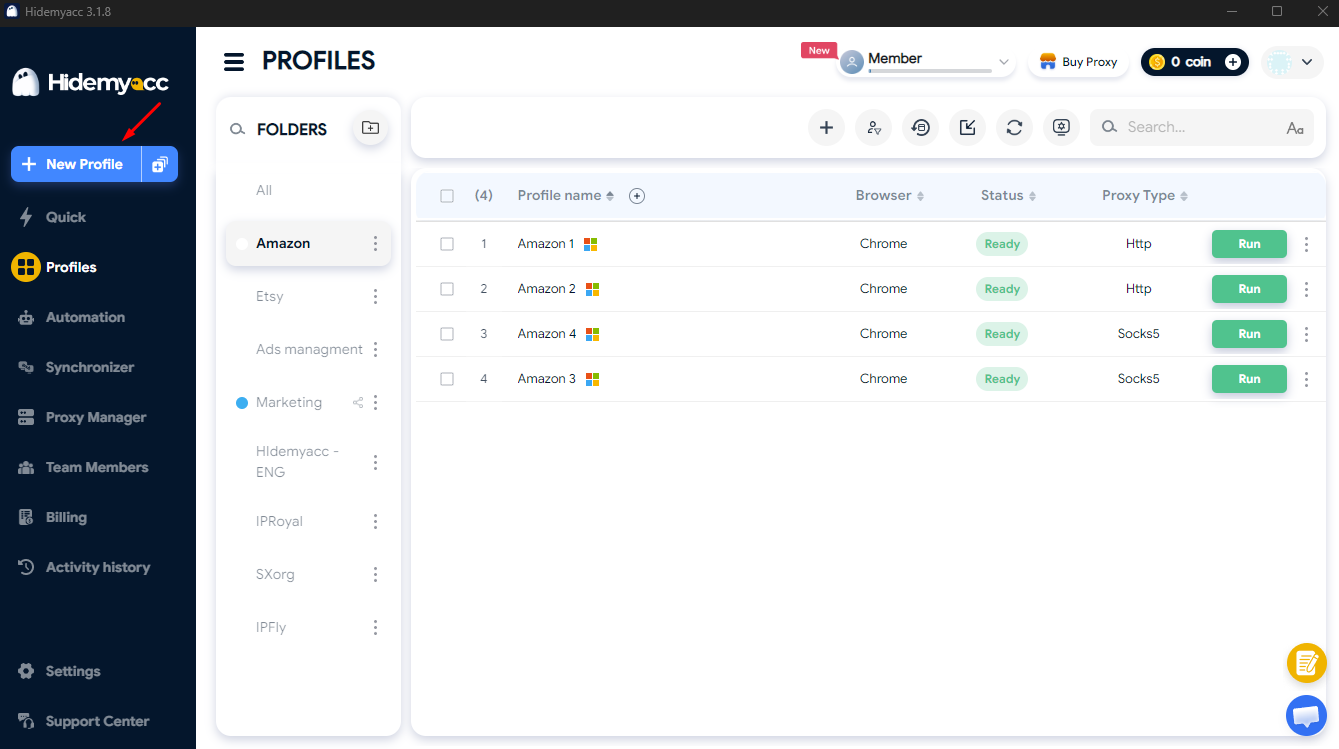
3.1. Create a new profile
In the profile manager, click New Profile. Create a folder for each marketplace, then name profiles by store, account or region. For example, an Amazon folder can hold Amazon US Store 01 and Amazon US Store 02, while a Shopee folder holds one profile per shop.
3.2. Configure the fingerprint
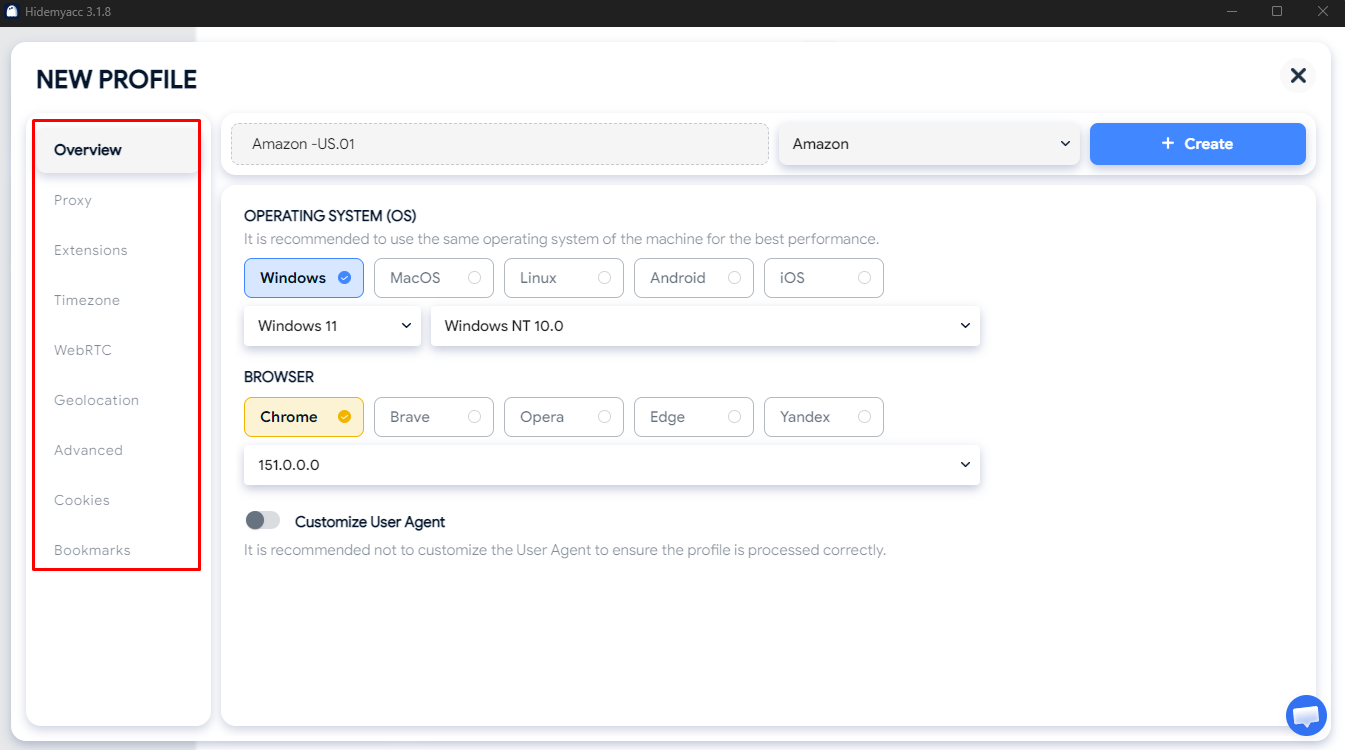
In the profile settings, set fingerprint details such as user agent, operating system, screen resolution, timezone and language to match the environment you want. Once set, keep this configuration stable for as long as the store runs.
3.3. Set up the proxy
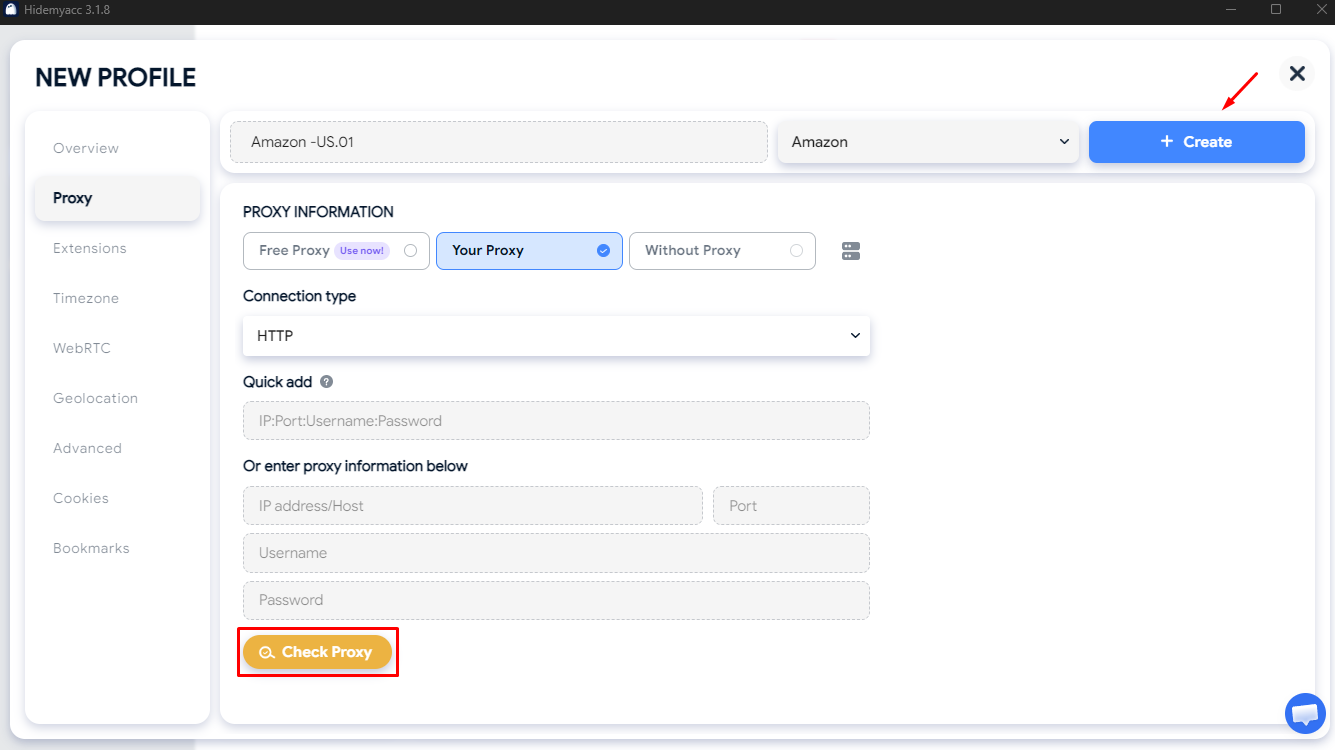
In the Proxy tab of the profile, add a proxy that fits the store's region and workflow. Enter the proxy details, click Check Proxy to test the connection, then click Create to finish creating the profile. For a full walkthrough, see how to use a proxy in Hidemyacc.
3.4. Launch the profile and log in
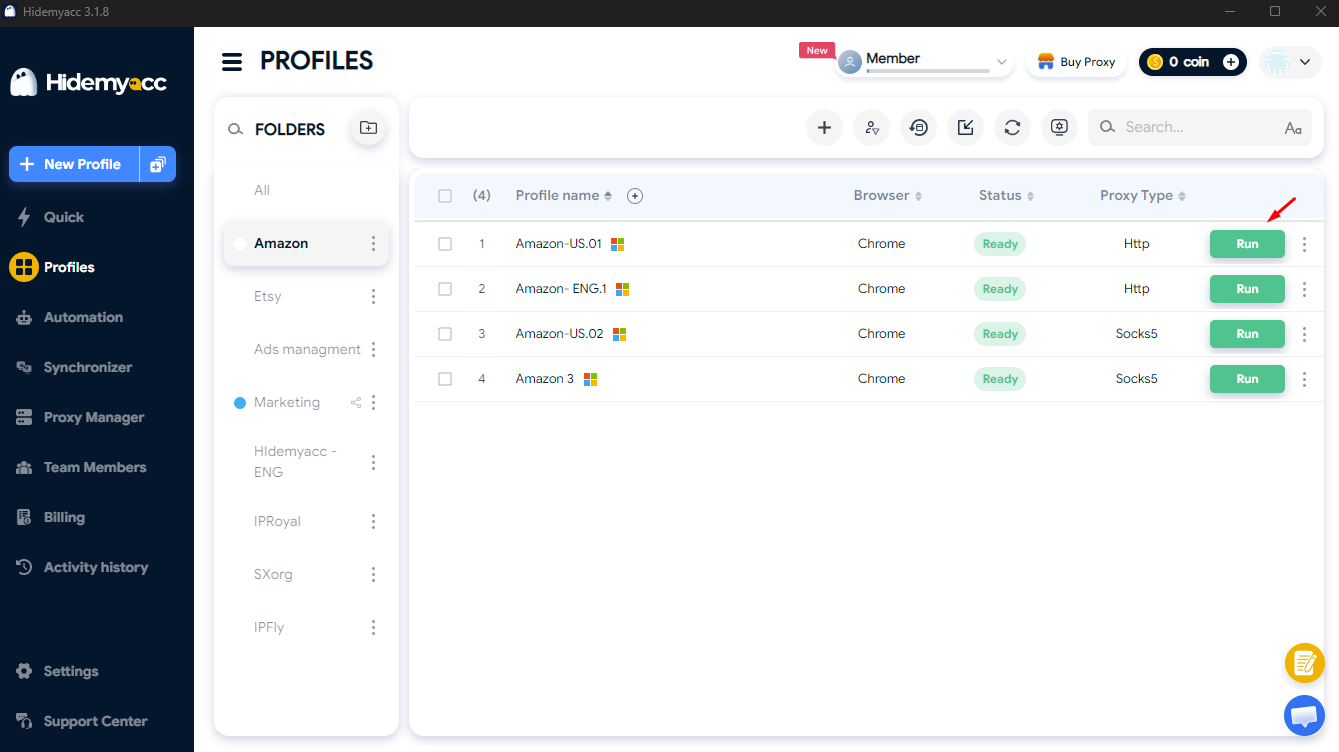
Click Run to open the profile, go to the marketplace and log in to the matching store account. From then on, just open the same profile to keep working on that store.
3.5. Share the profile with your team
When a team member takes over a store, use Share Profile to share the configured profile with them. They can keep working in that profile without ever receiving the main account's login details. When your team changes, update their access or use Transfer Profile to hand the profile to someone else.
Once you are done, every store has its own profile with the right configuration and working data. You can keep using the same profile every day and share it with the right people whenever needed, without setting anything up from scratch.
Related reading:
- How to safely manage multiple eBay accounts
- Can you have multiple Etsy shops? Key rules explained
- Would multiple Walmart accounts help you grow faster?
- How to manage multiple Shopify stores
- How to manage multiple WooCommerce stores
- How to create and manage multiple AliExpress accounts
- How to become a Flipkart seller: a step by step guide
4. FAQ
4.1. Can I manage multiple Amazon seller accounts on one computer?
Technically yes, but owning multiple accounts still has to follow Amazon's policy: each account needs a legitimate business reason and must be in good standing. The main risk is not opening several accounts, it is Amazon identifying them as related, for example when the same seller or employee accesses several accounts from one environment. If one account then violates a policy, its related accounts may be affected. Keeping each account in its own profile reduces the signals your stores share.
4.2. Does TikTok Shop limit the number of accounts per ID?
Yes, in many markets. Individual sellers can usually register only one TikTok Shop account per government ID, and the name on the linked bank account must match the ID. Verified businesses may register more accounts per legal entity, depending on each market's rules. Hidemyacc does not change these limits; it only keeps the environments of properly authorized accounts from sharing browser data.
4.3. Do Etsy and eBay allow multiple shops?
Yes, both allow it with no cap on the number of accounts. Etsy requires each shop to have its own account and email address, and all of your shops must be listed on your public profile. eBay allows separate accounts by product line but may automatically link accounts that share a name, address or login device. On both marketplaces, if one linked account is restricted, the others may be affected too.
4.4. Does Hidemyacc support proxies by sales country?
Yes. Assign a proxy to each profile to match the region the store serves. Proxy Manager supports HTTP, SOCKS4 and SOCKS5 connections and integrates directly with several proxy providers. The IP type (residential, datacenter or ISP) depends on the proxy provider you add, not on Hidemyacc.
4.5. Can I share a store profile with staff without giving them the main password?
Yes. Grant an employee or VA access to a specific store's profile, and revoke it at any time without changing the main account password. This is especially useful for stores tied to the owner's identity and bank details, since changing the main password can disrupt 2FA or active payment sessions.
Ready to run all your stores the smarter way?
Give every account its own environment, manage all your profiles in one place and keep each store's workflow clear with Hidemyacc.
Every new account starts with a 7 day free trial with 30 profiles. After that, choose from 5 plans and get 50% off when you pay yearly.
Comparing tools? See Hidemyacc vs Gologin, or explore more ways to use Hidemyacc.

Try for FREE now !
Don't forget you have 7 days free trial
Test it first and love it later.
Do you wanna join our Affiliate program? Join now!