Multilogin was once one of the first antidetect solutions on the market, launched in 2015, and widely known within the MMO/affiliate community. Since the end of July 2026, Multilogin has fully shifted to a Cloud Phone platform for mobile account management.
If you're interested in how Multilogin performed while it was still an antidetect browser — its fingerprinting technology, stability, and how it compared to other solutions on the market — the article below preserves that full review.
1. Looking back at Multilogin: the pioneering antidetect browser
Multilogin was once the first antidetect browser on the market, letting users create and manage large numbers of accounts on the same device. Every profile created in Multilogin had a completely unique browser fingerprint. Users could add a proxy to change the IP address for each profile, making each profile appear as an independent device running on a different network connection.
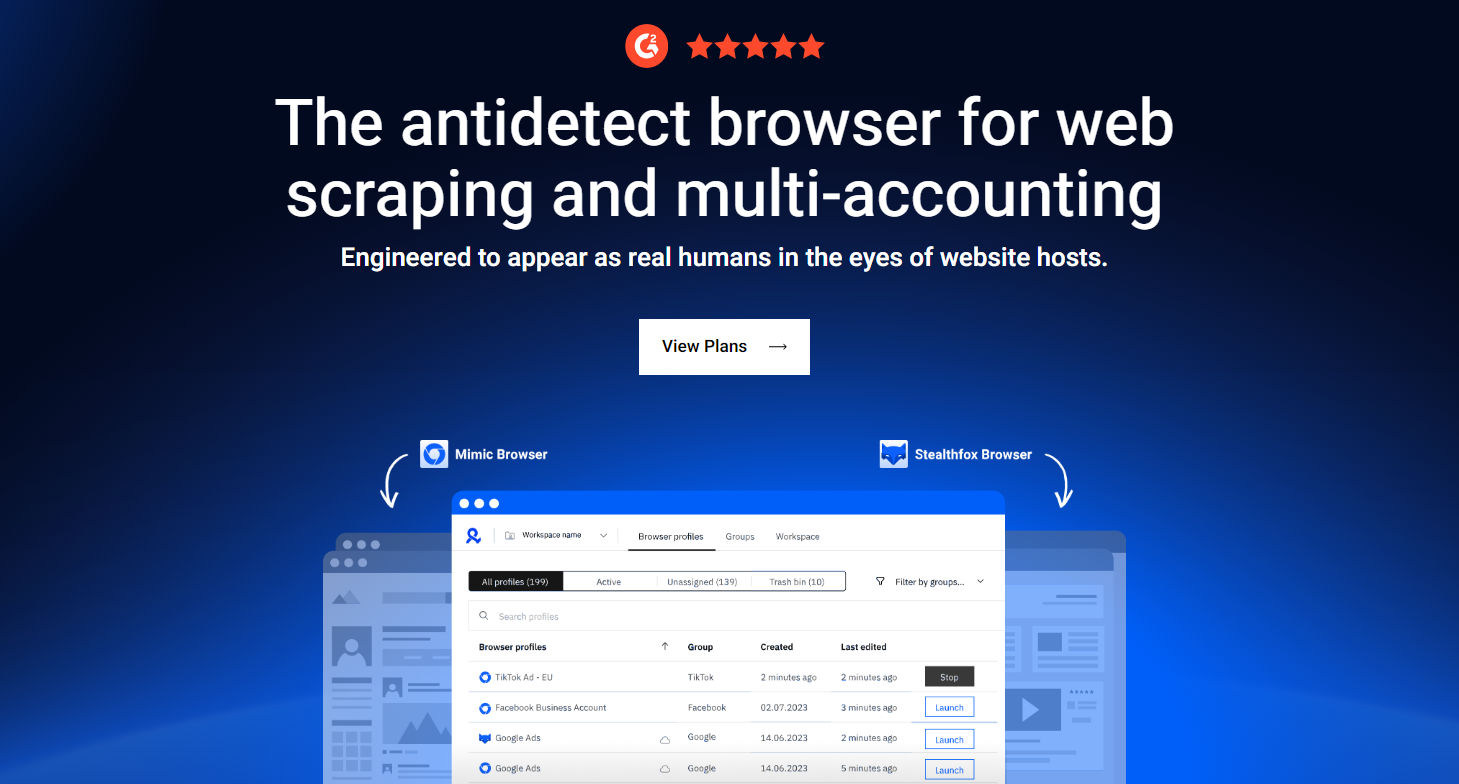
Multilogin ran on two browser engines, Mimic and StealthFox, built on Chromium and Firefox respectively, with a range of useful features such as creating and customizing profile parameters, granting profile access to other users, and selling high-quality residential proxies by package.
For a deeper look, check out our article on how antidetect browsers work for managing multiple accounts.
📌 As of July 31, 2026, Multilogin has officially repositioned itself as a cloud phone platform, integrating real Android cloud phones, browser profiles, proxies, and team management into a single dashboard, along with a permanent Free plan and pricing starting at $7.08/month. If you're researching Multilogin's current positioning, read our latest review here. If you're interested in Multilogin's performance and experience from back when it was still an antidetect browser, the review below has been kept intact as a reference.
>>>> ALSO SEE:
- In-depth review of the GoLogin antidetect browser
- Adspower Browser: Pros, cons, and an honest review
2. What Multilogin was used for back then
Multilogin's website was fairly intuitive and easy to navigate, with plenty of useful information for users. Multilogin released two versions, Multilogin 6 and Multilogin X, which could be easily installed on all three major operating systems: Windows, macOS, and Linux.
Users could sign up for an account directly on the website and manage their own profiles. However, Multilogin didn't offer a free trial, so you had to purchase a plan to access the platform.
Multilogin had supported millions of customers creating profiles over its more than nine years in operation. Like other antidetect browsers, Multilogin's core function was to alter browser fingerprint parameters (operating system, browser, screen size, fonts, peripheral devices, memory, etc.) for each profile, letting users create and manage accounts on virtually any platform.
2.1. Affiliate marketing
Earning through affiliate marketing requires creating a large number of accounts to share links and drive engagement. However, this carries risk and can cause websites to flag traffic coming from your links as suspicious.
With Multilogin, users could create browser profiles with entirely different parameters and non-overlapping IP addresses. You could create accounts to run affiliate campaigns for multiple products at once, targeting different audience segments simultaneously without raising suspicion on the website's end.
Additionally, users could use Multilogin's API to automate the process of creating and warming up accounts. However, this required a certain level of coding and IT knowledge.
2.2. E-commerce
If you ran an online business on marketplaces like eBay, Amazon, Etsy, Shopee, or Lazada, you'd need to create multiple stores to segment your products across different target audience groups.
However, these platforms typically limit the number of stores a single account can create in order to curb fraud and protect buyers.
Multilogin helped users create and register these online stores. Even though all the accounts were logged in from the same device, the website couldn't detect anything unusual because each profile was equipped with an entirely new set of parameters and a completely new IP address.
However, Multilogin didn't have an automation feature, so if you wanted to automate processes like product listing, order placement, or store reviews, you had to use the API and connect it with third-party automation tools.
2.3. Running online ads
As with running an e-commerce business or doing affiliate marketing, running online ads also requires a large number of accounts to improve your odds when bidding for ad placements.
If you wanted to create multiple ads for A/B testing or to target different customer segments, owning multiple Google Ads, Facebook Ads, and similar accounts was essential. Using an antidetect browser like Multilogin helped you create clean environments to create and warm up a large number of ad accounts without being detected by Google or other platforms.
>>>> DON'T MISS:
- Incogniton browser: an honest review
- Exploring the VMLogin antidetect browser
- Linken Sphere: is it an antidetect browser worth using?
3. Multilogin's pricing while it was still an antidetect browser
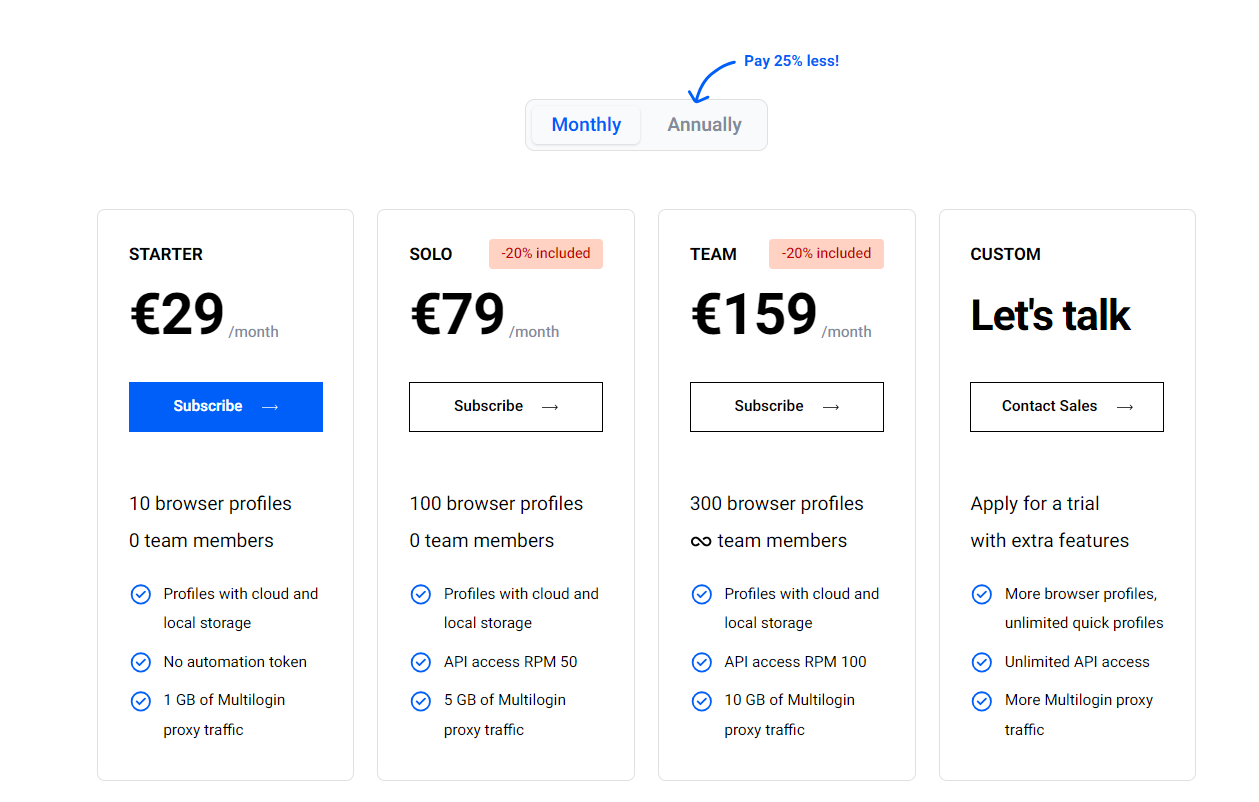
This is Multilogin's old pricing table from when it was still an antidetect browser. Plans at the time bundled together the number of browser profiles, proxy traffic (GB), Android Cloud Phone access, and mobile device usage minutes into a single package, rather than selling them separately as add-ons the way it does now. The pricing table below has been kept as a historical reference.
Trial plan
- Price: €1.99 (one-time payment)
- Duration: 3 days
- Profiles: 5 (Cloud + Local)
- Proxy traffic: 200 MB (one-time allowance)
- Mobile usage time: 60 minutes (one-time allowance)
- API access: No
This was not a free trial. Users had to pay €1.99 upfront to use the basic features for 72 hours. By comparison, Hidemyacc offers a 7-day free trial with no credit card required.
Pro plans (billed monthly)
| Plan | Profiles | Proxy (monthly) | Team seats | Price/month |
|---|---|---|---|---|
| Pro 10 | 10 | 1 GB | 1 | €9/mo |
| Pro 50 | 50 | 5 GB | 1 | ~€29/mo |
| Pro 100 | 100 | 10 GB | 2 | ~€49/mo |
Business plans (for agencies and teams)
| Plan | Profiles | Proxy (monthly) | Team seats | Price/month |
|---|---|---|---|---|
| Business 300 | 300 | 30 GB | Unlimited | ~€159/mo |
| Business 1000 | 1,000 | 100 GB | Unlimited | Contact sales |
| Business 10000 | 10,000 | Custom | Unlimited | Contact sales |
Overage costs
Once users used up the proxy traffic allotted in their plan, they had to pay an additional €3 to €7.08 per GB, depending on the plan tier. Likewise, exceeding the included mobile usage minutes was billed separately.
Was Multilogin worth this price?
Multilogin sat in the premium tier of the market, and its pricing reflected that. For large businesses that needed high fingerprint stability and had complex automation requirements, this cost could be entirely justified.
However, for small teams or individual users, there were alternative solutions that could match roughly 90% of Multilogin's features while costing only about 40–60% as much.
4. Multilogin X and Multilogin 6
In 2024, Multilogin launched Multilogin X — a completely rebuilt version of the platform. As of March 2025, Multilogin 6 officially stopped accepting new users, although existing customers were offered a free migration path.
If you were evaluating Multilogin at that point, Multilogin X was the only version still being offered.
Note: the comparison table below is based on Multilogin X data from when it was still positioned as an antidetect browser, and has been kept for reference.
| Feature | Multilogin 6 | Multilogin X |
|---|---|---|
| Interface | Desktop app only | Web dashboard + lightweight desktop app |
| Mobile device support | Not supported | Full support for mobile browsing |
| Cloud sync | Limited | Real-time profile sync across multiple devices |
| API | Basic REST API | API-first architecture, higher request limits |
| Android Cloud Phone | Not available | Included in all plans |
| Built-in proxy | Purchased separately | Bundled into subscription plans (with a GB allowance) |
| Browser engine | Mimic (Chromium) + Stealthfox (Firefox) | Same engines, with improved fingerprint update capability |
| Automation | Manual or via third-party tools | Built-in automation + support for Puppeteer / Playwright / Selenium |
| Pricing model | Based on number of profiles | Based on profiles + accompanying proxy traffic |
What improved with Multilogin X
- A new web interface that was significantly more user-friendly than the old desktop app.
- Android Cloud Phone emulation was a brand-new feature, useful for managing mobile-first accounts like TikTok or Instagram without needing a real phone.
- The API-first design made it easier for development teams to build and scale automation workflows.
- Profile sync across devices meant remote teams no longer had to manually transfer files like before.
What stayed the same (or got more complicated)
- Multilogin remained one of the most expensive options in the antidetect browser market.
- There was no free plan. The trial cost €1.99, lasted only 3 days, and was capped at 5 profiles.
- Even when using the web version, users still had to install a desktop agent, adding an extra step to setup.
- Fingerprint quality remained solid, but no longer offered the standout edge over competitors that it had 3–4 years earlier.
Multilogin X was a significant upgrade over Multilogin 6. However, this transition also came with a restructured pricing model and a more complex fee structure combining number of profiles, proxy traffic (GB), and mobile usage time.
For users who chose Multilogin 6 mainly for its fingerprint quality and profile isolation, the core value of the product remained essentially unchanged. The most noticeable change was in cost.
5. Multilogin review: strengths and limitations
More and more antidetect browsers were entering the market with increasingly capable and useful features. To choose the antidetect browser that best fit their needs, users needed to weigh the pros and cons of each product on the market. Below are the pros and cons of Multilogin during the period it operated as an antidetect browser — a useful reference if you're researching antidetect technology in general or weighing today's alternatives.
5.1. Pros
As a heavyweight in the industry with more than 9 years of experience, there's no denying Multilogin once had several standout strengths.
Once had leading antidetect browser technology
- Multilogin once supported two browser engines, Chromium-based and StealthFox, running quite stably and smoothly. This was also a key reason many users stuck with Multilogin despite its steep price and lack of a trial plan.
- Multilogin used to bypass many websites with ease, and its profiles ran stably, rarely running into errors or leaking customer information.
- Multilogin didn't focus on building out add-on features and instead went deep on core technology. This used to be a major selling point for the software.
Once sold residential proxies by package
- Multilogin used to have a high-quality residential proxy pool with more than 5 million IP addresses. Each plan included a proxy allowance, and if users ran out, they could buy more starting at €5.5/GB (Pro plan) up to €7.08/GB (Standard plan).
- Multilogin's residential proxies were also regularly checked and refreshed. However, the free allowance was fairly small and the top-up price was fairly high, so this feature was never truly optimized for users.
Once supported effective team collaboration
- Multilogin used to let users create workspaces and add other users to collaborate. Users could also share/transfer profiles to other users and grant profile access without sharing passwords or account credentials.
That said, because Multilogin focused mainly on its core technology, its supporting features stayed fairly basic, mostly geared toward helping users create and manage profiles in bulk.
5.2. Cons
Multilogin also had a number of drawbacks that gave users pause when trying the product.
High price
- Multilogin used to be the most expensive antidetect browser on the market. The price came with the quality, but many other antidetect browsers now offer comparable quality at a more competitive price (Hidemyacc being one example).
- Multilogin's cheapest plan used to cost more than $31/month for 10 profiles (with no API for automation or free team member slots) and 1GB of residential proxy. Buying additional residential proxy cost around $7.7/GB. This was a very high price point, and users didn't get to try a trial before committing to a purchase.
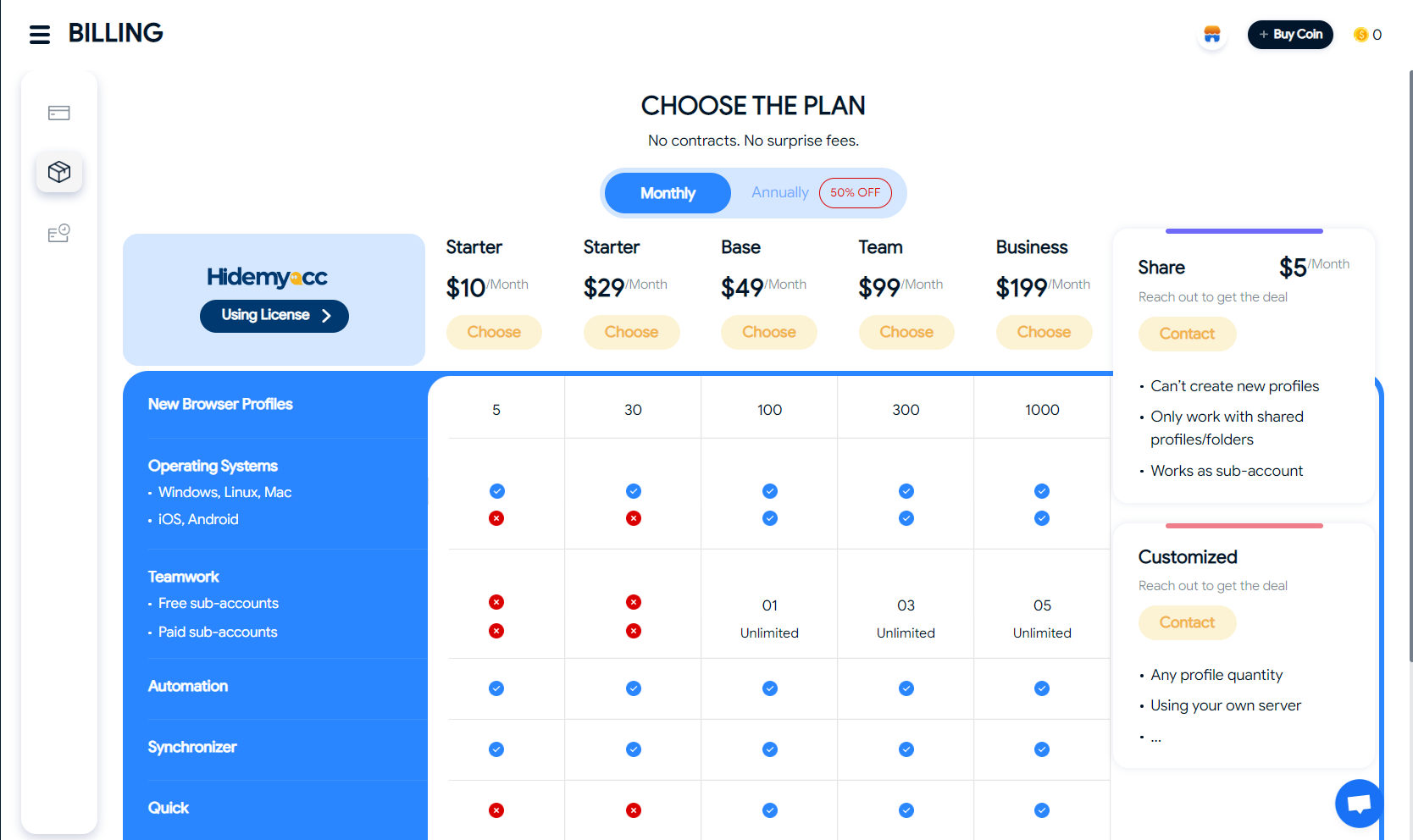
- By comparison, Hidemyacc offers a lower price point, letting users access more features for less. Hidemyacc's cheapest plan is $10/month for 5 profiles. From the Base plan ($49/month for 100 profiles) and up, users can access Hidemyacc's free datacenter proxy pool with more than 10,000 proxies. Hidemyacc's Automation feature is available on every account type, including trial accounts.
No support for importing profiles from other antidetect browsers
Rather than building a feature like Hidemyacc's Magic Link that lets users import profiles from other antidetect browsers into Multilogin, the software only ever walked users through creating new profiles with matching parameters — operating system, browser, browser language, screen size, and so on. However, because every application has its own set of parameters, it was difficult to guarantee that newly created profiles would carry truly identical fingerprints.
No in-app automation support
Multilogin used to provide an API that let users connect external tools to run automation on their profiles, but this was never an ideal solution. Users had to spend more money instead of using built-in resources. Not to mention that lower-quality third-party automation tools could hurt profile quality.
By contrast, Hidemyacc provides both an API and a no-code automation feature, helping users build large numbers of account-warming automation scripts without needing to know how to code. Users can also draw on a library of nearly 30 pre-built scripts from Hidemyacc's system script library.
>>>> RELATED ARTICLES:
Multilogin isn't an antidetect browser anymore?
No worries — meet Hidemyacc, a powerful antidetect browser with better pricing, ready to use right now
6. Hidemyacc — an alternative to Multilogin
If you're looking for an antidetect browser alternative to Multilogin with comparable technology at a more affordable price, Hidemyacc is a great fit.
Hidemyacc's Marco browser engine is built on Chromium, using today's leading antidetect browser technology along with a massive parameter database to help users create and manage large numbers of cross-platform accounts without being detected by websites.
When checked against fingerprint-testing webcheck tools, its profiles easily pass and show up as independent browser profiles.
Regarded as the best "Multilogin alternative," Hidemyacc offers a wide range of features that are useful and convenient for users:
- Customizable browser fingerprint parameters: Users can set parameters for each profile based on their own needs, or let the system randomize them, ensuring every profile has its own unique set of parameters.
- Member management: Beyond sharing or transferring profiles, you can create sub-accounts under a main account and share profile access with them. The main account retains management rights over sub-accounts, such as adding/removing them, renewing plans, changing passwords, and so on.
- Proxy management: Add proxies to a management pool, and when creating a new profile you simply select a proxy from that pool.
- Cheaper proxy purchases in the proxy store: Hidemyacc partners with many different proxy providers and offers exclusive discount codes (5–20%) for Hidemyacc users.
- Free proxies included: From the Base plan and up, users can access Hidemyacc's completely free datacenter proxy pool with more than 10,000 proxies from over 40 different countries.
- Import profiles from other antidetect browsers: Hidemyacc's Magic Link feature helps users create an environment identical to the original profile through a single URL. This makes it easy to move profiles from virtually any antidetect browser over to Hidemyacc.
- Automation: Hidemyacc offers automation with 3 script-building options: drag-and-drop pre-built commands, importing self-coded scripts, or recording user actions on a website. You can also access a free automation script library with nearly 30 scripts across various platforms.
- Action synchronization: With this feature, you only need to perform an action on one master profile, and that action gets replicated across the remaining profiles — including opening/closing tabs, typing, dragging and dropping, and more.
7. Multilogin (former) vs. Hidemyacc
Previously, Multilogin and Hidemyacc addressed the same core need: creating separate browser profiles with distinct fingerprints to safely manage multiple accounts. The comparison table below reflects the differences between the two platforms from when Multilogin was still positioned as an antidetect browser — covering cost, ease of use, and the features included in each plan.
Feature comparison
| Feature | Multilogin X | Hidemyacc |
|---|---|---|
| Starting price | €9/month (10 profiles) | $10/month — see pricing |
| Free trial | €1.99 for 3 days | ✅ Free for 7 days, no credit card required |
| Browser engine | Mimic (Chrome) + Stealthfox (Firefox) | Chromium-based |
| Fingerprint customization | Advanced (25+ parameters) | Advanced (OS, browser, Canvas, WebGL, fonts, etc.) |
| No-code automation | ❌ Requires API or coding | ✅ Built-in drag-and-drop automation builder |
| Code-based automation | Puppeteer, Playwright, Selenium | Puppeteer, Playwright, Selenium |
| Team collaboration | ✅ User permissions (from Pro 100+ plan) | ✅ Included in every plan |
| Profile sharing | ✅ Profile transfer and access permissions | ✅ Magic Link (one-click sharing via URL), Share Profile, Transfer Profile |
| Built-in proxy | ✅ Included in plan (GB-limited) | ✅ Free proxy included (from Base plan and up) |
| Android Cloud Phone | ✅ Available | ❌ Not supported |
| Profile migration (Magic Link) | ❌ Not supported | ✅ Import profiles from Multilogin, GoLogin, AdsPower |
| Synchronizer | ❌ Not supported | ✅ Syncs actions across multiple profiles at once |
| Supported OS | Windows, macOS, Linux | Windows, macOS |
| Linux support | ✅ Yes | ❌ No |
| Customer support | Email + Chat | Email + Chat + User community |
When was Multilogin the better choice?
- Your team runs on Linux and Linux support is a hard requirement.
- You need the Android Cloud Phone feature to manage mobile-first accounts.
- You're running a large-scale enterprise operation and have already built workflows around Multilogin's API.
- Fingerprint stability is your top priority and budget isn't a major constraint.
When is Hidemyacc the more sensible choice?
- You're an individual user, a small team, or an agency wanting strong fingerprint quality at a lower cost.
- You want automation without needing to write code or hire a developer.
- You're migrating from Multilogin, GoLogin, or AdsPower. Hidemyacc's Magic Link feature lets you migrate all your profiles in a single click while preserving fingerprint parameters.
- You want to try the product before buying. Hidemyacc's 7-day free trial requires no credit card.
- You run many profiles at once and need the Synchronizer feature to sync actions across multiple profiles simultaneously — a feature Multilogin doesn't offer.
8. Conclusion
Despite being an industry heavyweight, with its high price, lack of a trial plan, and limited add-on features, Multilogin was no longer the top choice. Instead, users had plenty of alternatives offering reasonable pricing and more supporting features, such as the Hidemyacc antidetect browser.
In terms of technology, Hidemyacc was in no way inferior to Multilogin when it came to anonymity and protecting accounts from detection. Users could easily verify this with specific tests on Google, Etsy, Amazon, Facebook, Instagram, and more.
Additionally, Hidemyacc offers a range of free features such as member management, proxy management, 2FA, automation, and more, helping users work more efficiently.
With 5 diverse pricing tiers suited to both individual and business needs, you can easily find the plan that fits you best with Hidemyacc.
To try a 7-day free trial with 30 profiles, download Hidemyacc and sign up for a trial account.
Want to migrate your Multilogin profiles to Hidemyacc?
Migrate large batches of Multilogin profiles to Hidemyacc safely and securely, with an identical parameter set and working environment, using the Magic Link feature.
>>> Other antidetect browser reviews
- MoreLogin browser: an in-depth review and alternatives
- Incogniton: an honest review
- BitBrowser: a detailed, practical review
- VMLogin review — is it an effective antidetect browser?
- Linken Sphere: is it the right antidetect browser?
- SessionBox review: an honest look at its features and limitations
- In-depth review of Ghost Browser: a multi-session browser
- Nstbrowser review: affordable pricing, but is it powerful enough?
- Lalicat: is it a good antidetect browser? A full review and hands-on testing.
- Octo Browser: an in-depth review for multi-account management
- Is Undetectable the right antidetect browser for your needs?
- Review of ixBrowser: how it works and whether it's good for multi-account use
- DICloak: is it a reliable antidetect browser? Pros and cons!
9. FAQ
What are Multilogin's main features?
Multilogin lets you create multiple separate browser profiles, each with its own fingerprint, cookies, and stored data. The platform supports both Chromium (Mimic) and Firefox (Stealthfox), while allowing deep customization of device parameters, IP, and browser environment. Multilogin also provides an API for automation and team collaboration.
What's the difference between Multilogin X and Multilogin 6?
Multilogin X is the current version, launched in 2024 to replace the earlier Multilogin 6 desktop app. Notable improvements include a web interface, Android Cloud Phone support, real-time profile sync, and an API-first architecture. Multilogin 6 stopped accepting new users as of March 2025.
Does Multilogin offer a free trial?
Multilogin didn't offer a fully free trial back when it was still an antidetect browser. New users could try the platform for 3 days at a cost of €1.99, which included 5 profiles and 200 MB of proxy traffic. If you want a free trial before deciding to buy, Hidemyacc offers a 7-day free trial with no credit card required.
Was Multilogin worth its price?
For large businesses running a high volume of accounts and with automation systems already in place, Multilogin's high price could be justified by its fingerprint stability and strong API integration capabilities. However, for small to mid-sized teams, solutions like Hidemyacc can offer comparable fingerprint quality along with more built-in features (such as no-code automation, Synchronizer, and Magic Link) at a significantly lower cost.
Can I migrate from Multilogin to another antidetect browser?
Yes. Hidemyacc's Magic Link feature lets you import profiles from Multilogin (and other antidetect browsers) just by pasting a URL. The migration process preserves key fingerprint parameters such as operating system, browser type, screen resolution, and fonts, with no manual reconfiguration needed.
What's the best Multilogin alternative?
Hidemyacc is one of the strongest alternatives worth considering to Multilogin. The platform offers powerful fingerprint customization, supports multiple proxy types, and is optimized for managing multiple accounts. Many users also find Hidemyacc more affordably priced and easier to scale when working in teams or operating at a larger scale.