Farming Facebook accounts is no longer as simple as it was a few years ago. The moderation system is becoming increasingly strict, especially for new accounts, clones, or accounts used for marketing purposes. Just a mistake in frequency, using an "unclean" IP, or exposing duplicate fingerprints can lead to a checkpoint within a few hours.
Hidemyacc will analyze the details of farming facebook accounts stage by stage: environment preparation, correct warm-up procedures, gradually increasing interaction behaviors, and risk control. The content also summarizes antidetect tools, proxies, and automation software to help manage multiple accounts more safely. If you need to build a sustainable account system, this is a practical guide that can be applied immediately.
1. Introduction to the standard for farming facebook accounts

Farming facebook accounts is the process of building and maintaining accounts naturally to increase credibility before leveraging them for marketing, sales, or building a satellite system. Meta's platform uses behavioral analysis algorithms to assess account risk. The system tracks login IPs, device fingerprints, friend request speed, messaging frequency, and content history. New accounts or clones usually have very low trust scores. If interactions increase suddenly or login environments are changed constantly, the likelihood of a checkpoint rises sharply. Therefore, applying the correct way of farming facebook accounts from the beginning helps limit unusual verifications, keeps accounts stable, and creates a foundation for long-term growth.
>>> What is the Facebook algorithm? Update the latest changes 2026
2. Basic principles for farming facebook accounts safely
Before ramping up interactions or leveraging accounts for marketing purposes, it is necessary to build a stable foundation. If this stage is skipped, the risk of a checkpoint will increase even if the activity is not excessively high.
2.1. Completing the personal profile
The profile is the first factor the system evaluates when determining trustworthiness. Accounts lacking an avatar, cover photo, or basic information are often classified as high-risk.
It is necessary to use a clear, natural face photo for the avatar that does not overlap with many other accounts. The cover photo should contain normal life content, avoiding advertising images or those containing too much text.
Personal information such as date of birth, gender, and place of residence should be filled out completely and reasonably. Do not edit this information continuously in a short period because Meta's system easily records this behavior as abnormal.
Additionally, you should post a few personal status updates before starting to add friends. An existing activity history helps the account look natural and reduces the risk of a checkpoint during the initial phase.
2.2. Creating a natural activity schedule
After completing the profile, the next step in farming facebook accounts is building an activity rhythm similar to a real user. Meta's system prioritizes behavior that is stable and distributed evenly over time.
In the first 7 days, you should only scroll through the newsfeed, leave reactions, and make short comments. Maintain 5-10 likes and 2-3 comments with different content each day. Avoid copying the same phrase for multiple posts.
You should not post sales content or attach external links right from the start. New accounts need to build an interaction history before performing commercial activities.
Frequency must increase gradually by the week. Do not spike activity in a single day because the system will record it as abnormal behavior and trigger the check mechanism.
2.3. Limiting friend requests and messaging
Adding friends is a sensitive behavior in the early stages. If too many invitations are sent in a short time, the account is very likely to be flagged as spam.
In the first 7 days, you should only send 5-10 invitations per day. Prioritize people with mutual friends to increase the acceptance rate. A low acceptance rate is a risk signal that Meta's system monitors very closely.
You should not mass unfriend or continuously retract invitations. These behaviors create an artificial growth pattern and decrease the trust score.
Regarding messages, absolutely do not send identical content to many people. New accounts should limit proactive messaging in the first week to avoid feature restrictions.
2.4. Using clean IPs and separate devices
IPs and device fingerprints are the two core factors in farming facebook accounts safely. If multiple accounts log into the same environment, the system can link them and assess risk by cluster.
Each account should be associated with a fixed IP. You should not change the login country or region continuously. In addition to the IP, the browser fingerprint must also be separate. This includes the operating system, user agent, screen resolution, and virtual hardware configuration. Meta's system has the ability to identify duplicate devices even if the IPs are different.
When operating multiple accounts, it is necessary to use a separate environment for each account. This separation helps reduce the risk of chain checkpoints and protects the entire system.
3. Preparation before farming accounts

After grasping the fundamental principles, the next step in farming facebook accounts is preparing a stable operating environment. This stage directly determines the checkpoint rate during the first 30 days.
3.1. Using separate phone numbers and emails
When farming facebook accounts, verification information serves as the foundation for account trust. If multiple accounts share the same email or phone number, the risk of linking and checkpoints will increase significantly.
Each account should have a separate email. The email needs to function normally before registration, for example, by sending and receiving mail for a few days. You should not create an email and register for Facebook in the same IP session.
Phone numbers should also be separated for each nickname. Avoid using public SMS services or virtual numbers that have been used many times, as these are easily flagged as risky by Meta's system.
After successfully linking, limit changing the email or removing the phone number within the first 30 days. If you edit verification information continuously, it may trigger identity check mechanisms.
3.2. Choosing quality proxies and IPs
The login IP is one of the most important factors in farming facebook accounts. Meta's system analyzes IP history to evaluate the stability and risk of an account.
Priority should be given to residential proxies or mobile proxies. These two types simulate real user behavior because they originate from residential internet service providers. Cheap datacenter IPs often have a history of spam and are easily placed on suspicion lists.
Each account needs to be associated with a fixed IP. You should not change countries, change regions, or rotate IPs continuously during the first 2-3 weeks. Sudden changes in the login environment are a common cause of checkpoints. Additionally, ensure the IP is clean and has never been abused for violating activities. Before use, check blacklists and activity history to reduce risk from the start.
3.3. Categorizing accounts before farming
Not every account has the same level of safety. Before implementing a process for farming facebook accounts, it is necessary to clearly categorize them to apply the appropriate procedure for each group.
They can be divided into three main groups:
- New clone accounts
- Old via accounts
- High trust accounts
New clone accounts are newly created accounts with no activity history. This group has a very low trust score, so it needs a slow warm-up, limited friend requests, and no early ad deployment.
Old via accounts are accounts that have existed for a while but were not created by you. It is necessary to check for a history of violations, checkpoints, or spam before use. If they were previously restricted, the risk of a re-checkpoint will be higher. These accounts usually must be purchased, and caution is needed when buying old Facebook accounts.
High trust accounts are accounts with a long activity history, natural interaction, and few violations. This group can increase interaction speed faster but must still adhere to the principle of gradual increases to avoid being flagged as abnormal by Meta's system.
3.4. Choosing support tools for farming accounts
When managing multiple accounts, completely manual operations will increase the risk of errors and behavioral duplication. Therefore, to farm facebook accounts professionally, support tools are an essential factor.
Common tools usually include antidetect browsers to help separate fingerprints for each account, automation tools or account farming software, and proxy managers, which are also important tools when operating multiple IPs.
4. Detailed process for farming facebook accounts
After completing the preparation steps, it is necessary to implement a clear roadmap. An effective way of farming facebook accounts does not rely on speed but on stability and growth through each stage. Additionally, depending on each person's farming method, there will be different steps; the methods below are for reference and can be customized according to your preference.
4.1. Creating accounts from a clean environment
Register using a fixed IP and a separate fingerprint. Personal information needs to be reasonable and not copied in bulk across multiple accounts.
After creation is complete, do not add friends or send messages immediately. You should let the account "rest" for a few hours before starting light operations.
4.2. Warm-up stage 14-17 days
In the first week, you should only scroll through the newsfeed and leave reactions. Limit this to 5-10 likes per day and a few short comments.
In the second week, you can start posting personal updates. Content should be lifestyle-oriented, without external links or direct advertising.
4.3. Daily interaction schedule
After the warm-up phase, you can gradually increase activity within a controlled framework:
|
Activity |
Week 1 |
Week 2-3 |
|
Like |
5-10/day |
15-25/day |
|
Comment |
2-3/day |
5-10/day |
|
Add friends |
5-10/day |
15-20/day |
Do not spike activity in a single day. The speed must increase gradually to match real user behavior.
4.4. Gradually increasing activity levels over time
After 30 days, the account can expand to stronger interactions. However, you must still maintain a stable IP and separate device.
Meta's system monitors unusual changes in long-term behavior. Therefore, growth needs to be linear, not leaping.
4.5. Monitoring warning signals
In the process of farming facebook accounts, you need to monitor warnings because they are just as important as interaction growth. Meta's system often sends signals before applying a heavy checkpoint.
Common signs include:
- Being restricted from sending friend requests
- Messages going into the spam folder unusually often
- Requests to verify phone numbers or emails
- "Unusual activity" notifications upon login
When one of the above signs appears, immediately reduce interaction frequency by 50-70% for 3-5 days. Do not continue mass friending or messaging.
Most importantly, keep the same IP and device used previously. If you change the login environment during a sensitive time, the system may elevate the verification level to a more serious checkpoint.
5. How should you handle it when encountering a checkpoint?
Even when applying the correct way of farming facebook accounts, checkpoints can still occur when the system detects risk signals. The most important thing is not to panic but to follow the correct procedure to avoid elevating the verification level.
A checkpoint is an automated verification mechanism deployed by Meta to check identity or abnormal behavior. Each type of checkpoint has a different risk level and requires its own handling method.
5.1. Overview of checkpoints during the farming process
Checkpoints are usually triggered when an account shows the following signs:
- Increasing interaction too quickly in a short time
- Changing IPs or devices continuously
- Mass friending with a low acceptance rate
- Early advertising activity or link spamming
New accounts and clone accounts are the groups most vulnerable to checkpoints due to low trust scores. If handled incorrectly, the account may be permanently locked.
5.2. What is checkpoint 282 and how to handle it
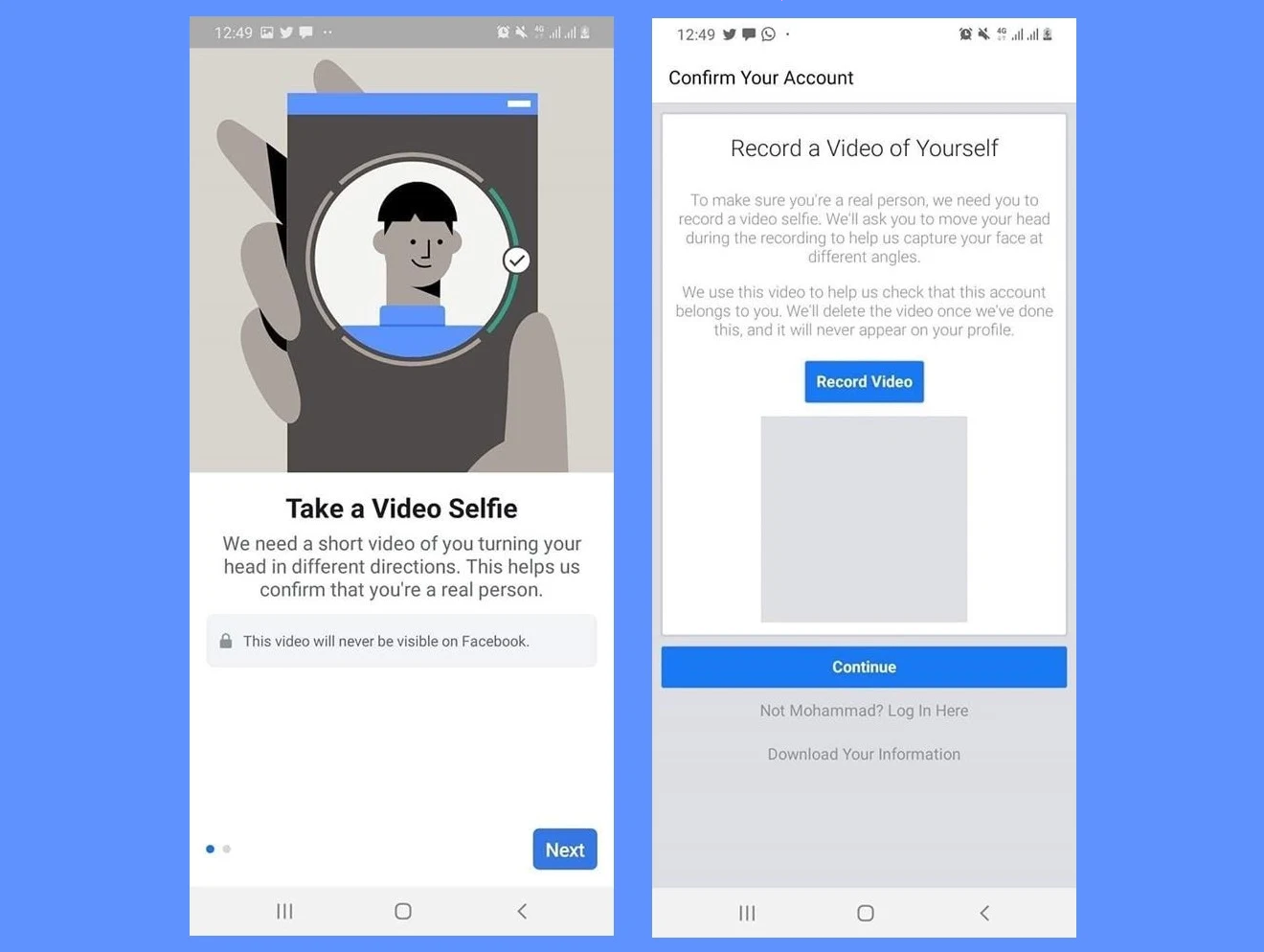
Checkpoint 282 is a form of behavioral verification commonly encountered when applying a way of farming facebook accounts with an incorrect growth rhythm. Meta's system requires users to record a video of their face to confirm the account is real.
The identifying feature is a notification requesting verification via a phone camera or computer webcam. This process takes place automatically and has no initial manual appeal step.
Common causes include:
- Sudden increase in friend requests and interactions
- Logging in from an IP in a different region than before
- Using multiple accounts on the same fingerprint
Safe handling:
- Keep the same IP and device used for the most recent login
- Perform verification in the old environment; do not change browsers
- After reopening, reduce activity frequency by 70% for at least 5 days
If verification fails multiple times, the Facebook account may be temporarily locked or moved to a higher checkpoint level. Therefore, it is necessary to ensure a stable login environment before performing verification.
5.3. What is checkpoint 956 and how to handle it
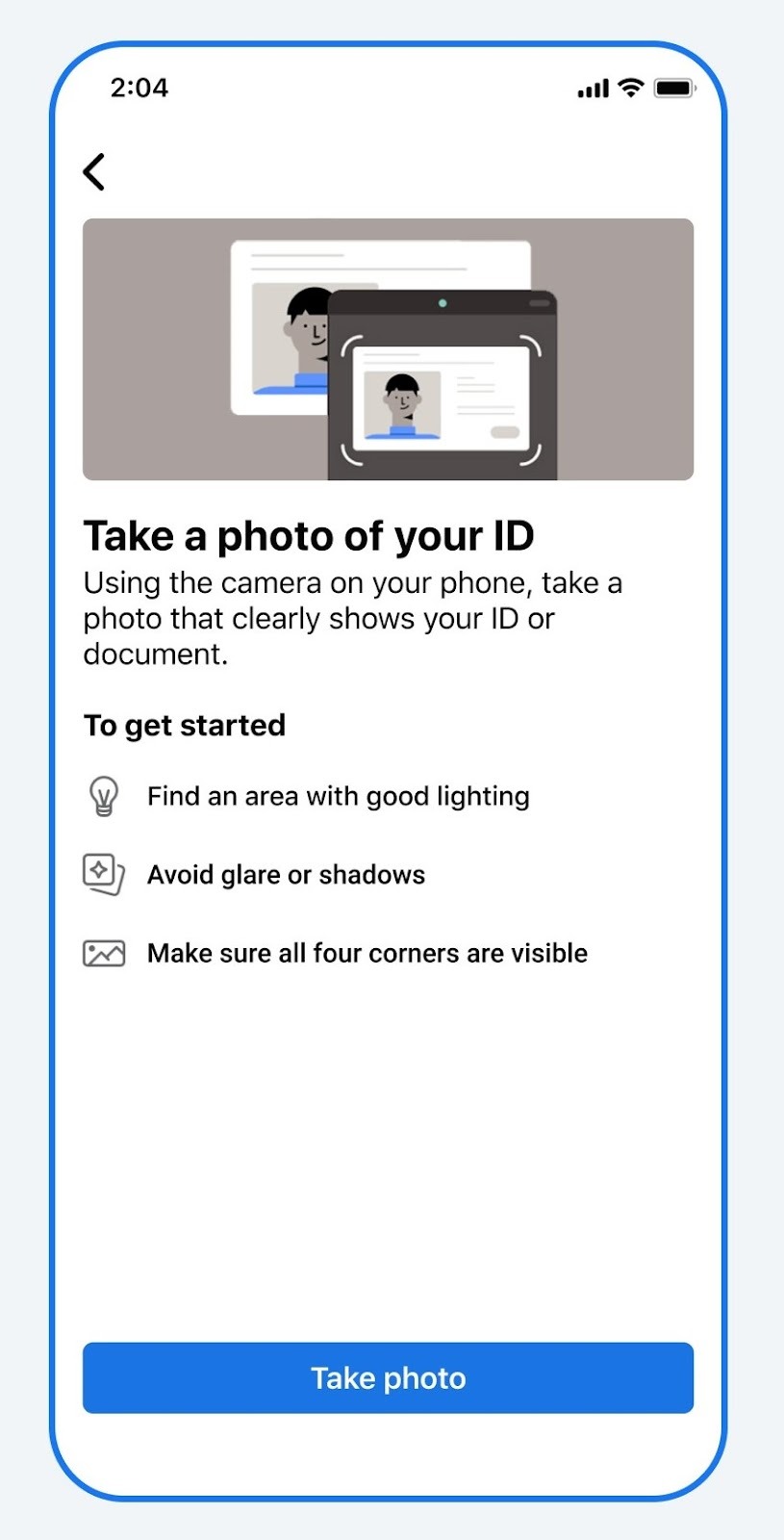
Checkpoint 956 is an advanced form of identity verification. This is a high-risk level while applying a method for farming facebook accounts, as the system requires authentication using personal identification documents.
The common feature is a notification requesting the upload of an ID card, citizenship card, or passport. The information on the documents must match the account data previously declared.
Common causes include:
- Accounts showing signs of identity impersonation
- Heavy spamming activity or abnormal advertising
- Device duplication with many other accounts
- Changing personal information multiple times in a short period
How to handle:
- If the account uses real information and has valid documents, upload as requested and wait for review
- If it is a clone account without a real identity, the possibility of recovery is almost zero
- Do not send continuous appeals because Meta's system may automatically reject them
After encountering CP 956, even if it is reopened, the account is still classified as high-risk, and if a violation recurs, there is a high probability the Facebook account will be suspended. Therefore, prevention from the early stages is always a safer strategy than handling incidents after they have occurred.
6. Tools and software supporting automation
When implementing a way of farming facebook accounts at a multi-account scale, completely manual operations will create risks regarding speed and repetitive behavior. Therefore, it is necessary to combine support tools while strictly controlling configurations.
6.1. Hidemyacc and safe browser fingerprint management
In a professional way of farming facebook accounts, separating fingerprints is a mandatory factor when operating multiple accounts. Hidemyacc is an antidetect browser that allows the creation of individual profiles with independent device configurations.
Each profile has its own user agent, canvas, WebGL, resolution, and operating system. This helps reduce the likelihood of Meta's system detecting multiple accounts logging in from the same environment.
Additionally, Hidemyacc allows for saving a fixed login state for each profile. When used correctly, the risk of chain checkpoints will decrease significantly.
6.2. Automation software and integrated automation
Once accounts have been warmed up, people often use Facebook automation tools or Facebook account farming software. Common tools usually feature auto-interaction, auto-posting, and scheduling for various interactions.
In the first 2-3 weeks, it is necessary to configure a low speed. For example, limit the number of likes per hour and create random delays between actions. Automated behavior that is too fast is a common reason for account verification.
In addition to independent automation tools, Hidemyacc also integrates basic automation features. Users can set up interaction scripts directly within each profile, helping to reduce the risk of environment overlap between the tool and the browser.
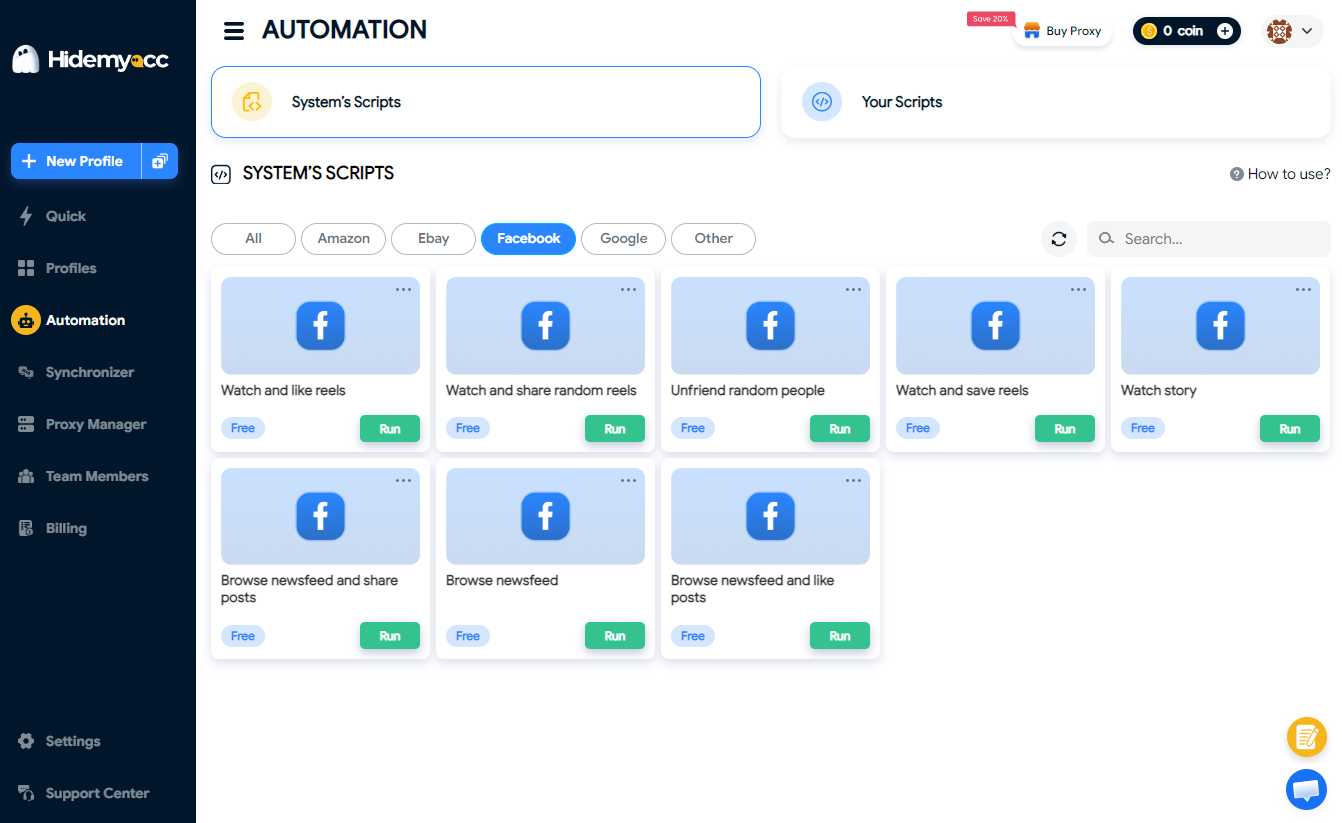
6.3. Proxies and IP management systems
Proxies are an important layer of protection in farming facebook accounts. Residential or mobile proxies usually have higher reliability than datacenter IPs because they originate from residential internet service providers. However, if you use a poor-quality provider to buy a proxy for Facebook, even if you choose residential or mobile proxies, the account risk will be equal to or greater than not using a proxy at all.
Each account should be associated with a fixed IP. Do not rotate IPs continuously during the warm-up phase. Suddenly changing the login region is a high-risk signal.
Furthermore, Hidemyacc supports direct proxy management within each profile. Users can assign a separate IP to each account and control the connection status centrally. This helps synchronize the login environment and reduces the risk of checkpoints due to incorrect IP configuration.
7. Common mistakes and how to fix them
Despite understanding the way of farming facebook accounts, many people still encounter checkpoints due to implementation errors. Most problems do not stem from the algorithm but from incorrect timing or unstable environment configurations.
7.1. Using the same IP or fingerprint for multiple accounts
This is the most serious error when operating a system. If multiple accounts log in with the same IP and the same device configuration, Meta's system can link and evaluate them as a risk cluster.
The fix is to completely separate IPs and fingerprints. To manage multiple Facebook accounts properly, each account needs its own environment and should not be cross-logged between profiles.
7.2. Pushing interactions too quickly from the start
Increasing friend requests, messaging, or posting continuously in the first week causes the account to be flagged for spam. A low trust score is not enough to withstand a high level of activity.
The solution is to apply a warm-up roadmap of at least 7-14 days. Growth must be linear, not leaping in a single day.
7.3. Skipping the warm-up stage
Many people create an account and immediately deploy sales activities. This almost certainly leads to a checkpoint.
New accounts need a history of natural interaction before attaching links or running ads. Warming up is a mandatory step in farming facebook accounts safely.
7.4. Adding or deleting verification emails multiple times
Changing security information continuously makes the system suspect that the account has been compromised.
After linking an email and phone number, keep them stable for at least 30 days. Do not edit personal information heavily in a short period.
7.5. Changing personal information continuously
Changing the name, date of birth, or profile picture multiple times in the first few days is an abnormal signal. The system records editing data too quickly as a form of risk.
The fix is to set up information from the beginning and limit changes. Long-term stability is always valued higher than fast but uncontrolled growth.
8. Conclusion
A safe way of farming facebook accounts does not lie in increasing interactions quickly but in the ability to control risks at each stage. The three most important factors include: setting up a clean environment, warming up at the right pace, and maintaining stable IPs and fingerprints.
Using quality proxies, antidetect browsers, and reasonable automation helps operate multiple accounts more effectively. If you are managing multiple social media accounts, they must be managed properly. However, tools only provide support; the deciding factors remain simulating real user behavior and linear growth.
When applying the correct way of farming facebook accounts, accounts will have higher trust scores, reducing the risk of checkpoints and maintaining long-term stability for marketing goals or building a sustainable system.
9. FAQ
1. How long does farming facebook accounts take to be safe?
Typically, it takes at least 14-30 days for an account to reach a basic trust level. During this time, you should maintain a steady warm-up and avoid commercial activities too early.
2. How long after creating a new account can I add many friends?
After about 2-3 weeks, if the account has not encountered any warnings, you can gradually increase the number of friend requests. However, you must still increase linearly and monitor the acceptance rate.
3. Is using a proxy mandatory when farming multiple accounts?
If operating 2-3 accounts or more, you should use a separate proxy for each account. Meta's system can link accounts when they share the same IP or device.
4. Should I use automation software right from the first week?
No. In the first week, you should only perform manual operations or configure automation at a very low level. Speeding up too early easily leads to checkpoints.
5. Can checkpoint 282 be reopened?
Yes, if verified in the correct old login environment and by providing the video as requested. After reopening, you must significantly reduce activity frequency for several days.
6. Can checkpoint 956 be recovered?
Recovery is only possible if the account uses a real identity and provides valid documents. For clone accounts, the possibility of recovery is almost zero.
7. Should I change personal information during the warm-up phase?
You should not edit information multiple times within the first 30 days. Continuously changing the name, date of birth, or email can trigger verification mechanisms.
8. Does the way of farming facebook accounts apply to ad accounts?
Yes, but accounts used for advertising need a longer warm-up time. You should not run ads immediately after creating an account to avoid feature restrictions.