Ecommerce continues to grow as one of the most effective ways to start and scale an online business. In 2026, advances in digital platforms, online payments, and global logistics have made it easier than ever to turn ecommerce business ideas into profitable ventures.
At the same time, consumer behavior is shifting toward convenience, personalization, and niche-focused brands. This creates strong opportunities for entrepreneurs to build ecommerce businesses with lower startup costs, flexible models, and long-term scalability.
This article explores 30+ ecommerce business ideas for 2026, helping you identify opportunities that align with current market trends and real customer demand.
1. Why ecommerce is a smart business choice in 2026
Ecommerce remains one of the smartest business models in 2026 due to its adaptability, scalability, and alignment with modern consumer behavior. For entrepreneurs evaluating long-term opportunities, ecommerce business ideas offer clear advantages over traditional offline models.
1.1 Digital-first consumer behavior
Consumers increasingly research, compare, and purchase products online. Trust in digital payments, reviews, and fast delivery continues to rise, making ecommerce the default shopping channel for many categories. This shift directly supports ecommerce business ideas built around niche audiences and value-driven offerings.
1.2 Lower barriers to entry
Starting an ecommerce business in 2026 requires significantly less capital than a physical store. Many ecommerce business ideas can be launched without inventory, storefronts, or large teams, thanks to models such as dropshipping, print-on-demand, and digital products.
>>> Best Print On Demand products to sell
1.3 Scalable and flexible business models
Ecommerce businesses are designed to scale. Once systems are in place, sellers can expand product lines, enter new markets, or add sales channels with minimal additional cost. This flexibility allows ecommerce business ideas to grow sustainably over time.
1.4 Multiple revenue opportunities
Modern ecommerce supports diverse revenue models, including direct-to-consumer sales, subscriptions, digital downloads, and social commerce. This versatility enables entrepreneurs to choose ecommerce business ideas that match their expertise, resources, and growth goals.
2. 30+ Ecommerce business ideas (High-potential for beginners)
E-commerce in 2026 is no longer just about "buy low, sell high." It's a game of innovation, niche markets, and customer experience. If you're a beginner, check out this list of 35 ideas categorized by resource level.
2.1. Group 1: Low-capital, Low-risk model (Lean startup)
Suitable for beginners to learn operational skills without needing a large capital investment.
- Specialized Dropshipping: Selling goods without a warehouse, focusing on a specific niche. Ex: Selling camping equipment (tents, flashlights) sourced directly from suppliers and reselling to the US/European market.
- Print-on-Demand (POD): Designing and selling custom-printed t-shirts, mugs, and pillows. Ex: Designing t-shirts featuring specific dog breeds (Corgi, Poodle) and printing them upon order.
- Digital Planner: Selling digital planners and schedules for tablet users. Ex: Selling PDF templates of personal financial management plans for GoodNotes users.
- E-books & Technical Guides: Packaging your knowledge into e-books. Ex: An e-book titled "Learn Photoshop in 7 Days" for beginners.
- Stock Photos/Assets: Selling images, videos, or graphic designs on private platforms. Ex: Selling icon sets or pre-recorded video footage of Vietnamese landscapes to editors.
- Software & Digital Tools Installation: Website design services or automation system installation. Ex: Selling automated landing page setup services for yoga instructors.
- Affiliate Niche Site: Building product review sites and earning commissions from e-commerce platforms. Ex: Building a blog reviewing home coffee makers and including links to purchase products on Shopee/Amazon.
2.2. Group 2: Products following modern lifestyle trends
Focuses on solutions to the problems of the next generation of consumers.
- Eco-friendly products: Bamboo toothbrushes, reusable silicone bags, beeswax food wraps. Ex: Gift sets including bamboo thermos flasks, stainless steel straws, and canvas tote bags.
- Smart home devices (IoT): Sensor lights, fingerprint door locks, automatic plant watering systems. Ex: Self-emptying robot vacuums or voice-controlled LED lighting systems.
- Home Office accessories: Ergonomic chairs, computer stands, smart memo boards. Ex: Height-adjustable standing desks or pegboards for decorating your workspace.
- Home fitness equipment: Premium exercise mats, smart weights, resistance bands. Ex: Alignment yoga mats or adjustable dumbbell sets.
- Mental health care products: Scented candles, essential oils, meditation kits. Ex: Essential oil diffusers with "Rainforest" or "Night Sea" scent collections.
- Biohacking functional foods: Vitamins that optimize sleep and concentration.
- Mini water and air purifiers: Products for personal health protection in urban areas. Ex: Neck-worn air purifiers or portable water bottles with alkaline ion filters.
- Mini hydroponic systems: For plant lovers living in small apartments. Ex: A kit for growing sprouts or lettuce right on your apartment balcony.
2.3. Group 3: Niche market for families & pets
This customer segment tends to have high spending power and brand loyalty.
- Pet Fashion & Accessories: Clothing, collars, and toys for dogs and cats.
- Organic Pet Food: Natural, preservative-free pet food.
- Educational Toys (STEM): Science kits and building blocks for children's intellectual development.
- Maternity & Baby Care Products: Organic and absolutely safe products for newborns.
- Smart Modular Furniture: Foldable beds and tables for small living spaces.
- DIY Kits: Candle-making kits, embroidery kits, and digital painting kits for home use.
2.4. Group 4: Sustainable fashion & beauty (D2C)
Building a private label with high profit margins.
- Vegan Beauty: Lipsticks and skincare products not tested on animals.
- Gender-Neutral Fashion: Minimalist clothing designs suitable for all genders.
- Custom Jewelry: Engraving names and anniversaries upon customer request.
- Recycled Fabric Fashion: Clothing made from bamboo fiber, coffee fiber, or recycled plastic.
- Tech Protection Accessories: Biodegradable phone cases and laptop bags.
- Men's Beard & Hair Care Products: The men's grooming niche is experiencing strong growth.
2.5. Group 5: Unique service & Product models 2026
Leading the Way with the Latest Market Trends.
- Subscription Box: Sending monthly samples of products (snacks, cosmetics).
- Refurbished Business: Buying, refurbishing, and reselling technology equipment with warranties.
- Meal Kits: Pre-prepared ingredients with recipes for customers to cook at home.
- EV Gear: Floor mats, chargers, and specialized accessories for electric vehicles.
- Luxury Resale Marketplace: Buying and reselling used designer items.
- Rental eCommerce: Renting wedding dresses, expensive toys, or filming equipment.
- Selling Virtual Space (VR/Metaverse) Assets: Designing settings and costumes for virtual characters.
- AI-powered personal style consulting: Using AI tools to create outfit combinations and sell those products directly.
3. How to choose the right ecommerce business idea in 2026 (Practical framework)
With so many ecommerce opportunities available, the biggest challenge is not finding ideas but choosing the right one. In 2026, successful ecommerce brands are built on alignment between market demand, execution capability, and long-term positioning. The following framework helps evaluate ecommerce business ideas objectively and strategically.
3.1 Start with real market demand
Every sustainable ecommerce business idea begins with demand. Rather than relying on assumptions, founders should validate whether customers are actively searching for and buying similar products.
Key indicators of demand include:
- Consistent search interest over time
- Existing competitors with active sales
- Customer reviews indicating unmet needs or frustrations
Ecommerce business ideas backed by real demand reduce risk and shorten the path to profitability.
3.2 Choose a niche, not a broad market
In 2026, broad ecommerce stores struggle to compete with established marketplaces. Niche-focused ecommerce business ideas, on the other hand, allow brands to build authority and trust faster.
Effective niches often have:
- A clearly defined audience
- Specific problems or preferences
- Willingness to pay for specialized solutions
Niche positioning also improves SEO performance and customer loyalty.
3.3 Match the idea with your skills and resources
Not all ecommerce business ideas are suitable for every entrepreneur. Some require strong branding, others depend on content creation, logistics, or technical expertise.
Ask key questions:
- Do you understand the customer segment?
- Can you create or source the product reliably?
- Do you have the time or skills to market the business effectively?
Alignment between capability and idea increases execution quality—an important factor for long-term success.
3.4 Evaluate profitability and unit economics
Before committing to an ecommerce business idea, it is essential to understand the numbers. This includes product costs, marketing expenses, fulfillment, and margins.
Key factors to evaluate:
- Product pricing flexibility
- Shipping and fulfillment costs
- Customer acquisition cost (CAC) vs. lifetime value (LTV)
Strong ecommerce business ideas are built on sustainable margins, not just high sales volume.
3.5 Consider scalability and long-term potential
Short-term trends may generate quick sales, but lasting ecommerce success requires scalability. The best ecommerce business ideas in 2026 are designed for growth.
Look for ideas that allow:
- Expansion into related products
- Entry into new markets or regions
- Automation of operations and marketing
Scalable ecommerce models create resilience and long-term value.
3.6 Build trust and authority from the start
Trust is a decisive factor in ecommerce. Search engines and customers both favor brands that demonstrate expertise, transparency, and credibility.
To strengthen trust:
- Provide clear product information and policies
- Publish educational or experience-based content
- Highlight social proof such as reviews and testimonials
Ecommerce business ideas that prioritize trust are better positioned for SEO visibility and customer retention.
4. Ecommerce trends to watch in 2026
Understanding ecommerce trends is essential when evaluating long-term ecommerce business ideas. In 2026, the most successful ecommerce brands are not chasing short-term hype, they are aligning with structural shifts in technology, consumer behavior, and digital infrastructure.
4.1 Sustainability and ethical commerce
Sustainability continues to influence purchasing decisions across multiple product categories. Consumers increasingly expect ecommerce brands to demonstrate ethical sourcing, eco-friendly packaging, and transparent operations.
Sustainability-driven ecommerce businesses are more likely to build trust and long-term loyalty.
4.2 Personalization powered by Data and AI
Personalization is becoming a baseline expectation rather than a competitive advantage. In 2026, ecommerce brands use customer data to tailor product recommendations, content, and offers.
Personalization also increases customer lifetime value and retention.
4.3 Social commerce and live shopping
Social platforms are evolving into full ecommerce ecosystems. Live shopping, influencer-led commerce, and in-app checkout are redefining how products are discovered and purchased.
This trend is particularly effective for visually driven and lifestyle-focused products.
4.4 Subscription and recurring revenue models
Subscription-based ecommerce continues to grow due to its convenience and predictability. Customers appreciate automated replenishment and curated experiences.
Recurring revenue improves cash flow stability and forecasting.
4.5 Creator-led and community-driven brands
Creators and subject-matter experts are increasingly launching ecommerce brands built on trust and audience relationships.
Brands rooted in expertise and experience align strongly with EEAT principles.
4.6 Operational automation and no-code tools
Automation and no-code platforms are reducing operational complexity. Tasks such as inventory management, customer support, and email marketing are increasingly automated.
Automation makes ecommerce more accessible and scalable.
5. Popular ecommerce platforms to launch your business in 2026
Choosing the right platform is a critical step in turning ecommerce business ideas into a functioning online store. In 2026, ecommerce platforms are more accessible and specialized than ever, allowing entrepreneurs to select solutions that match their business model, technical skills, and growth plans.
- Shopify & BigCommerce - Core platforms for most ecommerce business ideas, especially direct-to-consumer, subscription, and scalable product-based businesses.
- WooCommerce (WordPress) - Best for SEO-first and content-driven ecommerce business ideas that rely on organic traffic and brand authority.
- Wix Ecommerce - Suitable for small-scale stores, digital products, and early-stage ecommerce validation.
- Marketplace Platforms - Amazon and Etsy are commonly used to test demand, reach existing buyers, and support private-label or handmade ecommerce business ideas.
- Social Commerce Platforms - TikTok Shop, Instagram Shopping, and Facebook Shops play a key role in modern ecommerce business ideas by enabling discovery, live selling, and in-app checkout driven by creators and communities.
Most high-performing ecommerce brands in 2026 use a hybrid approach, combining owned platforms with social and marketplace channels to maximize reach and resilience.
6. How Hidemyacc support ecommerce businesses
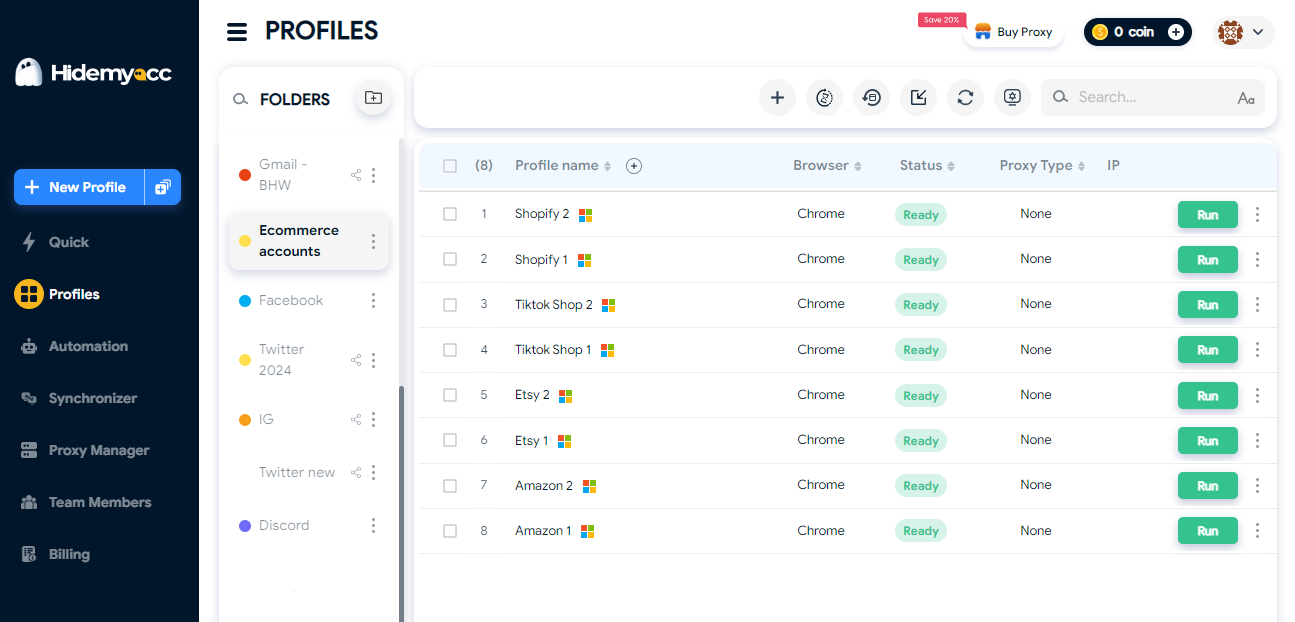
As ecommerce becomes more competitive in 2026, many sellers operate across multiple platforms, regions, and accounts. This is where antidetect browser Hidemyacc play an important role in supporting modern ecommerce business ideas, especially at the operational level.
Managing multiple ecommerce accounts safely
Many ecommerce businesses run multiple stores, ad accounts, or marketplace seller accounts to test products, target different markets, or reduce platform dependency. Antidetect browsers help isolate each account into separate browser profiles, minimizing the risk of account linkage or suspension.
For ecommerce sellers, this is especially relevant when managing:
- Multiple marketplace stores
- Several advertising accounts
- Different brands or niches under one operation
Supporting cross-border and multi-market ecommerce
Cross-border ecommerce is a key growth strategy in 2026. Antidetect browsers allow sellers to simulate distinct browsing environments, making it easier to manage stores and campaigns across different regions without technical conflicts.
This supports ecommerce business ideas focused on:
- International dropshipping
- Global D2C brands
- Market-specific testing and localization
Improving team collaboration and workflow
As ecommerce teams grow, multiple people often need access to stores, ads, and analytics tools. Antidetect browsers like Hidemyacc help separate roles and environments, reducing errors and improving security.
This is particularly useful for ecommerce businesses working with:
- Remote teams
- Freelancers or agencies
- Multiple operational roles (ads, fulfillment, customer support)
Enabling safer testing and scaling
Testing is central to validating ecommerce business ideas. Whether testing new products, creatives, or traffic sources, antidetect browsers provide a controlled environment that helps sellers experiment without impacting core business assets.
In practice, this allows ecommerce operators to:
- Test new ideas with lower risk
- Scale successful models more confidently
- Protect existing stores and accounts
7. Final thoughts
Ecommerce in 2026 offers more opportunity than ever but success depends on execution, not ideas alone. While the number of available ecommerce business ideas continues to grow, only those grounded in real demand, clear positioning, and long-term strategy are likely to succeed.
The most effective ecommerce businesses share common traits: they focus on specific audiences, deliver genuine value, and build trust through transparency and expertise. Rather than chasing every trend, successful founders choose ecommerce business ideas that align with their skills, resources, and understanding of the customer.
As ecommerce platforms, automation tools, and digital infrastructure continue to improve, the barrier to entry will remain low but competition will increase. This makes differentiation, credibility, and customer experience essential components of any ecommerce strategy.
If you are planning to start or expand an online business, use this guide as a framework. Evaluate ecommerce business ideas carefully, validate assumptions early, and commit to building a brand not just a store. In 2026 and beyond, ecommerce success will belong to businesses that combine strategy, trust, and consistent execution.
>>> Related article:
- Ecommerce Automation: Top tools to scale faster and stay secure
- What is a Trademark? Why Ecommerce sellers need to know about it?
8. FAQ
What are the best ecommerce business ideas in 2026?
The best ecommerce business ideas in 2026 focus on real customer demand, niche markets, and scalable models. Popular categories include sustainable products, health and wellness, pet products, digital goods, subscription-based ecommerce, and direct-to-consumer brands. Successful ideas align with long-term trends rather than short-term hype.
Are ecommerce business ideas still profitable in 2026?
Yes, ecommerce business ideas remain profitable in 2026 when built with the right strategy. Lower startup costs, global reach, and improved automation allow businesses to achieve strong margins. Profitability depends on niche selection, customer acquisition costs, and the ability to build trust and repeat purchases.
What is the easiest ecommerce business to start?
Low-barrier ecommerce business ideas include dropshipping, print-on-demand, and digital products. These models require minimal upfront investment and no physical inventory, making them ideal for beginners. However, long-term success still depends on branding, differentiation, and customer experience.
How do I choose the right ecommerce business idea?
Choosing the right ecommerce business idea involves validating market demand, selecting a clear niche, understanding your skills and resources, and evaluating profitability. The best ecommerce ideas solve specific problems and can scale over time without relying solely on paid advertising.
How much money do I need to start an ecommerce business?
The cost to start ecommerce varies by model. Some ecommerce business ideas can be launched with a small budget using no-code platforms and low-inventory models. Expenses typically include website setup, basic marketing, and initial tools, while inventory-heavy models require more capital.
What ecommerce trends will shape business ideas in the future?
Future ecommerce business ideas will be shaped by sustainability, personalization, social commerce, subscriptions, creator-led brands, and automation. Businesses that adapt to these trends are more likely to remain competitive and relevant in the coming years.
Can ecommerce business ideas work without marketplaces like Amazon or Etsy?
Yes. Many ecommerce business ideas succeed through direct-to-consumer websites, social commerce, and content-driven traffic. Owning the customer relationship allows brands to control data, messaging, and long-term growth, rather than relying solely on third-party marketplaces.
How long does it take to make money with ecommerce?
The timeline varies by ecommerce business idea and execution. Some models can generate revenue within months, while others take longer to build traction. Consistent marketing, SEO, and customer trust are key factors that influence how quickly an ecommerce business becomes profitable.