Many users of Midjourney, Stable Diffusion, or DALL·E create impressive artworks but get stuck when it comes to making money. In reality, AI art cannot generate profit on its own if you choose the wrong platform or lack a strategy.
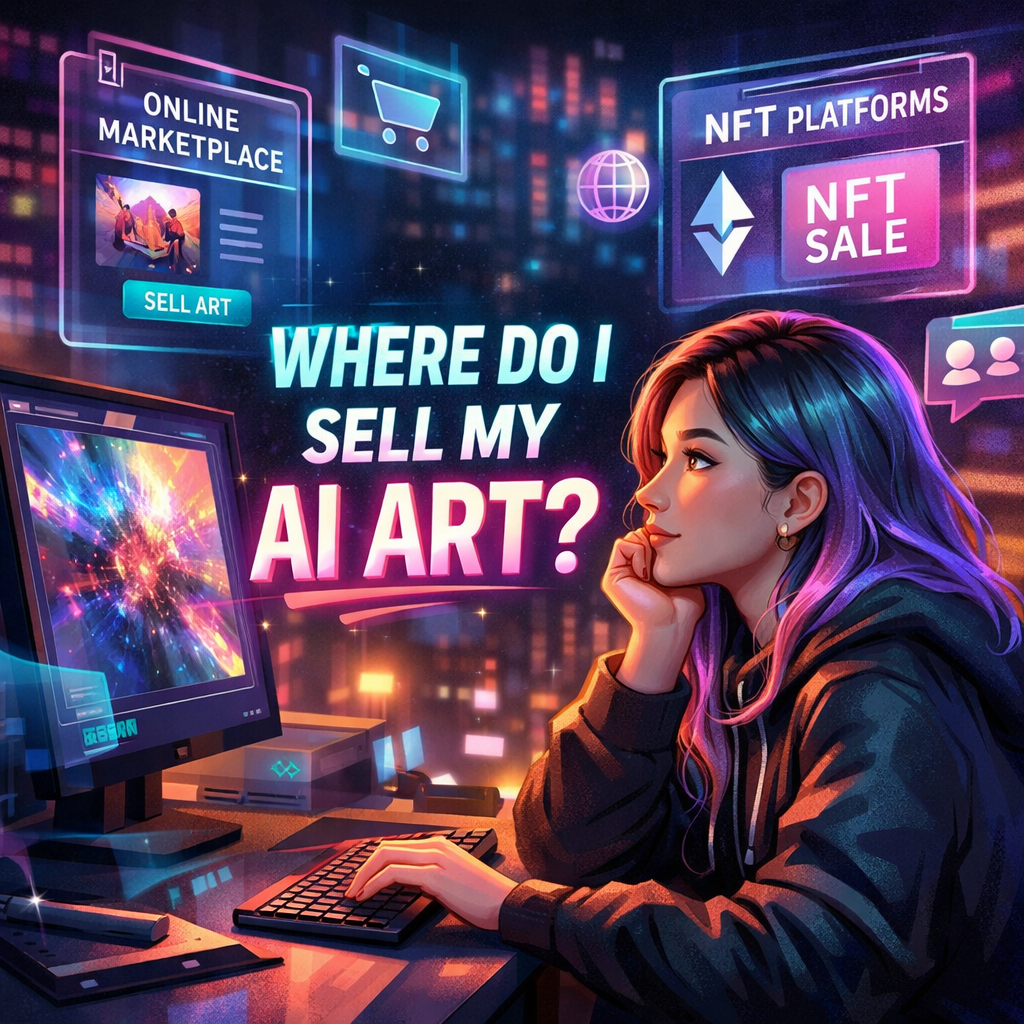
In this article, Hidemyacc will help you understand popular platforms, how to choose the right channel, and provide a detailed guide to answer the question where do I sell my AI art and how to generate real income.
1. Can you make money from AI art?
Many newcomers to the field of AI graphics are skeptical about the ability to make money from this model. Before exploring where do I sell my AI art, you need to clearly see the market reality and understand the nature of commercializing AI art.
1.1 The practical answer
Making money from AI art is entirely feasible, but it is necessary to recognize the true nature of this model. This is not a get-rich-quick scheme, but a form of digital product business, where the value lies in how you build and sell the product, not in the image generation tool.
Currently, many people generate income from AI art, especially on platforms like Etsy or print-on-demand systems. In some cases, the first order can come after just a few weeks if the product is properly oriented and meets specific needs.
However, it is important to understand that buyers do not pay for your use of AI, but for the value they receive. If an image has no clear application, for example, not used for printing, decoration, or design, it is very difficult to generate revenue. Conversely, if the product is clearly positioned as wall art, decorative posters, or ready-to-print files, the chances of selling are much higher.
Therefore, the deciding factor is not how you create the image, but how you turn that image into a usable product that is in demand in the market.
1.2 Current market situation
To better understand where do i sell my ai art, it is necessary to look at the current market reality, as the level of competition and buyer behavior directly affect sales performance.
- Fierce competition: AI reduces almost all barriers to entry, causing the number of participants to increase rapidly. Thousands of new products appear every day, so you not only compete on images but also on ideas and sales methods.
- Easy to be saturated: AI products are very easily duplicated in terms of style due to the use of shared training datasets. If you cannot identify a distinct direction, your product will blend into a series of similar results on platforms. Even with good image quality, the visibility and ability to attract buyers remain very low without a clear difference in ideas or packaging.
- Unstable initial income: Running an AI art business is not a get-rich-quick method. Sellers need time to build a loyal customer base and often have to combine selling on multiple platforms to optimize monthly revenue.
- High risk of copying: Famous image generation tools like Midjourney default to public prompts on shared servers. Therefore, others can easily copy prompts to create similar images if the original artwork is not further edited with graphic software.
Overall, these barriers show that merely creating beautiful images is not enough to help you survive and compete long-term in the market.
1.3 Factors determining success
To overcome market barriers and generate steady revenue, creators need to equip themselves with a sharp business mindset. Specifically, you need to focus on the following 4 core factors:
- Product niche: You must choose a very specific topic. For example, instead of making general animal art, focus on a group of fantasy watercolor animals or minimalist art designs for workspaces.
- Quality and packaging specifications: Customers always prioritize convenience. Package products and sell them in sets, provide high-resolution print files, and attach PSD source files to maximize value for buyers.
- Distribution channel: Deciding where do i sell my ai art will directly affect the customer base you can reach. Choose the right business model that suits your financial resources and time available.
- Execution strategy: Cover multiple channels to maximize customer touchpoints, continuously test new designs, and use actual sales data to eliminate underperforming products.
When combining harmoniously and ensuring all 4 of these factors, your journey of turning digital artworks into actual profit will become much clearer and more sustainable.
2. Where do I sell my AI art? Categorizing 5 platform groups
Commercializing digital graphics is currently one of the most breakthrough and low-risk ecommerce business ideas. However, to turn digital artworks into money, choosing the right playground is vital. Here are the 5 most popular platform groups to help you solve the problem of where do I sell my AI art effectively.
2.1 Digital product marketplaces
The first and most accessible option for beginners is digital product marketplaces. Characteristics of this platform group include:
- Typical platforms: Etsy, Creative Fabrica.
- How it works: Sellers upload digital files to virtual stores, such as AI poster, print files, or graphic design images.
- Application examples: A set of 5 fantasy animal posters, a set of print files containing inspirational quotes.
- Pros: The system possesses huge organic traffic with an existing user base that has high purchase intent. Sellers do not need to spend budget on running ads but can still reach millions of users every day. These platforms have built-in credibility, making it very easy for customers to make a payment decision.
- Cons: The level of competition is extremely fierce due to low barriers to entry. Thousands of new artworks are uploaded every hour, causing your products to easily be pushed down to later pages. It is mandatory for sellers to master search engine optimization skills for products, know how to set titles, write descriptions, and attach accurate keyword tags to have a chance of being displayed.
Overall, marketplaces are an ideal launchpad, but you need to invest time in researching keywords so that the product reaches the right target customers.
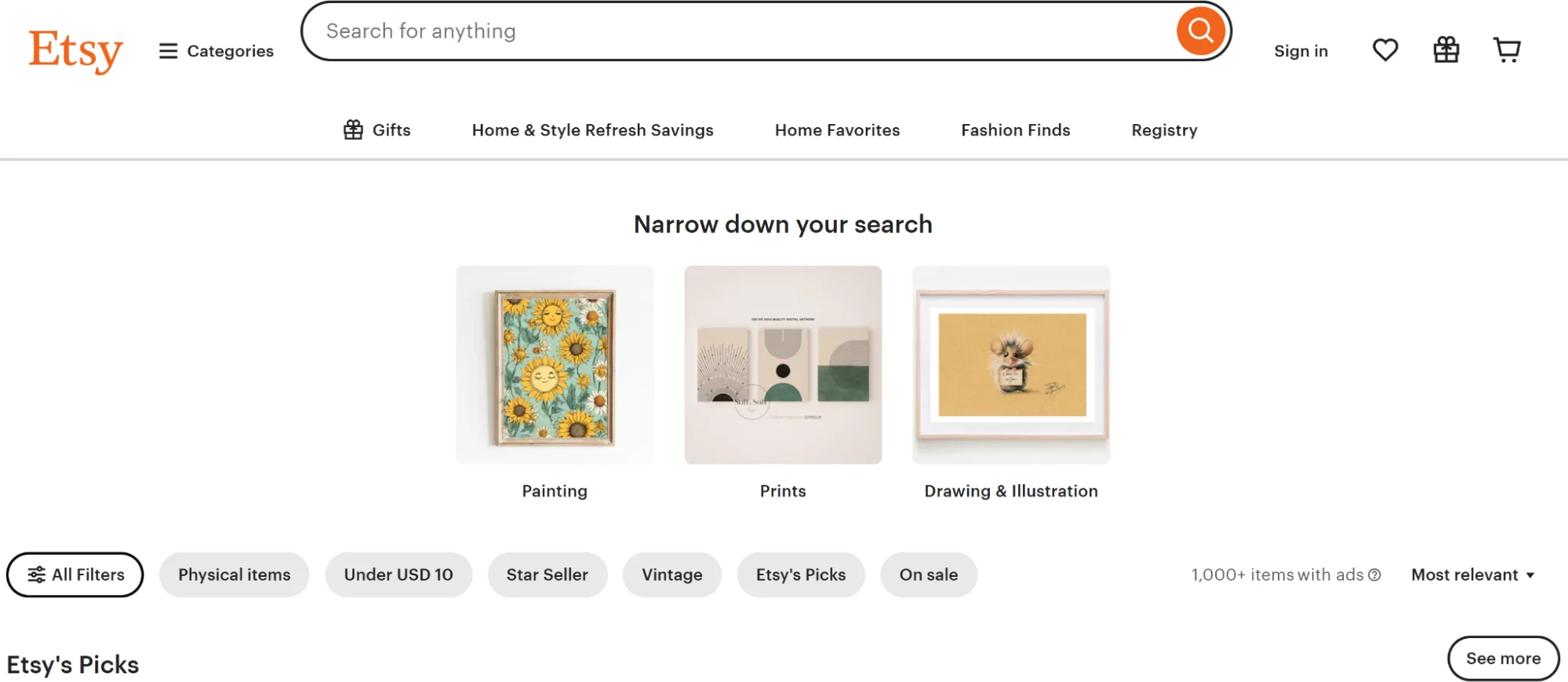
To optimize revenue on this channel, you can refer to the list of best-selling digital products on Etsy to combine with your AI artworks.
2.2 Print-on-demand platforms
If you do not want to bother with order processing or shipping, print-on-demand platforms are a highly optimal model. Here is the core information about this format:
- Typical platforms: Redbubble, Zazzle, Society6.
- How it works: Sellers upload designs to the system. The platform automatically prints on physical products like T-shirts, mugs, phone cases, and ships to customers.
- Application examples: Sellers upload designs to the system, then the platform automatically prints images on physical products and delivers them to customers. You should apply AI designs to print-on-demand products like T-shirts, mugs, or stickers to easily get orders.
- Pros: No need to spend capital to import goods, no worries about warehousing, shipping, or handling returns. The entire customer service process is automatically taken care of by the platform. Sellers can easily replicate one design onto dozens of different products.
- Cons: The profit margin on each product sold is quite low, usually accounting for only a small portion of the final selling price. Revenue depends entirely on the platform's algorithm policy, and sellers always face the risk of unexpected account suspension for violating platform policies without prior notice.
The print-on-demand format brings maximum convenience, in return you need to sell a diverse volume of designs to generate an attractive profit margin.
2.3 Freelance platforms
For those with good communication skills and wanting to maximize the value from each artwork, freelance platforms are a direction worth considering. This service-selling format has the following characteristics:
- Typical platforms: Fiverr, Upwork.
- How it works: Post services to create AI images according to the personalized requirements of customers.
- Application examples: Accept designing AI avatars, drawing cartoon-style pet portraits, transforming real photos into artistic paintings, or making album covers for bands.
- Pros: Cash flow comes quickly and there are opportunities to get projects with very high contract values. Customers are willing to pay many times more for a custom artwork tailored exactly to their liking. This is also an ideal place to build a network of enterprise clients for long-term collaboration.
- Cons: This is trading time for money, completely not generating passive income. Sellers must spend a lot of effort communicating, negotiating, and handling continuous revision requests from customers.
Joining freelance platforms helps cash flow circulate quickly, however, you must truly focus and invest effort in handling each individual project.
2.4 Stock photo and distribution
If your goal is to generate steady cash flow even while sleeping, stock photo libraries are the perfect answer. The specifics of this distribution platform group are summarized as follows:
- Typical platforms: Adobe Stock, Freepik, Wirestock.
- How it works: Users upload photos to online archives and receive royalties whenever someone downloads the artwork. The Wirestock platform also supports automatically distributing photos to multiple archives simultaneously.
- Application examples: A set of AI nature illustrations, a set of futuristic city landscape photos.
- Pros: Creates genuine and sustainable passive income over many years. One photo can be sold thousands of times without taking extra effort to maintain. Especially, applying ecommerce automation solutions allows you to upload images to multiple archives simultaneously in huge quantities, saving maximum time.
- Cons: Income per download is very small, requiring sellers to build a massive photo library to see clear results. The initial quality moderation process of these platforms is also becoming increasingly strict for AI-generated images.
The stock photo model requires patience in the early stages but will yield sweet results when your portfolio is large enough.
2.5 Building your own online store
Once you have a certain customer base and want to develop into an independent brand, building your own online store is an inevitable step. Here are points to note with this model:
- Typical platforms: Payhip, Shopify, Gumroad.
- How it works: Create an independent sales website, set your own prices, and sell directly to target customers.
- Application examples: AI prompt template sets with tutorial videos, monthly high-quality photo download membership packages.
- Pros: Gain full control of customer data to serve future remarketing campaigns. Proactively build a professional personal brand and enjoy the highest profit margins by not having to share commissions with e-commerce platforms.
- Cons: Have to spend your own advertising costs or spend a lot of time doing marketing content on social networks to attract initial traffic. If there are no marketing skills, the store will have absolutely no visiting customers.
Opening your own store is a long-term business endeavor, in return you will own a completely independent and sustainable sales ecosystem.
3. Overview comparison table of platforms
Once you understand the characteristics of each model, deciding where do i sell my ai art will become easier if you directly compare it with your current goals and resources. The detailed summary table below will classify and clarify core criteria, helping you quickly make the right choice based on personal business goals:
|
Platform |
Type |
Traffic |
Difficulty |
Income level |
When to use |
|
Etsy |
Marketplace |
Available |
Medium |
Fairly stable |
When you are a beginner and want early orders without finding customers yourself |
|
Redbubble |
Print-on-demand |
Available |
Easy |
Low |
When you want to list many products, no need to worry about operations |
|
Fiverr |
Freelance |
Available |
Medium |
High |
When you need quick money and are ready to work on request |
|
Adobe Stock |
Stock |
Available |
Hard |
Low |
When you want to build long-term passive income |
|
Wirestock |
Distribution |
No need to care |
Easy |
Low |
When you want to bulk upload to multiple platforms at once |
|
Payhip |
Private store |
None |
Hard |
Very high |
When you want to build a brand and control all profits |
Depending on whether you want an immediate income source or want to build a long-term revenue-generating system, the answer to where do I sell my AI art will be completely different. The safe advice is to choose an accessible platform to get used to the market, then gradually scale to harder channels to optimize profit margins.
4. Prerequisites before selling AI art
Before deciding where do I sell my AI art, you need to ensure that all technical and legal elements are fully met. Thorough preparation right from the start will help the business process run smoothly and avoid unfortunate risks like account suspension or getting involved in disputes.
4.1 Own an AI account with commercial rights
Not all AI tools allow using images for business purposes. Most platforms today have clear regulations on ownership and commercial exploitation of generated content.
Specifically, only paid registered accounts are granted the right to use images for commercial purposes. Using the free version to download images and sell them is a direct violation of the developer's policy. In some cases, this can result in product removal, account suspension, or legal risks.
Therefore, before listing for sale, you need to clearly check:
- Whether your current account plan allows commercial use
- Image terms of use of each AI platform
Upgrading the account is not only a mandatory requirement but also the first step to ensure safe and long-term business operations.
Important note: You should frequently update the terms of service of each tool as they change continuously. At the same time, prioritize using private generation mode if the platform supports it to protect your exclusive design prompts from being copied.
4.2 Process upscaling image files
Image quality is a vital factor determining the value of a digital product. Images output directly from AI systems are usually very small (around 1024x1024 pixels), completely falling short of commercial printing standards.
- Technical requirements: For files intended for printing on T-shirts or posters, the graphic file must achieve a minimum pixel density of 300 DPI. Horizontal and vertical dimensions must be increased to 4000 to 8000 pixels depending on the actual paper size of the product.
- Processing note: You should use dedicated upscaling software (AI Upscaler) like Topaz Gigapixel (paid) or Upscayl (free). These tools help enlarge images many times without losing sharpness, blurring, or causing glitchy details.
Investing seriously in the post-production stage of upscaling not only helps the product pass the platforms' moderation round but also enhances the customer experience, minimizing the risk of refunds due to blurry printed images.
4.3 Prepare international payment gateways
Most digital product e-commerce platforms are headquartered abroad. To receive money from these platforms, sellers need to pre-register and verify popular international payment gateway accounts like PayPal or Payoneer.
- Verification requirements: You must provide accurate identification information, perfectly matching valid ID documents. When expanding the business to a professional level, you can explore more about owning multiple PayPal accounts to diversify cash flow risks.
- Transaction note: Newly created accounts often face temporary holds for security verification. Additionally, thoroughly research withdrawal fees or consult Payoneer alternatives to optimize the foreign exchange rate received per order.
Once these three fundamental conditions are fully prepared, you can step into the real-combat phase with peace of mind and confidently present your artworks to customers worldwide.
5. Starter strategy when you don't know where do I sell my AI art
When faced with too many choices, beginners are often easily overwhelmed and lose direction. If you are still wondering and haven't decided where do I sell my AI art, apply this 4-step practical strategy immediately to navigate and find your own formula for success.
5.1 Step 1: Choose a market niche
The biggest mistake of newbies is creating whatever they like without paying attention to the actual market demand. To stand out, you need to narrow your focus to a very specific niche:
- Do not make mainstream content, pick a core theme running through the entire store to establish a distinct brand mark.
- Some potential niche suggestions currently in high demand include fantasy landscapes, watercolor animals, minimalist art, or children's book illustrations.
Identifying the right niche from the beginning will help platform algorithms easily categorize and distribute your products to the right target audience.
5.2 Step 2: Prepare the product portfolio
A store with too few products cannot build trust with buyers and the algorithm also lacks data to make recommendations. Before officially launching sales, prepare a thorough portfolio to increase visibility and for testing:
- You should pre-produce and completely upscale at least 10 to 20 high-quality graphic files before listing.
- Prioritize packaging single artworks into themed collections, while providing various file formats to maximize usability for buyers.
A diverse and professionally packaged product portfolio will stimulate customers to buy multiple items at once, thereby increasing the average order value.
5.3 Step 3: Multi-channel distribution
The initial phase requires broad testing. Combine opening stores on marketplaces, uploading to stock libraries, and print-on-demand platforms simultaneously. Instead of picking just one platform, maximize the power of widespread coverage during the startup phase:
- Conduct testing by simultaneously opening marketplace stores, uploading to stock libraries, and pushing designs to print-on-demand platforms.
- Closely monitor market feedback to evaluate which distribution channel is receiving your design style best.
Multi-channel distribution helps diversify your income streams, while quickly pinpointing the platform that yields the highest conversion rate to focus efforts on later.
5.4 Step 4: Measure and optimize
Running a digital product business is a continuous process of testing and refining based on real data. You cannot just list products and leave them alone:
- Evaluate data on views and conversion rates periodically every month for each participating platform.
- Boldly remove or change the thumbnails for products with zero views. Meanwhile, deeply analyze top-selling products to find a common formula and duplicate into many new variations.
Continuous tracking and optimization is the vital key to keeping your business aligned with trends and profitably sustainable in a fiercely competitive market.
A clear strategy will help you stop wondering where do I sell my AI art, as you now have a systematic market approach. Instead of random testing, start from a niche, build products, distribute widely, and continuously optimize. This is the way to move faster and limit risks in the early stages.
6. Common mistakes when searching where to sell AI art
When entering the digital graphics market, making mistakes in the early stages is inevitable. Here are common mistakes causing many beginners to fail in finding the answer to where do I sell my AI art:
- Ignoring practical application: Many just focus on creating visually pleasing images for personal taste, forgetting that customers buy products to solve a specific need like decorative printing, gifting, or website design.
- Rambling design without a niche: Creating a little bit of everything, from landscapes and portraits to animals, dilutes the product portfolio. Platform algorithms also cannot identify the core theme of the store to suggest it to the correct audience.
- Uploading too few products: Distribution algorithms always need a lot of data to evaluate a new store's potential. Posting only a few products and waiting for orders drops buyer reach to nearly zero.
- Depending on a single sales channel: Pouring all resources into one platform poses very high risks. If the account is suddenly suspended due to policy changes, you will entirely lose the income source you worked hard to build.
- Lacking copyright law knowledge: Currently, laws in many countries do not grant intellectual property rights to images fully created by AI. Sellers must perform extra editing via professional graphic software to create uniqueness and avoid future legal disputes.
Being aware of and proactively avoiding these mistakes right from the start will save you maximum time, effort, and minimize risks during business operations.
7. Conclusion
The market for commercializing artificial intelligence artworks is booming, unlocking many opportunities but also coming with numerous challenges. In reality, no single platform is suitable for everyone. Depending on skills, resources, and goals, each person will have a different choice between e-commerce marketplaces, print-on-demand platforms, or stock photo archives.
To correctly answer where do I sell my AI art, you must clearly understand that a system-generated picture itself will not independently generate revenue. Artificial intelligence only acts as a support tool for the graphic production stage. The deciding factor lies in your business mindset, niche selection ability, product packaging, and appropriate distribution strategy.
Hopefully, this detailed article has helped you completely clear up any confusion regarding distribution channel selection and provided enough practical knowledge.
8. FAQ
1. Does selling AI art violate commercial copyright laws?
No violation if the design does not contain characters or logos of protected brands. However, current laws do not allow registering intellectual property rights for completely AI-generated artworks.
2. Which platforms should total beginners choose to start experiencing?
Etsy and Redbubble are the two most suitable choices. These platforms already have huge visitor traffic and the product listing process is very easy to operate.
3. Is it mandatory to know how to use professional design software?
Not mandatory. You just need to use basic online tools for cropping borders, inserting text, or upscaling images, which is totally enough to start.
4. How long does it typically take to get the first income stream?
The average time is 2 to 4 weeks if you perform well in niche selection and keyword optimization. Some cases can take a few months depending on product competition.
5. Which product niches are currently in the highest demand?
Digital products like sticker files, children's coloring pages, digital papers used in design, and minimalist decorative posters have huge purchasing power.
6. Is it necessary to edit AI images before selling?
Yes. Re-editing images helps increase quality, creates a difference, and reduces duplication risks. Besides, in some cases, human intervention makes the product more commercially acceptable.