As revenue grows, many Amazon sellers turn to Amazon multi-seller scaling to expand their brands, markets, and operational capacity. But adding more seller accounts does not automatically create a scalable business.
Without a clear operating system, multiple storefronts can quickly lead to overlapping responsibilities, inconsistent processes, disconnected reporting, and account-level risk. The real challenge is not simply managing more accounts. It is building a structure that allows people, processes, data, and access environments to work together without creating unnecessary complexity.
This guide explains how to build that system, from choosing an organizational model to assigning account ownership, standardizing reporting, and maintaining separate operating environments.
1. What is Amazon multi-seller scaling?
An Amazon seller uses Seller Central to manage products, orders, inventory, customer service, and other selling activities on Amazon.
Amazon multi-seller scaling means building the processes, staffing structure, and tools needed to operate several seller storefronts as one organized system.
That is different from simply registering another seller account.
With ad hoc multi-accounting, each account may be managed separately. Employees may use different workflows, information may be stored across disconnected spreadsheets, and the owner may need to manually check every account.
A systematized approach gives every account:
- A clearly defined owner
- Standardized workflows
- Account-level KPIs
- Centralized reporting
- Controlled access
- A documented operating environment
The difference can be summarized simply:
Multi-accounting means operating more than one Amazon seller account.
Multi-seller scaling means building a system that allows those accounts to be managed and expanded efficiently.
Before expanding, sellers should also understand Amazon's requirements for operating multiple seller accounts. For the policy and eligibility considerations, see our guide on how to open multiple Amazon seller accounts.

2. Why sellers build a multi-account system when scaling
A multi-account structure can support business growth in several ways. The right reason depends on the company's brands, markets, and operational structure.
Revenue Growth Beyond the Ceiling of a Single Account
As a business grows, one seller account may no longer be enough to support multiple distinct brands, business units, or approved selling operations.
A structured multi-account model can create additional capacity while giving each account clearer ownership and performance visibility.
The goal is not simply to increase the number of accounts, but to create additional revenue opportunities without making management disproportionately more complicated.
Risk Distribution Across Brands or Markets
Separate account structures can make it easier to monitor different brands or market operations independently.
For example, businesses can track:
- Revenue by account
- Account health
- Return and cancellation rates
- Inventory position
- Operational workload
However, multiple accounts should not be treated as guaranteed protection against suspension or policy issues. Related accounts can still be affected by compliance problems, so every account needs to remain in good standing.
Better Use of the Operations Team
Managing multiple accounts does not necessarily mean assigning one employee to every account. A structured system allows businesses to allocate employees according to their roles and workload.
For example, one team member may focus on listing operations across several accounts while another handles inventory or customer service.
With standardized SOPs and clear ownership, the same team can support more accounts without duplicating every operational role.
Expansion Into New Markets or Regions
Different Amazon marketplaces can have different customer expectations, languages, pricing strategies, and operational requirements.
A multi-account structure can help businesses organize regional operations while allowing teams to adapt their approach to each market.
This becomes particularly useful when expanding from one market into North America, Europe, or other regions.
3. Are you ready to scale multiple seller accounts?
Before choosing an organizational model, businesses should determine whether their existing operation is ready for additional complexity.
Signs Your Business Is Ready
Current seller accounts are operating consistently without recurring issues.
Existing accounts should have stable day-to-day operations without frequent problems involving orders, inventory, customer service, or account health.Standard operating procedures already exist.
Recurring tasks should already be documented, including listing management, order processing, inventory checks, customer service, reporting, and escalation procedures.Inventory and cash flow are predictable.
The business should have a clear understanding of purchasing cycles, inventory requirements, fulfillment timelines, and working capital before increasing operational volume.One person has become the operational bottleneck.
If the owner or one senior employee has to review every account, approve every task, and resolve every issue, the business may need a stronger delegation structure before scaling further.Reporting is centralized.
Managers should be able to monitor multiple accounts from one reporting system instead of collecting information manually from disconnected spreadsheets.Quick Readiness Check
Ask five questions:
- Are current accounts stable?
- Are recurring tasks documented?
- Is inventory predictable?
- Can responsibilities be delegated?
- Can management see account performance in one place?
If several of these conditions are not yet in place, strengthen the existing operation before adding another seller account. Scaling works best when the underlying system is already stable enough to support additional workload.

4. Organizational models for multi-seller scaling
There is no single organizational structure that works for every business.
The right model depends on whether the operation is primarily organized around brands, geographic markets, or team capacity.
4.1 Brand-based model
The brand-based model assigns each seller account to a distinct brand. Each account can maintain its own catalog, marketing strategy, commercial targets, and performance reporting.
This structure keeps each brand relatively independent, making it easier to measure performance and develop a separate growth strategy.
Key advantages include:
- Independent growth for each brand
- Clear performance measurement
- Minimal interference between brand strategies
- Clear ownership boundaries
However, this model also comes with some limitations:
- Higher management costs
- Potentially duplicated administrative work
- Requires shared processes to maintain consistency
This model is best suited to businesses with multiple distinct brands that need clear boundaries between their brand operations.
4.2 Market or Region-Based Model
The market-based model organizes seller accounts according to geographic markets. Each account or operating unit can adapt its pricing, content, customer service, and other processes to the requirements of its target market.
This approach gives regional teams more flexibility while allowing the wider business to maintain centralized oversight.
Key advantages include:
- Regional optimization
- Localized pricing and content
- Easier market-specific customer service
- Greater regional expertise
However, regional operations can also create additional complexity:
- More complex regional requirements
- Multilingual operations may be necessary
- More complicated inventory coordination
- Requires stronger communication between regional teams
This model is particularly suitable for international sellers operating across multiple Amazon marketplaces where local market conditions require different operating approaches.
4.3 Operations-Team-Based Model
The operations-team-based model groups seller accounts according to workload rather than brand or geography. This structure is also commonly known as a pod structure, where a small cross-functional team manages a defined cluster of seller accounts.
For example, one pod might include an account manager, listing specialist, and operations specialist who collectively manage several seller accounts.
The main advantage is that businesses can allocate employees according to workload instead of creating a separate team for every account.
Key advantages include:
- Flexible resource allocation
- Easier workload balancing
- Specialists can support multiple accounts
- Easier to scale staffing as account volume increases
At the same time, this model requires stronger operational controls:
- Strict SOPs are needed
- Consistent quality control is required
- Different pods can develop inconsistent standards without proper oversight
- Management becomes more complex as the number of pods increases
This model is best suited to agencies and larger Amazon operations teams that manage enough accounts to benefit from flexible resource allocation.
Comparison table:
| Model | Main advantage | Main drawback | Best fit |
|---|---|---|---|
| Brand-based | Independent brand growth | Higher management cost | Brand owners |
| Market-based | Regional optimization | Compliance complexity | Global sellers |
| Operations team (pod) | Flexible resource allocation | Requires strong SOPs | Agencies |
These models do not have to remain completely separate.
A larger organization could use a brand-based structure at the management level while using pod-based teams for daily operations. The best model is the one that creates clear ownership without adding unnecessary management layers.
5. Common mistakes when scaling a multi-account system
Scaling problems often come from weak operational systems rather than the number of accounts itself.
No Clear Ownership Between Accounts and Staff
Centralized reporting is useful, but combining all account data into a single set of numbers can hide problems at the individual account level. Businesses managing several seller accounts often pair KPI dashboards with a multi-accounting browser so each account is operated from its own dedicated browser profile while remaining easy to manage.
Each seller account should therefore retain its own KPIs and performance history within the centralized reporting system. This allows managers to identify which account is performing well, which one requires attention, and where operational resources should be allocated.
Sharing the Same Access Environment Across Accounts
Using the same browser, device, or network environment across multiple seller accounts can create unnecessary overlap between account operations. Browser fingerprinting, for example, can use characteristics of a browser and device to help identify whether different sessions are connected. Keeping account environments clearly separated can therefore help maintain a more organized multi-account operation.
No Independent Performance Tracking
Centralized reporting is useful, but combining all account data into a single set of numbers can hide problems at the individual account level.
Each seller account should therefore retain its own KPIs and performance history within the centralized reporting system.
This allows managers to identify which account is performing well, which one requires attention, and where operational resources should be allocated.
Scaling Too Fast Before the Management System Is Solid
Adding several accounts at the same time can increase pressure on inventory, customer service, reporting, account management, and team coordination. A more sustainable approach is to expand sequentially.
The business can add an account, monitor how the system handles the additional workload, improve the relevant SOPs, and then move to the next stage of expansion.
6. How to implement a multi-account operating system
Once the organizational structure is in place, the next step is turning it into a repeatable operating system. The goal is to make responsibilities clear, keep performance visible, and ensure each account is managed consistently as the business grows.
6.1 Build assignment and oversight workflows
Every seller account should have a clearly defined owner and a consistent workflow for daily operations. This prevents tasks from being duplicated or overlooked as more employees become involved.
At a minimum, the operating structure for each account should define:
- Account owner: The person responsible for day-to-day coordination and performance
- Backup owner: The person who can take over essential operations when needed
- Reporting cadence: How often account performance is reviewed and reported
- Approval authority: Who can approve important operational or strategic decisions
These responsibilities should be documented rather than relying on informal communication between team members. A clear assignment structure also makes it easier for managers to identify who should handle an issue when something goes wrong.
Access Governance
Account access should follow the same principle of clear ownership. Instead of sharing the primary Seller Central login directly with employees or virtual assistants, businesses should use delegated permissions or role-based access whenever possible.
A practical access structure should:
- Give each employee only the permissions required for their role
- Keep account ownership clearly documented
- Review permissions when employees change roles
- Remove access when employees or contractors leave
- Maintain a record of who can access each account
This creates a more controlled workflow while reducing the risk of employees accessing the wrong seller account or retaining unnecessary permissions.
6.2 Standardize data and centralized reporting
As the number of seller accounts increases, collecting information manually from separate spreadsheets becomes increasingly difficult to manage. A centralized reporting system gives managers one place to monitor the business while still keeping each account's performance separate.
The reporting system should use a consistent set of account-level KPIs, such as:
- Daily and weekly revenue
- Cancellation and return rate
- Account Health Rating
- Customer response rate
- Inventory status
- Advertising performance
- Fulfillment performance
Using the same reporting structure across accounts makes it easier to compare performance and identify accounts that require attention.
For Amazon FBA business , inventory should also be included in the reporting system. Teams can monitor stock levels, inbound inventory, excess inventory, and potential fulfillment issues at the account and SKU level.
The key is to combine centralized visibility with independent account tracking. Management should be able to see the overall business performance without losing sight of what is happening within each seller account.
6.3 Isolate the access environment per account
Access management is another important part of a multi-account operating system. Amazon may evaluate technical and behavioral signals when assessing relationships between seller accounts. For businesses managing multiple legitimate seller accounts, antidetect browser Hidemyacc can help maintain a separate browser profile for each account and keep account access organized across teams.
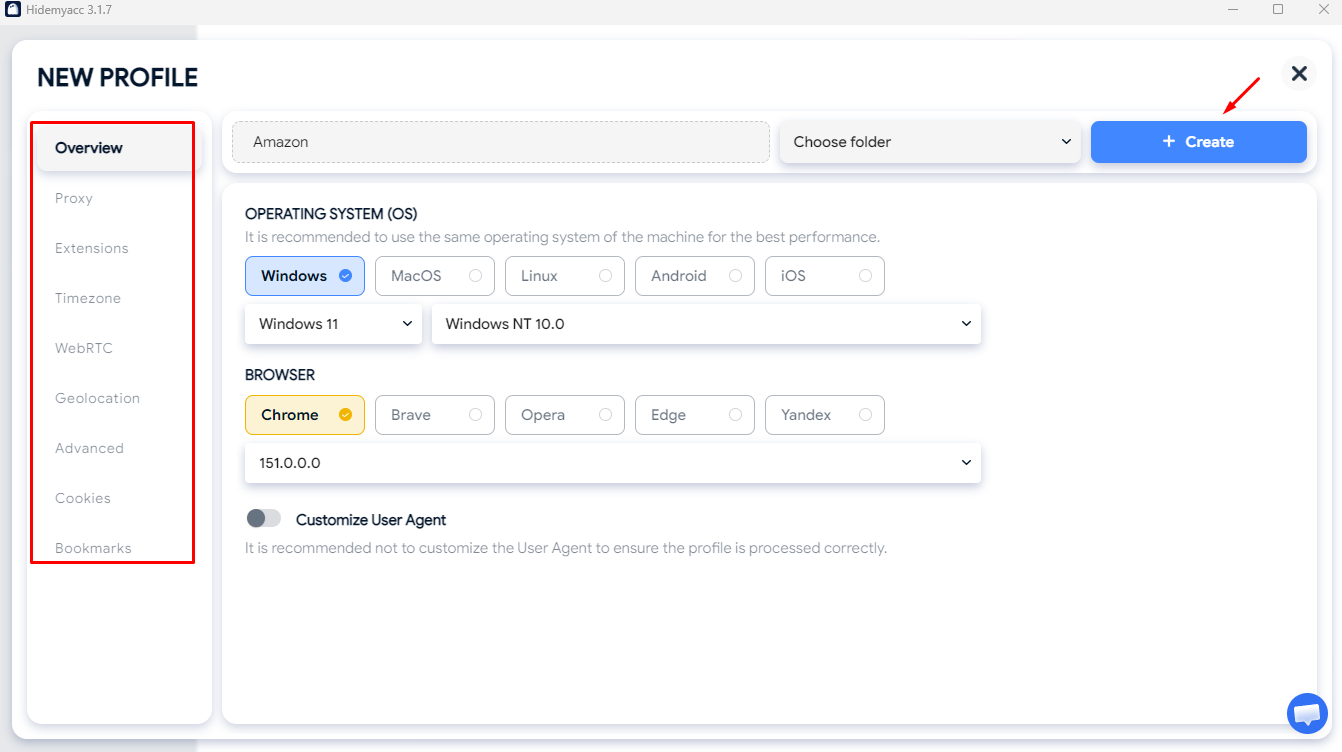
A practical setup can be implemented in four steps:
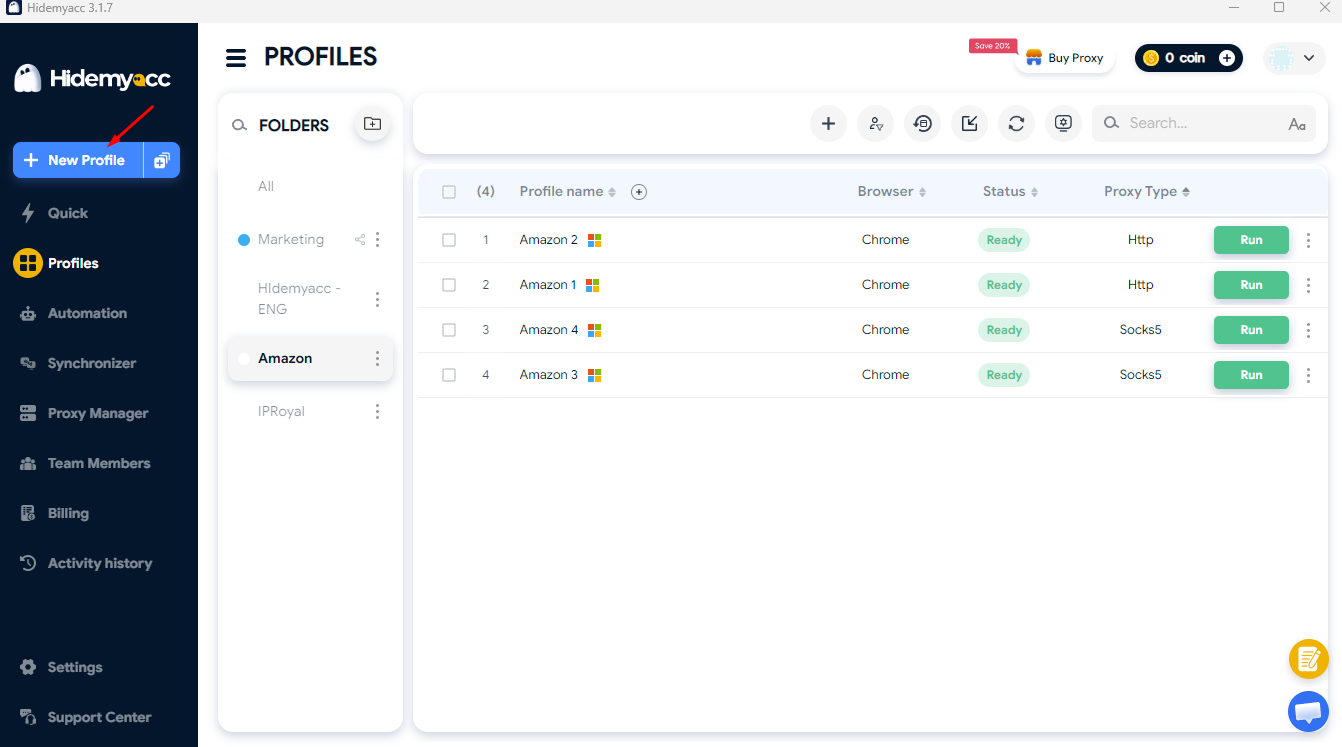
Step 1: Create One Browser Profile Per Account
Download and install Hidemyacc on your computer, then create a new browser profile by selecting New Profile.
Assign each Amazon seller account to its own profile instead of managing multiple accounts from the same browser profile.
Step 2: Assign a Separate Network Connection Per Profile
Assign a separate and stable network connection to each profile according to the business's operational requirements.
The important point is to keep the configuration consistent rather than repeatedly switching between unrelated network environments when managing the same account.
Step 3: Restrict Profile Access by Team
Profile access should be limited to the employees responsible for that account.
This can include the account owner, relevant operations staff, and approved managers. Restricting access reduces accidental logins to the wrong account and makes responsibilities easier to track.
Step 4: Keep One Fixed Profile Per Account
Once a browser profile has been assigned to an account, keep that relationship consistent throughout ongoing operations.
Employees should avoid switching between profiles when moving between accounts or using whichever profile happens to be available.
The operating principle is simple: one seller account, one designated browser profile, and one defined team workflow.
This setup supports consistent account management and access control. It should be used as part of a compliant operating system, not to bypass Amazon's policies or conceal unauthorized accounts.
Watch this video for a detailed guide on how to register as an Amazon seller:
7. Key considerations when scaling the system
Once the multi-account system is in place, keep these considerations in mind as the business expands:
- Maintain technical separation: Keep each account's browser profile and network environment consistent throughout ongoing operations.
- Track performance independently: Use centralized reporting while maintaining separate KPIs for each seller account.
- Standardize team training: Train employees with the same SOPs for recurring tasks such as listings, inventory, customer service, and reporting.
- Reassess the organizational model: Review the structure as the number of accounts, employees, brands, or markets changes.
- Document and archive SOPs: Keep procedures centralized, updated, and easy for the team to access.
- Weigh operating costs: Consider staffing, inventory, customer service, tools, and management costs before adding another account.
- Assign a backup owner: Every seller account should have a documented backup owner who can maintain essential operations when the primary owner is unavailable.
- Expand sequentially: Add accounts gradually rather than opening several simultaneously. Stabilize the system after each expansion before moving to the next account.
The goal is to scale the number of seller accounts without allowing operational complexity to grow faster than the business can manage.
8. Conclusion
Effective Amazon multi-seller scaling is not simply about managing more seller accounts. It is about building a reliable operating system behind them.
With clear account ownership, standardized workflows, centralized reporting, controlled access, and consistent operating environments, businesses can expand their seller operations without creating unnecessary complexity.
Build the system first, then scale the accounts.
Read more:
- Why is your Amazon account locked? 3 tips to unlock it
- How to master Amazon SEO and increase your product visibility\=
9. FAQ
1. Does Amazon allow multiple seller accounts?
Amazon allows sellers to operate more than one account when there is a legitimate business reason and the accounts comply with Amazon's policy. This article focuses on operational scaling, while the complete legal and policy explanation is covered in the dedicated policy guide.
2. Which model should sellers choose when they first start scaling?
Sellers starting with a small number of accounts usually benefit from the brand-based or market-based model because ownership boundaries are clear. The operations-team model becomes more valuable once multiple staff members are involved.
3. What's the difference between multi-accounting and multi-seller scaling?
Multi-accounting simply means operating more than one Amazon seller account. Multi-seller scaling goes further by introducing standardized workflows, ownership, reporting systems, and isolated operating environments that allow the business to grow without creating operational bottlenecks.
4. How many accounts justify building a formal system?
There is no universal number, but many businesses begin formalizing their operations once they manage around three or more seller accounts. At that stage, centralized reporting and documented SOPs usually become more effective than manual management.
5. Does each account need its own dedicated team?
Not necessarily. The priority is assigning a clearly identified owner to every account. One team can successfully manage multiple seller accounts as long as responsibilities and reporting are standardized.
6. What tools help manage multiple accounts effectively?
Beyond centralized reporting, tools that create separate browser profiles for each seller account help isolate operating environments. Combined with documentation, delegated access, and KPI dashboards, they support sustainable multi-seller scaling.