Looking to gather prices, tags, customer reviews, or sales volume across thousands of Etsy listings for product research, but finding manual transcription far too slow? Etsy scraping allows you to automate this data pipeline; however, each technical approach carries specific engineering constraints and ban risks. This guide compares 5 popular methods—from official APIs and no-code tools to custom Python scripts, browser automation, and commercial scraping APIs—to help you select the right solution for your operational scale.
1. What is Etsy scraping and what data points can you collect?
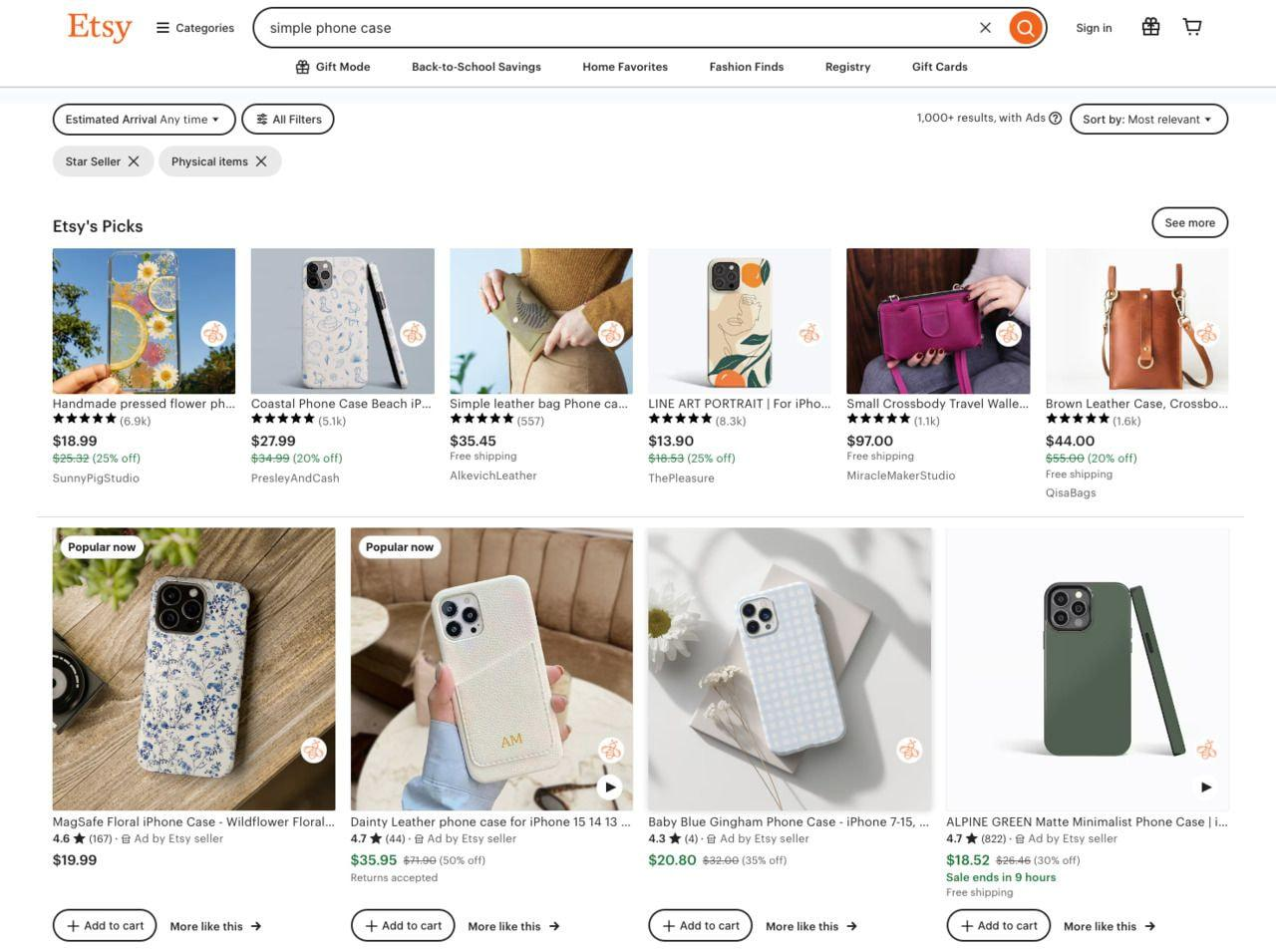
Etsy scraping is the process of programmatically extracting publicly accessible data from Etsy pages using dedicated software or scripts rather than copying information by hand. Through automated extraction, you can pull comprehensive intelligence from individual listings, shop storefronts, or search result feeds into consolidated files for downstream analysis.
Data points you can extract from Etsy
Depending on your tooling and method, available data attributes vary. Common target datasets include:
- Product Attributes: Title, listing URL, high-resolution media URLs, item description, category taxonomy, and listing tags.
- Pricing Metrics: Base retail price, sale or discounted price, and currency denomination.
- Customer Feedback: Total review count, aggregate star rating, and public review text. Certain reviews display customer usernames or account identifiers—personal data points that require privacy compliance considerations discussed in the legal section.
- Storefront Data: Shop name, total active inventory count, seller location, and publicly visible storefront details.
- Search and Ranking Data: Keyword search placements, category breadcrumbs, applied filter parameters, and organic listing ranks.
How is Etsy data used?
Extracted Etsy data typically supports:
- Niche and Product Discovery: Identifying trending items, high-performing tags, and emerging search interest within target niches.
- Price Tracking and Competitor Benchmarking: Monitoring competitor pricing strategies, inventory velocity, and catalog updates.
- Listing Optimization: Analyzing titles, descriptive tags, and recurring keywords across top-ranking competitor listings.
- Trend and Sentiment Analysis: Aggregating historical review data over time to pinpoint buyer pain points and product gaps.
Different business objectives demand different technical architectures. Depending on your data volume and required operational control, review the available methods below to choose the most suitable path forward.
Learn more: Web Scraping 101: How it works and practical applications
2. Extracting Etsy data using the official API
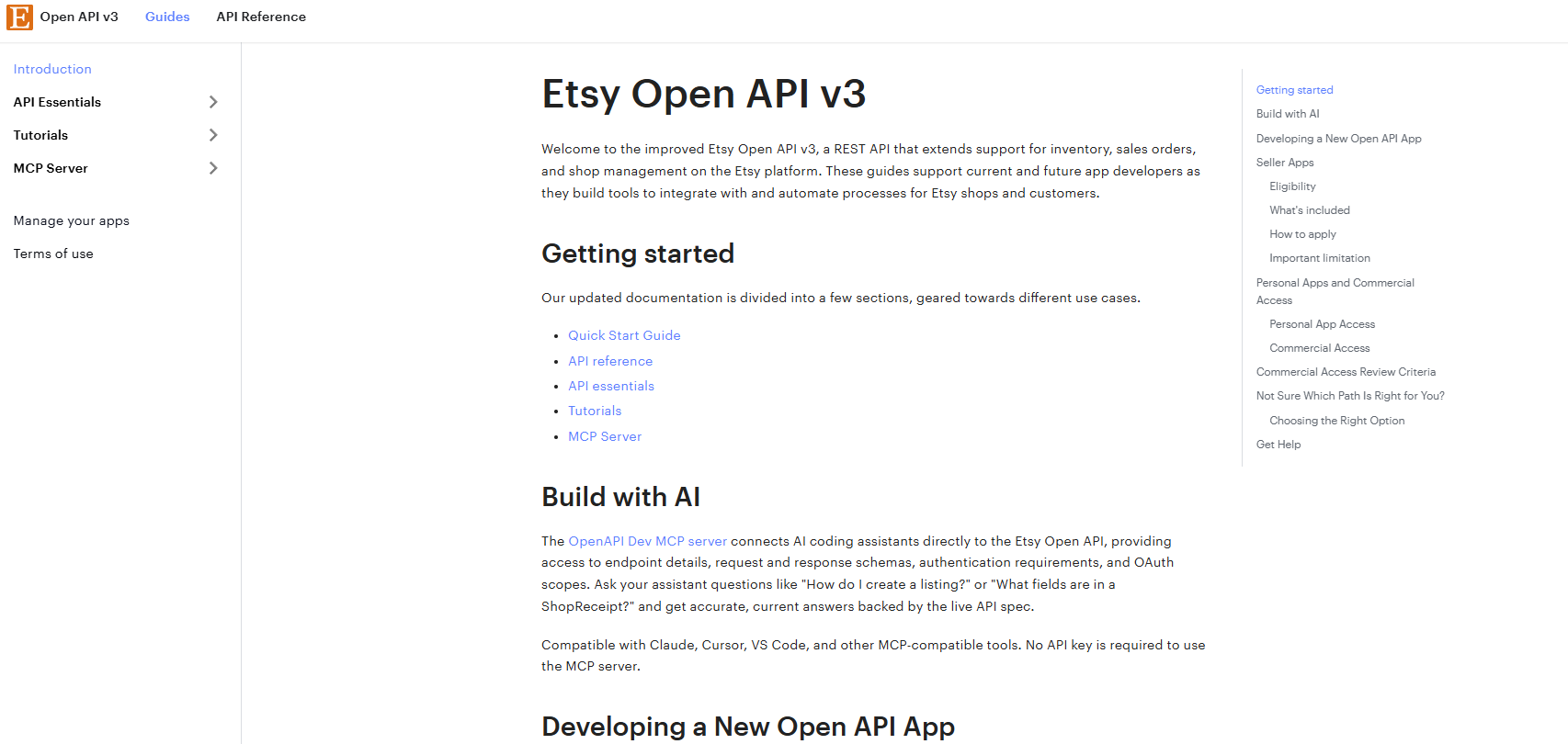
The Etsy Open API v3 serves as the official integration pathway for applications to connect with Etsy and ingest structured data across sanctioned endpoints. Rather than parsing rendered web pages manually, your software queries the API and receives validated payloads within its approved permission scope.
Think of the API as a standardized bridge between your application and Etsy. You request specific resource models, and the API returns structured data defined by your endpoint access and application approval tier.
Available data
The Etsy API provides endpoints covering listing metadata, shop profiles, and related transaction details depending on your application permissions. Actual data access depends on active API schemas, your registered developer tier, and Etsy's platform terms.
Pros
- Standardized, structured data schemas that eliminate custom parsing.
- Significantly lower risk of IP blocks compared to parsing front-end web pages directly.
- Fully compliant official channel sanctioned by Etsy.
Cons
- Requires formal developer registration, app review, and access permission setup.
- Enforces strict rate limits per application, including daily quotas and per-second request limits at the API key level.
- Scaling to higher usage tiers requires submitting formal quota increase requests to Etsy.
- Not all front-end marketplace data points (such as complex buyer signals) are exposed via API endpoints.
Best suited for
The official Etsy API is ideal for merchants managing their own shop catalogs or analytics teams requiring stable, compliant data pipelines. If your goal is simply scraping a small batch of external listings for exploratory research, no-code scraper extensions may prove far simpler to implement.
For teams requiring custom data access without managing formal developer approvals, no-code web scrapers offer an accessible alternative.
3. No-code Etsy data scraping tools
Not every research workflow requires writing custom Python scrapers. For product discovery, competitor monitoring, or scraping reviews across selected listings, visual no-code tools accelerate your timeline. Typically, you only need to input target keywords or listing URLs, select target attributes, and export the structured results.
3.1 Apify
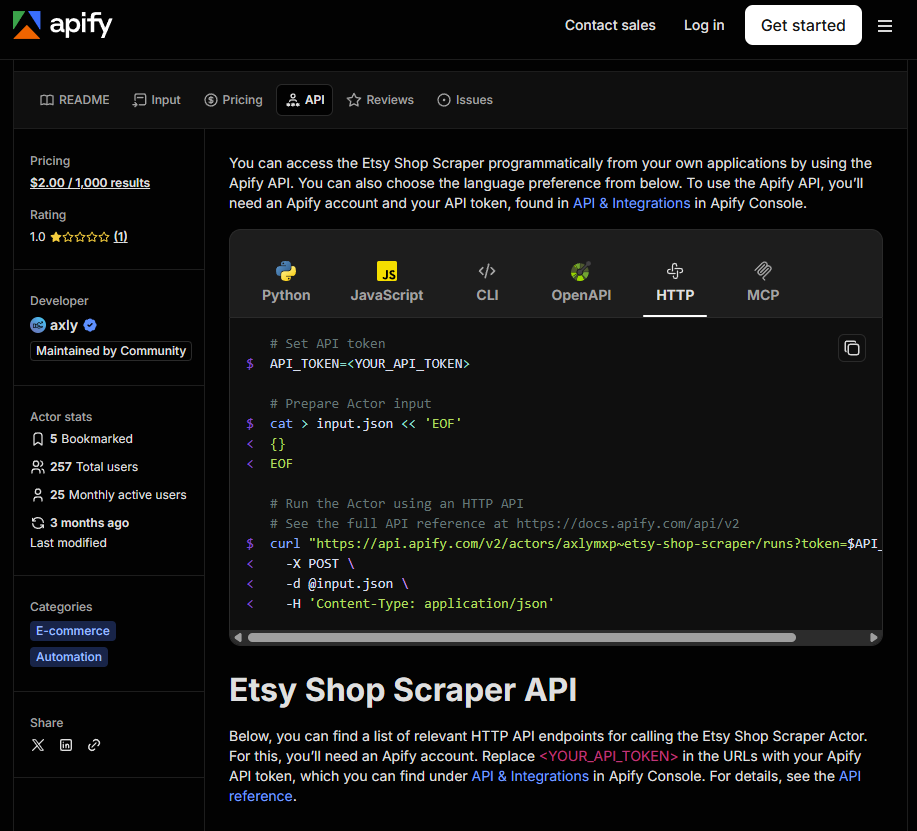
Apify hosts an extensive marketplace of turnkey Etsy scrapers (called Actors) tailored to diverse data extraction tasks. You can deploy ready-made Actors to scrape data by search terms, shop handles, individual listings, or review feeds without maintaining crawler code.
Many Actors support automatic pagination, data filtering, and result sorting. Certain modules interface with the Etsy Open API v3, while others scrape rendered web pages directly with integrated proxy configurations.
Pros
- No custom script development required.
- Wide variety of specialized Actors targeting different page types.
- Select Actors include proxy management, custom filtering, and pagination handling.
- Direct dataset exports to JSON, CSV, or Excel formats.
Cons
- Actors are authored by independent developers, leading to varying code quality and output schemas.
- Sudden Etsy front-end updates can break selectors until the author issues a patch.
- Certain modules only extract search feeds or specific subsets of product data.
- Review datasets may capture personal user identifiers requiring careful data handling.
Best suited for
Apify is practical for teams wanting to extract Etsy data without engineering an in-house scraping stack. Sellers and product analysts can run targeted extractions on demand and scale into scheduled runs once workflows prove reliable.
3.2 Web Scraper
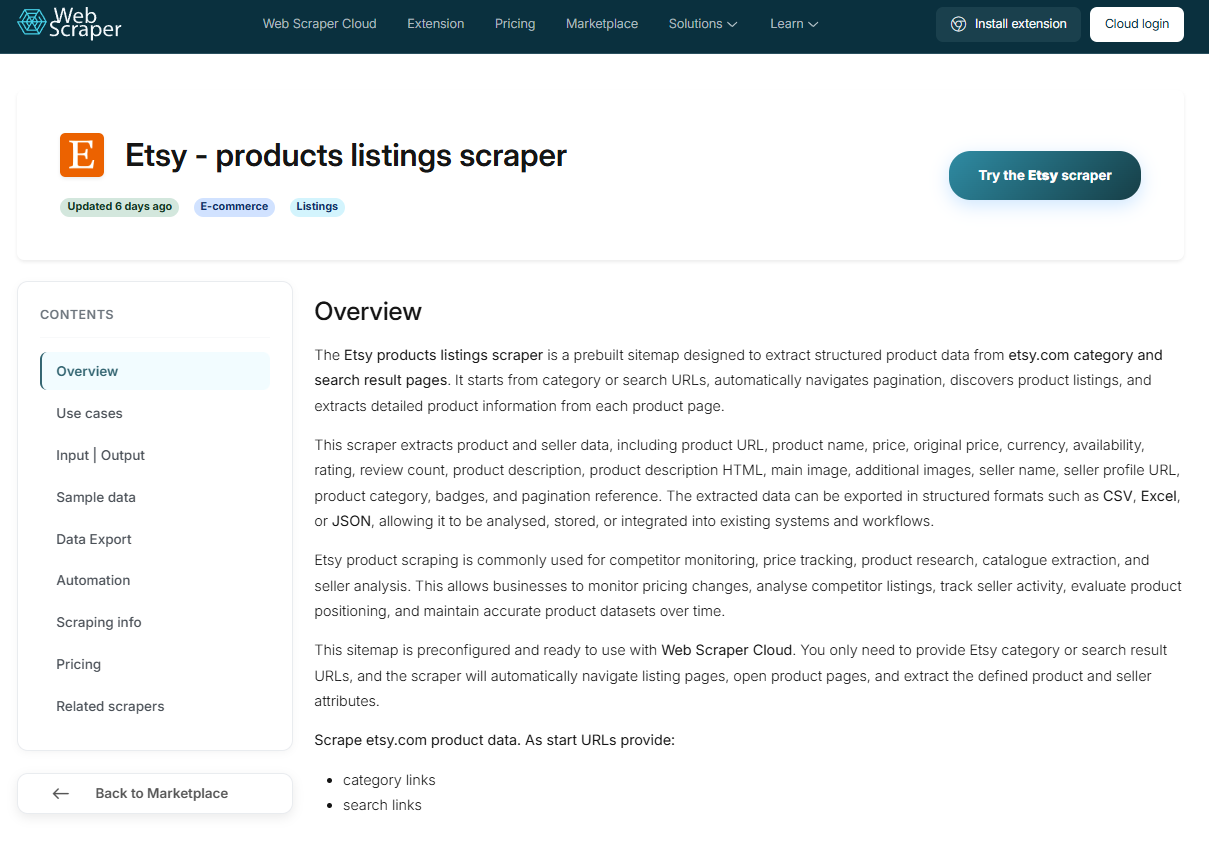
Web Scraper provides a visual browser extension template designed for the Etsy Marketplace, extracting product attributes through a point-and-click interface without code. You configure a sitemap, enter category or search URLs, and define navigation selectors across paginated pages.
Available fields include product titles, canonical URLs, current prices, original retail prices, currency, inventory availability, star ratings, review tallies, descriptions, image URLs, seller handles, shop names, and category breadcrumbs.
Pros
- Visual interface requiring zero coding expertise.
- Pre-mapped selectors for standard product fields.
- Direct data exports to CSV, Excel, and JSON.
- Captures associated seller and shop metadata alongside product fields.
Cons
- Less architectural flexibility compared to custom Python scrapers.
- Requires manual sitemap adjustments whenever target layouts change.
- Certain dynamic JavaScript components and anti-bot challenges can interrupt high-volume browser-based extraction.
Best suited for
This extension fits non-developers needing to extract standard product catalogs through a desktop browser. For projects requiring custom post-processing logic or dynamic request routing, Python scripts provide greater architectural control.
3.3 Etsy Reviews Extractor (Chrome Extension)
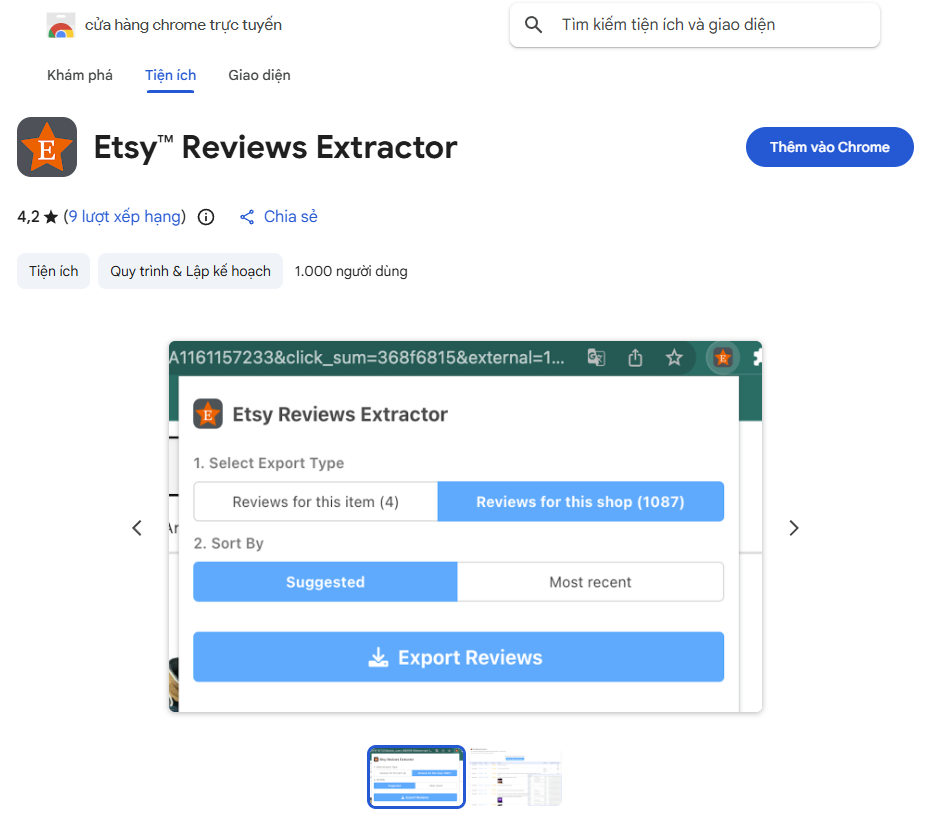
Etsy Reviews Extractor is a specialized Chrome extension dedicated to pulling review data from individual listing pages. Rather than deploying full-site crawlers, analysts use this tool when the sole requirement is analyzing buyer feedback and sentiment for specific items.
Extracted records include reviewer usernames, star ratings, feedback text, attached review images, publication dates, and listing IDs. Datasets export cleanly to CSV, JSON, or XLSX files.
Pros
- Minimal setup with immediate one-click extraction.
- Laser-focused on customer review datasets.
- Built-in AI-powered review summarization features.
- Flexible export options for spreadsheet analysis.
Cons
- Limited to single-listing parsing rather than catalog-wide crawling.
- Unsuitable for bulk search ranking or category extraction.
- Captured review feeds often contain personal usernames requiring compliance hygiene.
Best suited for
This extension serves researchers and merchants analyzing customer sentiment on targeted listings to improve product positioning. For harvesting thousands of items across full categories, broader scraping solutions are necessary.
3.4 EtsyHunt and eRank (Research Platforms, Not Scrapers)
Market intelligence does not always necessitate running custom scrapers. Analytics platforms like EtsyHunt and eRank focus on pre-aggregated product research, keyword tracking, and demand analytics, fulfilling research requirements without requiring raw extraction pipelines.
EtsyHunt specializes in catalog performance tracking and product discovery. eRank concentrates on SEO keyword search volume, tag optimization, and competitive visibility.
If your sole goal is finding viable products or evaluating search volume, these platforms eliminate the operational overhead of web scraping. However, when you require raw, unaggregated datasets for custom internal databases, a dedicated scraper remains essential.
Read more: Etsy Automation: Top 15 tools you should try
4. Scraping Etsy with Python (Requests and BeautifulSoup)
When you require custom data transformation and pipeline ownership, Python provides far greater flexibility than off-the-shelf software. Pairing the Requests library with BeautifulSoup allows developers to fetch listing pages, parse target HTML nodes, and output structured records.
Implementation workflow
First, define target URLs and identify required fields such as product titles, current prices, descriptions, or review metrics. The Requests library dispatches HTTP GET calls to the target listing, while BeautifulSoup navigates the DOM tree to isolate target elements.
Conveniently, significant portions of Etsy listing metadata are embedded directly inside HTML script tags as JSON-LD objects. Extracting this structured JSON payload is far more resilient than parsing volatile front-end CSS selectors.
The code snippet below demonstrates dispatching a request to an Etsy listing and parsing embedded JSON product data:
import json
import requests
from bs4 import BeautifulSoup

url = "https://www.etsy.com/listing/LISTING_ID"
headers = {"User-Agent": "Mozilla/5.0 (Windows NT 10.0; Win64; x64) AppleWebKit/537.36 (KHTML, like Gecko) Chrome/120.0.0.0 Safari/537.36"}

response = requests.get(url, headers=headers, timeout=10)
soup = BeautifulSoup(response.text, "html.parser")

# Locate script tags containing structured JSON product data
tag = soup.find("script", string=lambda s: s and '"offers"' in s)
data = json.loads(tag.string) if tag else {}

print("Title:", data.get("name", "N/A"))
print("Price:", data.get("offers", {}).get("price", "N/A"))
Operational considerations for raw HTTP requests: Etsy frequently returns 403 Forbidden errors or CAPTCHAs upon detecting automated request patterns. Start with individual listing URLs first, as product pages often embed static JSON within HTML, whereas search pages frequently require client-side JavaScript rendering. When scaling, your script must handle pagination states and missing data fields gracefully.
Pros
- Complete control over target fields, request cadence, and data pipelines.
- Customizable architecture tailored to specific project requirements.
- Integrates easily with Pandas, databases, and visualization tools.
Cons
- Requires proficiency in Python and HTML parsing.
- Vulnerable to 403 blocks and anti-bot CAPTCHAs upon unthrottled execution.
- Layout adjustments on Etsy can invalidate custom CSS selectors without notice.
- Handling pagination and schema exceptions requires proactive code maintenance.
Best suited for
Python is optimal for developers requiring custom control over Etsy extraction. For small datasets, you can start with a handful of listings, validate output schemas, and incrementally add pagination, proxy rotation, and retry handlers.
5. Scraping Etsy with browser automation frameworks
When static HTTP requests fail or target elements require JavaScript execution to hydrate, automated headless browsers become necessary. The three standard frameworks are Playwright, Selenium, and Puppeteer. These libraries simulate real browser sessions, making them ideal for scraping dynamic, client-rendered interfaces.
Playwright, Selenium, and Puppeteer
While differing in their underlying driver architectures, all three operate by driving real browser engines. Your script opens an active browser window, waits for dynamic DOM elements to render completely, and extracts data from the live document rather than parsing raw network strings.
- Playwright: Modern framework supporting multi-browser architectures with built-in auto-waiting mechanisms, well-suited for dynamic web components.
- Selenium: Long-standing industry standard supporting diverse programming languages and legacy enterprise testing infrastructure.
- Puppeteer: Maintained primarily for Chromium environments, providing deep integration for Node.js development stacks.
Pros
- Fully renders dynamic content driven by complex client-side JavaScript.
- Emulates genuine browser interactions far more accurately than raw HTTP requests.
- Integrates with custom proxies, cookie storage, and multi-tab workflows.
Cons
- Significantly higher CPU and RAM consumption compared to lightweight HTTP scripts.
- Slower scraping throughput due to full page and asset rendering.
- Default automation flags (such as navigator.webdriver) can still be fingerprinted by anti-bot firewalls.
- Running concurrent headless instances requires dedicated system resource management.
When orchestrating multiple concurrent browser instances, environmental isolation is paramount. IP addresses, cookies, and browser fingerprints must remain strictly separated to prevent platforms from linking concurrent sessions running on a single host.
Pairing browser automation with Hidemyacc
When scaling Etsy scraping, engineering challenges extend beyond parsing HTML or executing JavaScript. Running multiple browser instances from a single unmasked environment leads to correlated fingerprints, shared local storage, and rapid IP flagging. This is where the antidetect browser Hidemyacc provides a dedicated management layer.
Hidemyacc allows you to create independent browser profiles, each configured with isolated hardware fingerprints, local cookie jars, and dedicated proxy assignments. This architecture isolates every extraction worker completely.
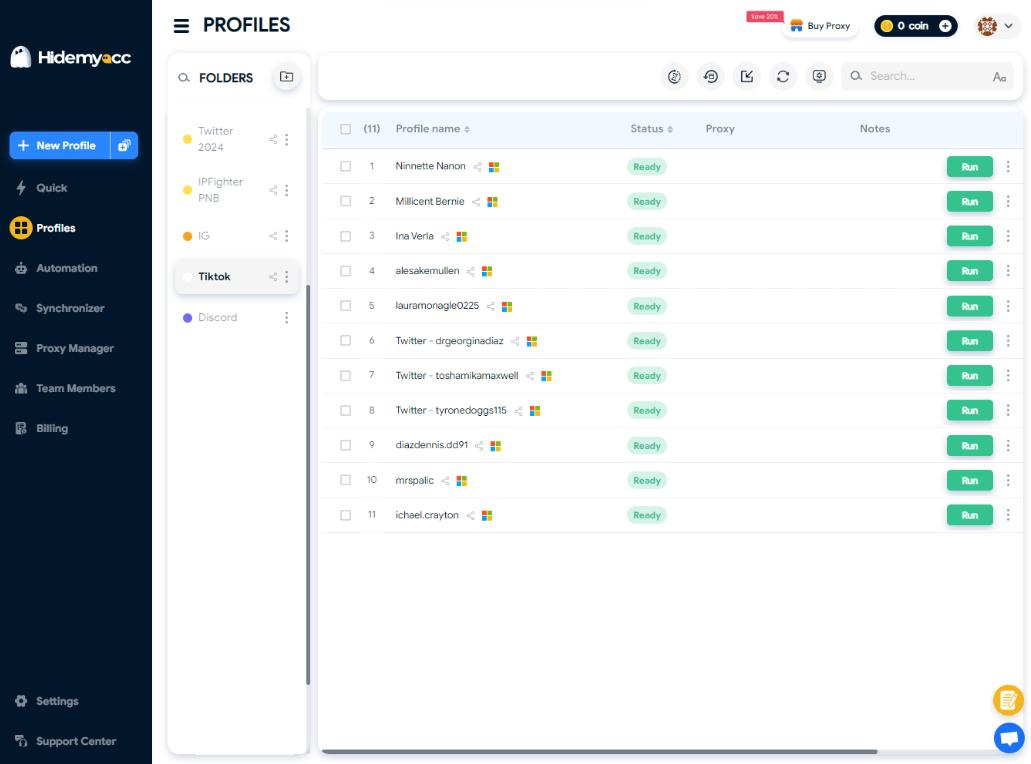
Browser profile management console inside Hidemyacc.
A production-ready Etsy scraping workflow operates as follows:
- Profile Provisioning: Generate dedicated browser profiles for each scraping session.
- Proxy Assignment: Bind high-quality residential proxies to individual profiles for IP isolation.
- Automation Integration: Connect Playwright or Puppeteer to running profiles via local Chrome DevTools Protocol (CDP) debugging ports.
- Data Extraction: Execute scripts to parse listings, pricing tables, tags, and review fields within the masked environment.
- Validation and Scaling: Test workflows on a small sample, monitor platform response codes, and scale concurrency gradually.
Importantly, Hidemyacc does not replace your scraping logic: Playwright or Puppeteer continues to handle page navigation and data extraction, while Hidemyacc delivers isolated, natural browser environments for each worker thread. This hybrid approach is ideal for teams running concurrent multi-profile extraction pipelines.
However, using an antidetect browser does not grant total immunity from bot detection. You must still enforce request throttling, randomize interaction intervals, manage proxy health, and pace collection volumes responsibly.
Related reading:
- What is an antidetect browser? Why it outperforms basic VPNs and proxies
- Antidetect browsers for web scraping: Top tools for 2026
6. Commercial scraping API services
When extraction requirements reach enterprise volumes and managing local proxy rotation, JavaScript hydration, or CAPTCHA challenges becomes unfeasible, commercial scraping APIs offer a turnkey alternative. Rather than engineering crawler infrastructure, you send target URLs or keywords to an API endpoint, and the provider handles proxy rotation, unblocking, and parsing server-side.
6.1 Bright Data
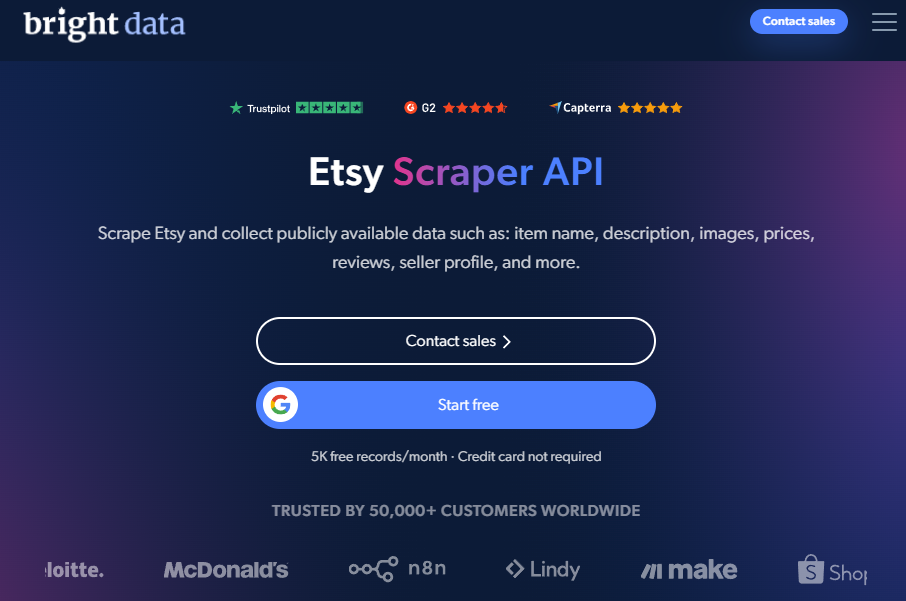
Bright Data offers three dedicated Scraper API endpoints engineered specifically for Etsy: product URL extraction, keyword search queries, and shop storefront parsing. Delivered payloads include titles, prices, shop names, specifications, variant models, shipping/return policies, aggregate ratings, and featured reviews. Pre-collected Etsy datasets are also available off-the-shelf.
Pros
- Three specialized endpoints covering listings, search queries, and shop pages.
- Clean, pre-parsed JSON payloads eliminating custom selector maintenance.
- Pre-aggregated historical datasets available for immediate ingestion.
Cons
- Requires familiarity with RESTful APIs and JSON data ingestion.
- Introduces external vendor reliance into your technical stack.
- Cost-prohibitive for small, ad-hoc data collection tasks.
Best suited for
Bright Data is built for enterprise operations requiring high-throughput, recurring Etsy data. If you are building broad e-commerce intelligence systems, turnkey APIs and ready-made datasets drastically reduce internal DevOps overhead.
6.2 Oxylabs
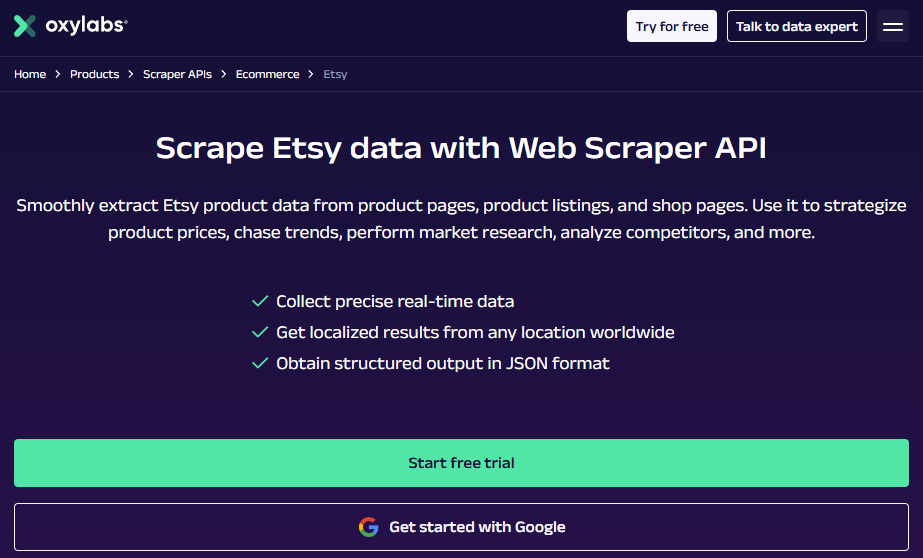
Oxylabs features a dedicated Etsy Scraper inside its E-Commerce Scraper API, combining unblocking technology with global residential proxy networks. You submit target requests via API and receive normalized JSON data ready for direct insertion into your data warehouse.
Extracted fields include product titles, prices, currency, media URLs, category paths, seller ratings, shipping locations, and inventory availability. The API supports custom parameters for geo-targeting, User-Agent emulation, and device profiles.
Pros
- Comprehensive technical documentation with dedicated Etsy code samples.
- Standardized, pre-parsed JSON response schemas.
- Integrated residential proxy routing managed by a single vendor.
Cons
- Requires field schema verification against target project specs prior to launch.
- Subject to enterprise usage minimums and vendor API rate limits.
- Overkill for monitoring a few dozen listings.
Best suited for
For organizations looking to focus on data analytics rather than proxy rotation and crawler maintenance, Oxylabs handles unblocking and infrastructure. This approach works particularly well for teams with mature downstream ETL pipelines.
6.3 ScraperAPI
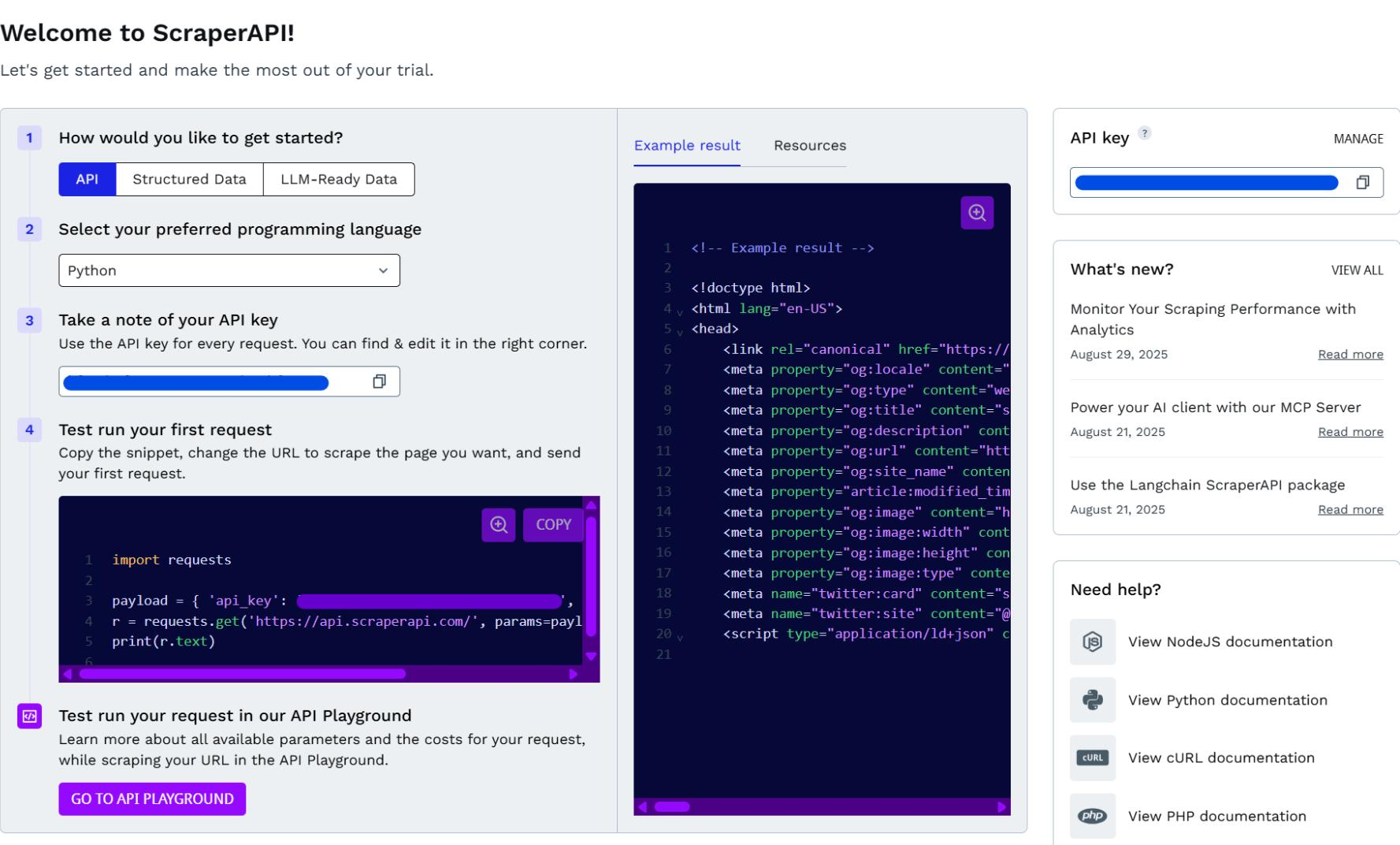
ScraperAPI delivers a straightforward unblocking proxy interface. You pass target Etsy URLs through their API gateway, and the service handles IP rotation, request headers, and browser rendering, returning raw HTML for downstream parsing.
The platform provides Python integration guides for Etsy and supports geographic targeting, custom headers, and automated CAPTCHA solving server-side.
Pros
- Simple implementation requiring only a gateway URL wrapper.
- Step-by-step Python integration guides for Etsy.
- Multi-platform utility suitable for scraping multiple e-commerce domains.
Cons
- Returns raw HTML, requiring you to maintain custom parsing logic. Example CSS selectors may break if Etsy updates its layout.
- Unsuited for complex workflows requiring account authentication or interactive forms.
- Granular country targeting may require higher-tier plans.
Best suited for
ScraperAPI fits developers comfortable with Python who want to retain custom parsing logic while offloading proxy management and CAPTCHA solving to an unblocking gateway.
6.4 Scrapfly
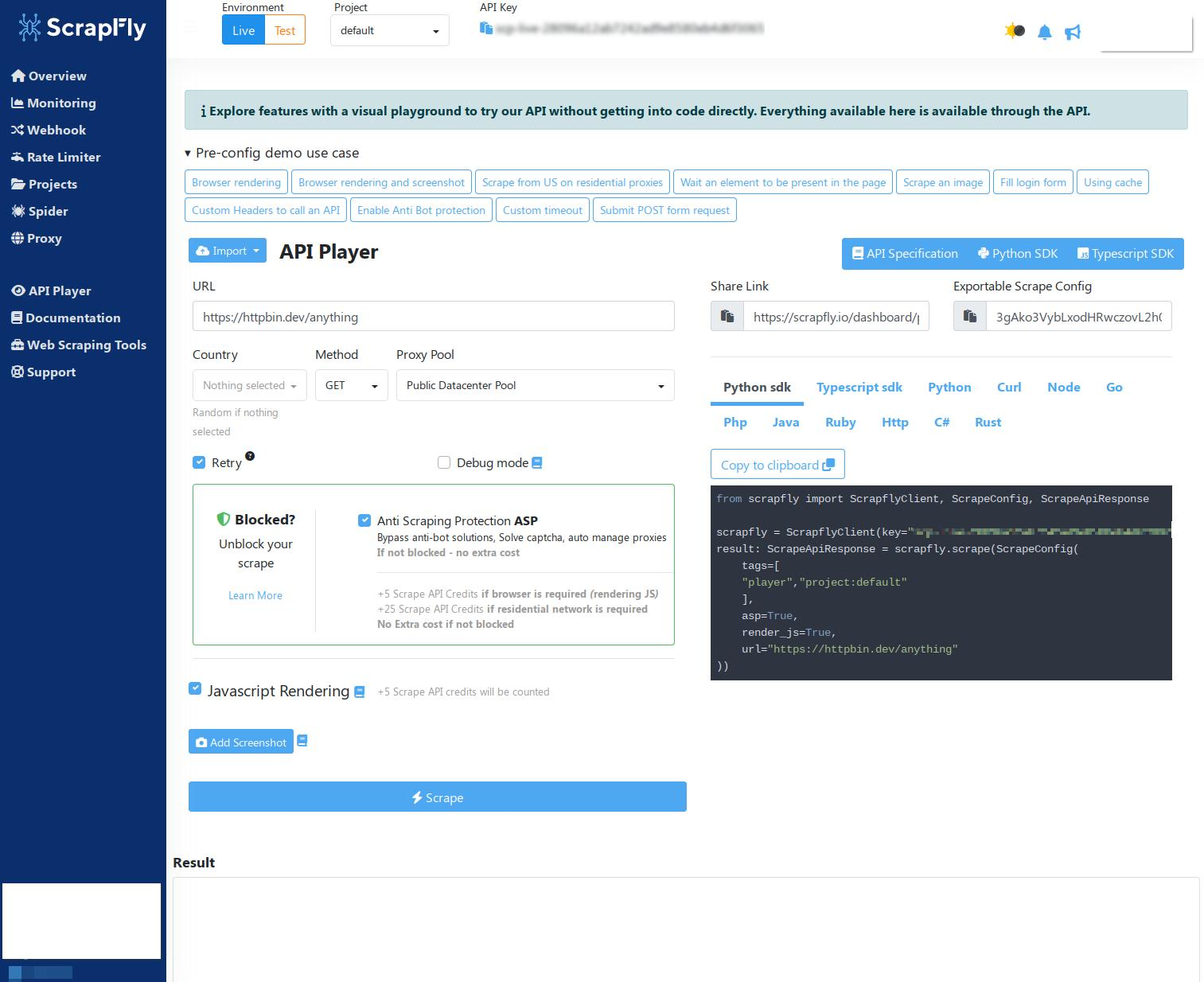
Scrapfly provides a developer-centric web scraping API featuring residential proxy rotation, anti-bot mitigation, and cloud headless browser rendering. They provide Python tutorials specifically for Etsy extraction, making it straightforward to embed into existing scrapers.
You submit target Etsy URLs via API, specify rendering options (such as JavaScript execution), and receive rendered HTML or pre-parsed content. Scrapfly also provides multi-language SDKs for modern development environments.
Pros
- Built-in anti-bot bypass and JavaScript rendering.
- Multi-language SDKs with practical Etsy code implementations.
- Granular country-level IP geolocation selection.
Cons
- Cost per request increases when enabling anti-bot features, JavaScript rendering, and residential proxies.
- Entry-level subscription tiers cap simultaneous concurrency.
- Developers must still maintain data cleaning and normalization logic.
Best suited for
Scrapfly is ideal for developers who maintain custom scrapers but want to offload proxy infrastructure, anti-bot solving, and headless rendering. The API handles underlying network complexities while leaving data transformation logic in your control.
6.5 Comparing Etsy scraping APIs
These commercial services adopt distinct architectural approaches. The comparison table below highlights their key functional differences:
| Tool | Turnkey Etsy Scraper | API Access | Proxy Integration | Implementation Ease | Best Suited For |
|---|---|---|---|---|---|
| Bright Data | ✓ (3 dedicated endpoints) | ✓ | Included residential pools | Moderate | Enterprise scale, broad data field coverage |
| Oxylabs | ✓ (E-Commerce Scraper) | ✓ | ✓ (Residential proxies) | Moderate | Teams requiring unified API and proxy sourcing |
| ScraperAPI | ✓ (Dedicated endpoint returning raw HTML) | ✓ | ✓ (Automated IP rotation) | Easy | Developers wanting fast setup with custom HTML parsing |
| Scrapfly | Guides available | ✓ | ✓ (Residential proxies included) | Moderate | Developers running resilient custom crawlers |
For small datasets, simple Python scripts or visual no-code tools are generally sufficient. For high-volume harvesting, scraping APIs remove proxy maintenance, JavaScript hydration, and unblocking challenges at scale.
7. High-level comparison: 5 Etsy scraping methods
Each scraping method presents distinct operational trade-offs. The official API delivers structured data and compliance, while custom Python and headless browsers provide granular control. No-code tools serve simple ad-hoc tasks, and commercial APIs remove engineering friction at enterprise scale.
| Method | Setup Difficulty | Anti-Bot Resilience | Long-Term Stability | Target Scale | Compliance Level |
|---|---|---|---|---|---|
| Official API (Etsy Open API v3) | Low | Not applicable (sanctioned access) | High (if account remains compliant) | Shop owners, compliant enterprise apps | High (under API terms) |
| No-Code Tools | Low | Tool-dependent | Moderate (relies on author maintenance) | Small to medium | Review platform terms |
| Python (Requests + BeautifulSoup) | High | Low (vulnerable to anti-bot firewalls) | Low (breaks upon DOM shifts) | Small projects | Review platform terms |
| Browser Automation | High | Moderate (requires profile isolation) | Moderate | Dynamic JavaScript pages, concurrent workers | Review platform terms |
| Scraping API Services | Low to Moderate | Moderate to High (vendor-dependent) | Moderate to High | Enterprise scale | Review platform terms |
Choosing by operational scale
- Dozens of listings: A visual no-code extension or basic Python script is completely adequate for ad-hoc product research, price audits, or listing comparisons.
- A few thousand listings: Python or headless browser frameworks give you complete ownership over data schemas and pipelines. For recurring jobs, commercial scraping APIs are worth evaluating.
- Tens of thousands of listings: Turnkey scraping APIs or distributed headless browser clusters are required to manage concurrency and bypass network blocks reliably.
- Data covered by Etsy Open API: If the official API exposes the specific fields you need and your application qualifies, always prioritize official endpoints over custom scrapers.
Scale is only one dimension. Consider target data fields, extraction frequency, technical skills, and required pipeline control before settling on an architecture.
8. Best practices for scraping Etsy safely and avoiding blocks
Etsy deploys automated access controls to identify abnormal traffic patterns. Firing unthrottled requests or orchestrating concurrent instances from unmasked environments can result in Etsy account suspensions and IP blocks. Follow these four operational best practices to prevent disruptions:
Etsy enforces automated rate controls. High-frequency bursts often trigger CAPTCHAs, 403 Forbidden errors, or network-level IP bans. Apply these practices to keep extraction running smoothly:
- Understand how Etsy detects automated traffic: IP reputation, browser fingerprints, request velocity, and interaction timing all act as telemetry signals alongside cookies and active sessions. Search feeds typically enforce stricter bot protections than individual listing URLs, and some tools target category URLs instead of search feeds. Start with product listings or category pages, pace request frequency, and test small batches first.
- Select quality proxies and avoid free IP pools: Low-grade public proxies or recycling a single IP across all requests lead to rapid blacklisting. Use clean residential or mobile proxies.
- Maintain consistent fingerprints and sessions: When running browser automation, ensure your User-Agent, OS identifiers, and timezone match the proxy's geographic location. When orchestrating parallel workers, isolate each session in its own browser profile as outlined in Section 5.
- Review platform terms and legal considerations: Platform policies regarding automated access vary: Etsy's Terms of Use restrict unauthorized scraping, while public data collection has received distinct treatment under various legal jurisdictions. Review Etsy's Terms of Use and robots.txt file prior to deployment. Avoid extracting or storing personal identifiers (such as reviewer names) and never use scraped datasets to replicate sellers' proprietary designs. This guide does not constitute legal counsel; consult legal counsel for commercial operations.
Validating extraction logic on small datasets before scaling ensures data quality and helps you catch formatting errors before processing thousands of records.
See more: Top Etsy proxy providers for managing multiple accounts in 2026
9. Common pitfalls when scraping Etsy data
Scraping failures often stem from architectural missteps rather than syntax bugs. Avoid these three common mistakes to protect accounts and ensure clean data:
- Scraping while logged into your primary seller account: If an automated scraper triggers security flags while authenticated, your primary store faces suspension risks. Always scrape unauthenticated or use dedicated research accounts.
- Scaling immediately while relying on fragile CSS classes: Test scrapers on a small batch of listings first. Prioritize embedded structured JSON payloads over volatile CSS selectors, save raw intermediate outputs, and validate records for duplicates or empty fields before analysis.
- Using a single extraction method for every page type and scale: Listing pages, search feeds, shop storefronts, and review tabs enforce different anti-bot measures. Match your technical method to the target page type using the matrix in Section 7 rather than forcing one tool across all jobs.
Avoiding these issues early saves engineering time and prevents having to re-scrape datasets due to missing or corrupted fields.
10. Conclusion
Scraping Etsy does not require building complex crawler architectures from day one. The key is identifying required data fields, project volume, and your team's technical capacity. From there, select the appropriate route among official APIs, visual no-code tools, custom Python scripts, headless browsers, or managed scraping APIs.
For dozens of listings, simple Python scripts or browser extensions easily suffice. When harvesting thousands or tens of thousands of listings, choosing an architecture with proper unblocking and concurrency management prevents pipeline failures.
Regardless of your method, start with small batches, audit data quality, and clarify your analytical objectives before expanding. Once stable, scale your collection pipeline to power product research, price monitoring, or broader Etsy market intelligence.
Related reading:
- Top 30+ digital products to sell on Etsy
- Can you run multiple Etsy shops? A practical guide
- How to scrape eBay data like a pro
- How to scrape the Instagram Explore page: Essential tools and tips
- Amazon scraper: Comparing popular data extraction methods
11. FAQ
1. Is scraping Etsy legal?
Legality depends on target data types, collection methods, and intended use. Review Etsy's Terms of Use and applicable data privacy regulations before deploying scrapers. Customer reviews frequently contain personal names or user identifiers; handle this data cautiously and avoid storing personal data.
2. Should I use the official Etsy API or scrape web pages directly?
If required fields are available in the Etsy Open API and your application qualifies, official endpoints provide structured, reliable data feeds without ban risks. Web scraping accesses additional front-end marketplace data, but requires managing proxies, unblocking, and selector maintenance.
3. Is scraping Etsy with Python difficult?
For small datasets, extracting embedded JSON with Requests and BeautifulSoup is straightforward. Scaling extraction across thousands of listings or handling dynamic JavaScript elements requires pagination logic, headless browsers, and proxy rotation, which increases technical complexity.
4. Does Etsy block automated scrapers?
Yes. Rapid, unthrottled requests or concurrent sessions from unmasked environments trigger rate limits, 403 Forbidden errors, and CAPTCHA challenges. Pace request frequency and scale collection volume gradually.
5. Do I need an antidetect browser to scrape Etsy?
Not for every scenario. Antidetect browsers become necessary when running multi-threaded headless automation via Playwright or Puppeteer that requires distinct hardware fingerprints, persistent sessions, and dedicated proxy environments for each worker thread.